
Why Your Cat Rips Through the House After Pooping
The litter box sprint looks like chaos. It is a survival reflex, a stress release, and a nervous system reset happening in under ten seconds.
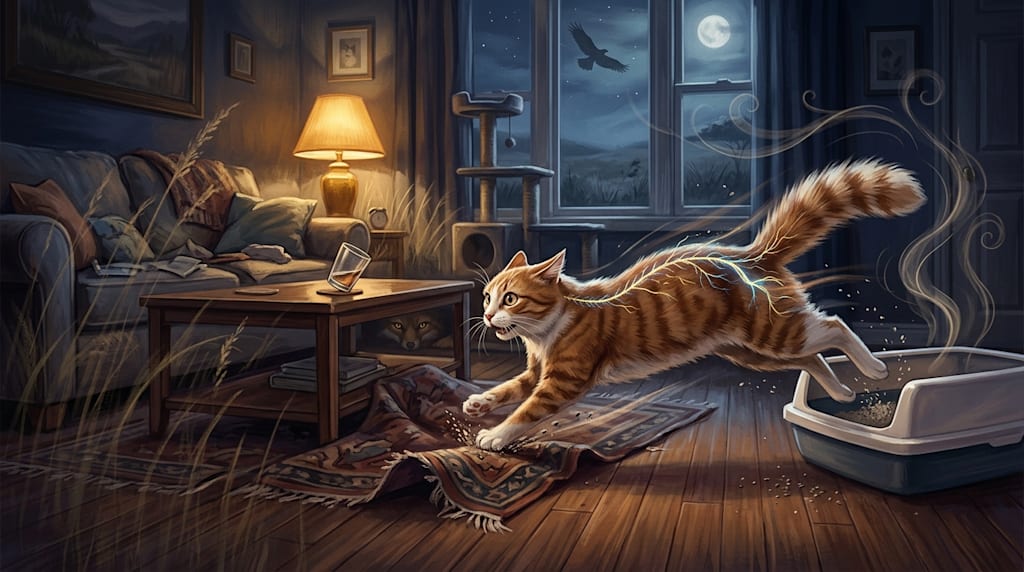
At one in the morning, scratching comes from the litter box. Three seconds later, the cat shoots out, four paws skidding on wood, tail puffed like a bottlebrush. It races down the hall, jumps on the sofa, then crosses the coffee table by stepping on your stomach. You stand there holding the scoop. The litter box is still warm.
This is the post-poop zoomie. It falls under FRAPs, or frenetic random activity periods. Kittens and young cats do it most. Adult cats do it too. It looks like something is chasing the cat. The reason is older than the living room.
1. Pooping is the cat's most inconvenient few minutes
In the wild, a cat is a small hunter and also on the menu. Hawks, foxes, jackals, wolves, and wild dogs might all see it as a meal. It survives by being agile, hidden, and cautious. When it eliminates, it has to squat and hold still. It cannot spring away, climb a tree, or chase. For those few minutes, it hands its most vulnerable self to the environment.
Scent travels outward too. To predators with sharp noses, the smell of waste is a signpost. It says a cat is here and just left. Cats are small. They cannot beat large animals. They choose another path. They leave less scent and make themselves less noticeable.
So cats bury their waste. In the litter box, a domestic cat scratches at the litter, covers it, sniffs, and covers it again. The action cleans. It also hides traces. A cat spends thirty to forty percent of its waking hours grooming, which is also scent management. The smell is strongest when it poops. After it buries the waste, instinct tells it to leave.
It rushes out of the litter box. The thought in its head may be simple: do not let the smell catch up.
2. Running is evacuation and pressure release
Before pooping, a cat checks the room. While pooping, it squats and stays alert. Its body is not ready to move. After it finishes, the risky task is over. The pressure drops. The adrenaline remains. The energy remains. Zoomies, jumps, tail chasing, and sofa leaps are outlets.
People finish something tense and sigh. They stand up and walk around. Cats do not sigh. They get all four paws off the ground.
Some cats stroll out after pooping and find a place to sleep. Some are rockets. Personality, age, environment, and the litter box all matter. Kittens and young cats are more likely to sprint. In a multi-cat home, a cat may worry about being ambushed while eliminating. After it finishes, it wants to escape even more.
3. The vagus nerve and that bit of relief
During defecation, intestinal movement, changes in abdominal pressure, and anal stimulation can trigger the vagus nerve. The vagus nerve is part of the parasympathetic system. It is involved in heart rate, digestion, and breathing. After defecation, the body may briefly relax. Heart rate may change. There may be a feeling similar to relief.
People feel better after using the bathroom. Cats may feel something similar. A cat will not sit on the toilet and scroll through a phone. Its comfort is simple. The danger is over, the body is relaxed, and the energy is still there. So it runs.
This explanation does not cover every cat. Post-poop zoomies are usually several causes stacked together: scent management, pressure release, physiological response, and environmental safety.
4. The litter box can make the escape worse
For a domestic cat, the litter box is an elimination cave. If the cave is uncomfortable, the cat runs after pooping.
A box that is too small makes turning around hard. Dirty litter smells harsh. A box next to the washing machine, in a hallway, or somewhere a dog can get close does not feel safe. In a multi-cat home, too few boxes can make a cat worry about being cornered. Any of these can send a cat launching out of the box after it poops.
Check the box size. The cat should be able to turn around and dig easily. Check the litter. Scoop at least once a day and change it regularly. Check the location. It should be quiet, have an escape route, and not sit in a dead end. In a multi-cat home, the number of boxes should ideally equal the number of cats plus one. Check the area around the box. A dog, a child, or another cat can make the spot feel unsafe.
When the box feels safe, a cat may leave more calmly. Many cats will still run. Instinct is older than the environment.
5. Do not chase the cat to wipe its butt
When a cat rushes out after pooping, people often want to chase it and wipe it. The cat runs faster. It may hide from people and the box. Chasing and wiping can make the cat link pooping with being chased, grabbed, and forced. Over time, the cat may develop a bad association with the box, hold its poop, or go outside the box.
Unless its butt is covered in soft stool and needs attention, let it run. Wait until it stops. Then gently clean it with a wet wipe. Check whether soft stool is causing the sticking.
If the cat is simply excited after a normal poop, do not chase it. The more you chase, the more it thinks this is a game or a hunt.
6. When to see a veterinarian
Post-poop zoomies are usually not a disease. Watch for these signs:
Going in and out of the box often, squatting for a long time without producing anything
Crying out or arching its back while pooping
Stool with blood or mucus, or an abnormal color
Alternating soft stool, diarrhea, and constipation
Vomiting, low energy, not eating
Scooting its anus along the ground, or licking the anus too much
Frequent urination, blood in urine, or urinating outside the box
These may involve urinary, digestive, or anal gland problems. Urinary blockage in male cats is an emergency. Do not wait.
If the cat passes a well-formed poop, has good energy, and runs around, it is most likely normal post-poop zoomies.
7. Back to the living room
After running, the cat stops by the window and licks its front paws twice. The litter in the box has been dug into a pit. You put down the scoop and push the glass on the coffee table a little farther in. It glances at you, jumps onto the cat tree, and lets its tail hang down.
The next time it launches out of the box, you do not have to chase it. Put away fragile things. Close the windows. Leave a runway. It runs its route. You scoop your litter.
About the Creator
Jin
Writer of reamstories
https://reamstories.com/jin
Enjoyed the story? Support the Creator.
Subscribe for free to receive all their stories in your feed. You could also become a paid subscriber, letting them know you appreciate their work.
Comments
There are no comments for this story
Be the first to respond and start the conversation.