
What Documents Do You Need for Emotional Support Animal
Learn Which Documents Are Required to Get a Legitimate ESA Letter and Protect Your Housing Rights with an Emotional Support Animal.

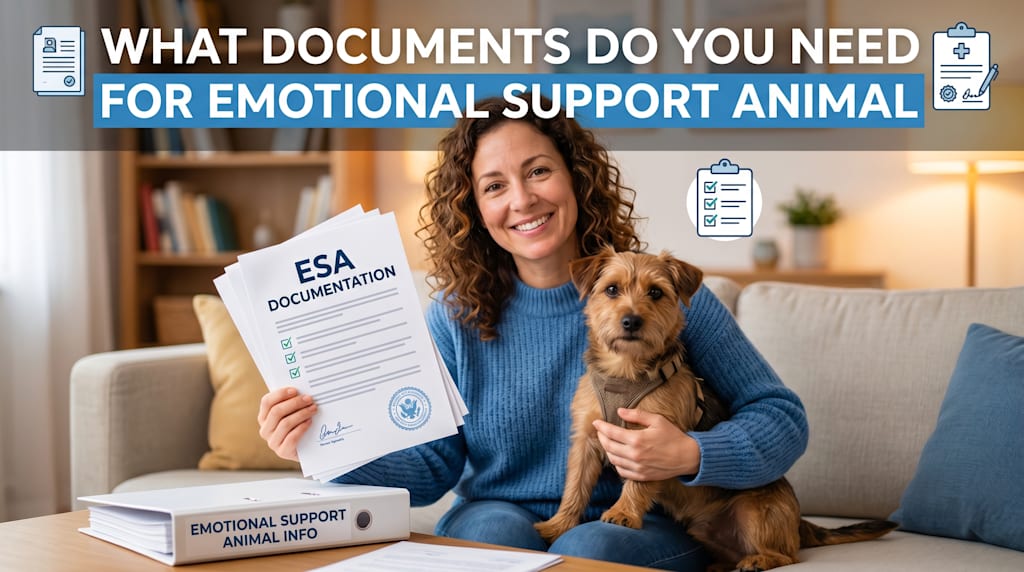
If you have an emotional support animal, or you are thinking about getting one, you have probably wondered what paperwork you actually need. A lot of what you find online is misleading: fake registries, certificates that look official but mean nothing, and confusing advice about what landlords can and cannot ask for.
This guide covers exactly what documents matter, what they do, and how to get them done right.
The One Document That Actually Matters: The ESA Letter
The most important document for an emotional support animal is an ESA letter. This is the only document that gives your animal legal standing as an emotional support animal.
An ESA letter is a signed letter from a licensed mental health professional. This could be a therapist, psychiatrist, psychologist, licensed counselor, or clinical social worker. The letter states that you are a patient under their care, that you have a recognized mental or emotional health condition, and that your emotional support animal is part of your treatment plan.
Without this letter, your pet is legally just a pet. With it, your landlord may be required to make reasonable accommodations for your animal, even in buildings that have a no-pets policy.
What Should the Letter Include?
A valid ESA letter should have all of the following:
- The date it was written
- The name and signature of the licensed mental health professional
- Their license type, license number, and the state where they are licensed
- A statement that you are their patient and that you have a qualifying mental health condition
- A statement that your ESA is recommended as part of your treatment
- The type of animal (dog, cat, etc.)
The letter does not need to describe your diagnosis in detail. Your privacy is protected. It simply needs to confirm that the animal serves an emotional support role for you.
How Long Is It Valid?
Most ESA letters are written for a one-year period. After that, you may need a new letter. Landlords can ask for updated documentation if your letter is expired, so it is good to stay on top of renewals.
How to Get a Legitimate ESA Letter
You need to go through an actual licensed mental health professional. This is not optional. It is what makes the letter legally valid.
There are two main ways to do this:
Through your current therapist or doctor. If you already see a mental health professional, you can ask them to write an ESA letter. They will assess whether your condition qualifies and whether an ESA is a reasonable recommendation for you.
Through an online mental health service. If you do not have an existing provider, several legitimate online platforms connect you with licensed clinicians who can evaluate you and, if appropriate, write you a letter. One example is RealESALetter, which matches people with licensed mental health professionals who can conduct a proper evaluation and provide documentation. The key is that a real evaluation must happen. It should not be a quick form you fill out and pay for with no actual clinical review.
Be careful of websites that sell instant certificates, ID cards, or registrations without any real evaluation. These are not legally valid, and using one could cause problems when you actually try to rely on the document.
What About ESA Registration and Certificates?
This is where a lot of people get confused. You may have seen websites offering to register your pet in an ESA registry, or selling official-looking certificates with your pet's photo and a fancy seal.
These registries are not official or government-recognized. There is no national database or registry for emotional support animals in the United States. Any website claiming to offer official registration is not providing something that has legal weight.
A certificate from one of these sites does not give your animal ESA status. It will not protect you in a housing dispute. Landlords are not required to accept these documents.
The only document that matters is the ESA letter from a licensed mental health professional.
ESA Documents for Housing
Under the Fair Housing Act, people with disabilities, including mental health conditions, have the right to request reasonable accommodations in housing. This includes the right to keep an emotional support animal even in a no-pets building or one that typically charges pet fees.
To make this request, you will give your landlord or property manager your ESA letter. They are allowed to verify that the letter came from a real licensed professional, but they cannot ask you for detailed medical records or the specifics of your diagnosis.
What Your Landlord Can and Cannot Do
Your landlord can:
- Ask for an ESA letter as documentation
- Verify the license of the professional who signed it
- Deny the request if the animal poses a direct threat to others or would cause significant property damage
Your landlord cannot:
- Charge you a pet deposit or pet fee for your ESA
- Ask you to describe your disability in detail
- Require breed-specific documentation in most cases
- Refuse a reasonable accommodation without a valid reason
The rules around housing accommodations have been updated in recent years and individual situations can vary. If you run into problems with a landlord, speaking with a tenant's rights organization or a housing attorney can help you understand your options.
ESA Documents for Air Travel
As of 2021, the U.S. Department of Transportation updated its rules, and most major airlines no longer recognize emotional support animals as distinct from regular pets.
What this means practically is that ESAs now fly as regular pets on most airlines, subject to the usual fees and size restrictions. Some smaller or regional carriers may have their own policies, so it is worth checking directly with the airline before you book.
Airlines do still recognize trained psychiatric service animals, which are a different category from ESAs. If your animal has specific training for psychiatric tasks, that is a different situation and may involve different documentation.
A Quick Summary of What You Need
For housing accommodations: An ESA letter from a licensed mental health professional. This is the core document.
For air travel: In most cases, your ESA will be treated as a pet. Check with your airline directly.
For registration or certificates: These are not legally required and do not replace a real ESA letter.
To get an ESA letter: See a licensed mental health provider, either someone you already work with or through a legitimate online service that conducts actual evaluations.
About the Creator
Enjoyed the story? Support the Creator.
Subscribe for free to receive all their stories in your feed.
Comments
There are no comments for this story
Be the first to respond and start the conversation.