
The Insect with a Chemical Defense System
Nature's Tiny Warrior

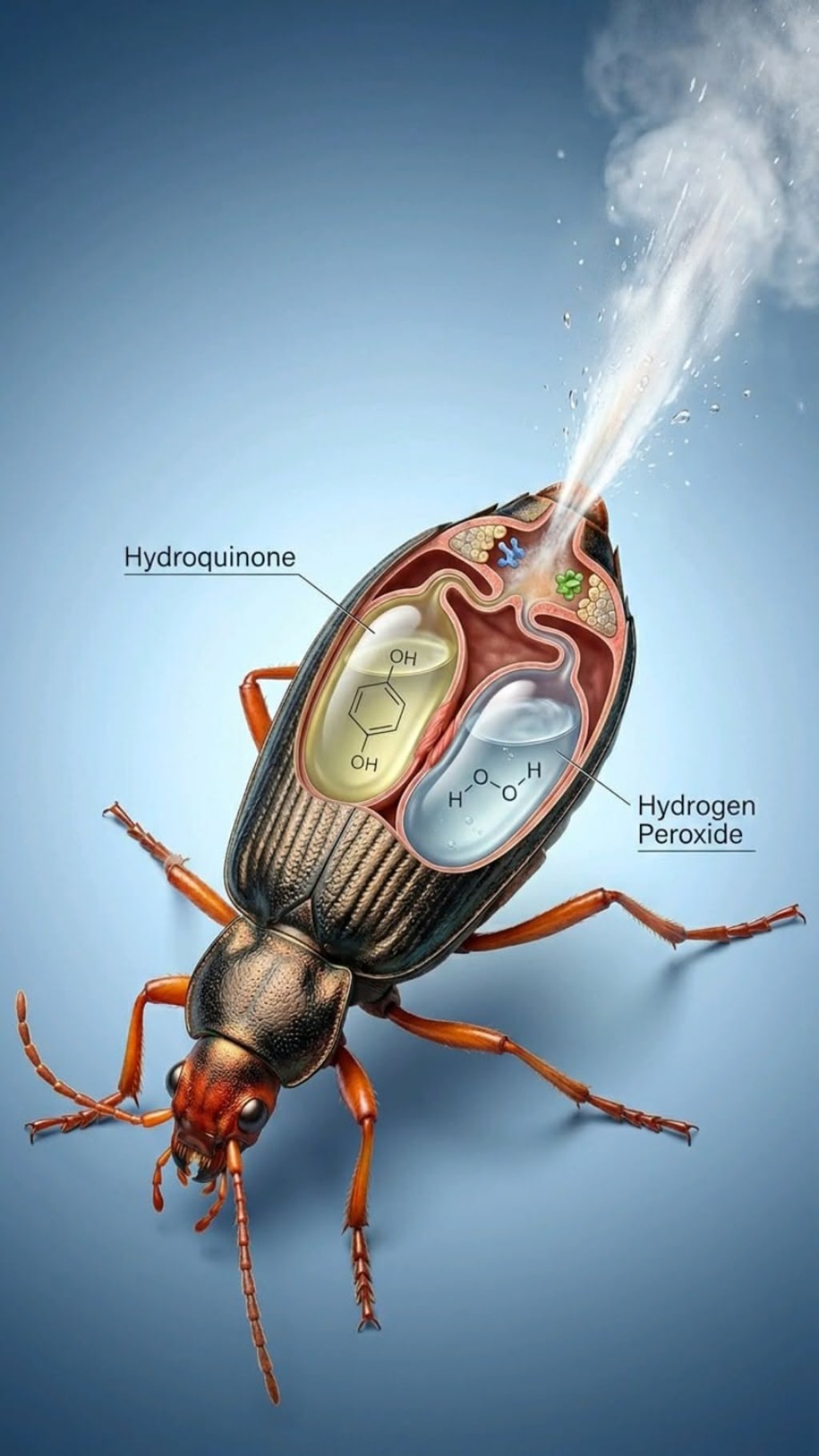
Nature contains many surprising survival strategies, but one of the most unusual belongs to an insect that can defend itself using chemistry. This insect is famous for protecting itself by releasing a hot chemical spray from its abdomen when threatened. The image shows two important chemicals often involved in this process: hydroquinone and hydrogen peroxide.
Inside the insect’s body, these chemicals are stored separately in special compartments. Keeping them apart is important because if they mixed too early, the reaction would happen before the insect needed protection. When danger appears, the chemicals move into a small reaction chamber inside the insect’s abdomen.
In this chamber, special natural substances act like catalysts and cause the hydroquinone and hydrogen peroxide to react quickly. This reaction produces heat and pressure in a very short time. As a result, the insect shoots out a hot defensive spray with surprising speed and accuracy.
One of the most famous insects that uses this method is the bombardier beetle. Instead of biting or stinging, it relies on this powerful chemical defense. The spray can reach temperatures close to the boiling point of water and is released in quick bursts. The sudden heat, sound, and irritating chemicals help scare away predators such as spiders, ants, frogs, and small animals.
Another interesting feature is control. The beetle can aim the spray in different directions by moving the tip of its abdomen. This allows it to target threats even if they approach from the side or behind. The release happens in short pulses rather than one continuous stream, helping the insect avoid harming itself.
Scientists have studied this defense system for many years because it combines biology, chemistry, and engineering in an efficient way. Researchers are interested in how such a tiny creature safely stores reactive chemicals and releases controlled bursts only when needed. These studies sometimes inspire ideas for safer chemical storage systems and small-scale engineering designs.
This defense system shows how animals can develop highly specialized survival methods over long periods of evolution. While many insects depend on camouflage, speed, or physical armor, this insect uses a controlled chemical reaction as protection.
The process is a reminder that even small creatures can have remarkably advanced mechanisms. What looks like an ordinary insect can contain a carefully organized system of storage chambers, reaction controls, heat production, and precise release mechanisms.
Among the many examples of adaptation found in nature, this hot chemical spray remains one of the most unusual and memorable insect defense strategies.
Deep in the natural world lives a small insect with one of the most surprising defense systems ever discovered. At first glance, it looks ordinary and easy to overlook. It does not have giant claws, sharp teeth, or powerful wings. Yet predators quickly learn that attacking this tiny creature is often a mistake.
This insect is famous because it protects itself by spraying a hot chemical burst from its abdomen.
Inside its body are two chemicals that stay stored in separate chambers: hydroquinone and hydrogen peroxide. On their own, they remain stable and harmless to the insect. But when danger appears, something remarkable happens.
A predator approaches.
The insect senses movement and prepares its defense. Instead of running away immediately, it activates a special reaction chamber hidden inside its abdomen. Tiny amounts of hydroquinone and hydrogen peroxide move into this chamber at exactly the right moment.
Once inside, natural catalysts trigger a rapid chemical reaction.
Within fractions of a second, heat and pressure build up. The chemicals transform into a hot defensive spray that bursts outward with surprising force. The insect directs this blast toward the attacker, creating an effect that is sudden, noisy, and unpleasant.
To a predator, the experience can be shocking.
Imagine expecting an easy meal and instead being hit with a hot chemical cloud. The attack is usually enough to confuse or scare away spiders, ants, frogs, and other hunters. Most quickly decide that searching for another meal is the better option.
What makes this defense even more fascinating is how carefully controlled it is.
The insect does not simply release all its chemicals at once. It fires in short bursts, almost like tiny pulses. This prevents damage to its own body while making the spray more effective. The end of the abdomen can even move, allowing the insect to aim at threats from different directions.
For scientists, this tiny animal became an object of curiosity.
Researchers wondered how such a small creature could safely store reactive chemicals without harming itself. They studied the internal chambers, pressure control, and rapid release system. The more they learned, the more impressive the design appeared.
The insect’s defense combines biology and chemistry in a way that seems almost engineered.
Instead of armor, speed, or camouflage, it uses controlled reactions to survive. Every part of the process—from storage to mixing to spraying—works together with remarkable timing.
In nature, survival often depends on adaptation.
Some animals blend into their surroundings. Others escape quickly or hide underground. But this insect developed something completely different: a chemical shield activated only when necessary.
Its unusual defense reminds us that size does not determine strength.
Even a tiny insect can possess an extraordinary solution to life’s challenges. Hidden beneath a small shell is a miniature laboratory capable of producing heat, pressure, and protection in moments of danger.
This amazing insect is known as the Bombardier beetle, and it remains one of the most unusual examples of survival in the natural world.
Its story shows that nature’s greatest inventions are sometimes found in the smallest creatures.
About the Creator
Niaz Muhammad
Insha Allah, I will write in such a good way that people with weak eyesight or the elderly can easily read it.
Enjoyed the story? Support the Creator.
Subscribe for free to receive all their stories in your feed.
Comments
There are no comments for this story
Be the first to respond and start the conversation.