
The Box I Failed to Check
What searching for a psychiatric service dog taught me about invisible illness, asking for help, and being seen.

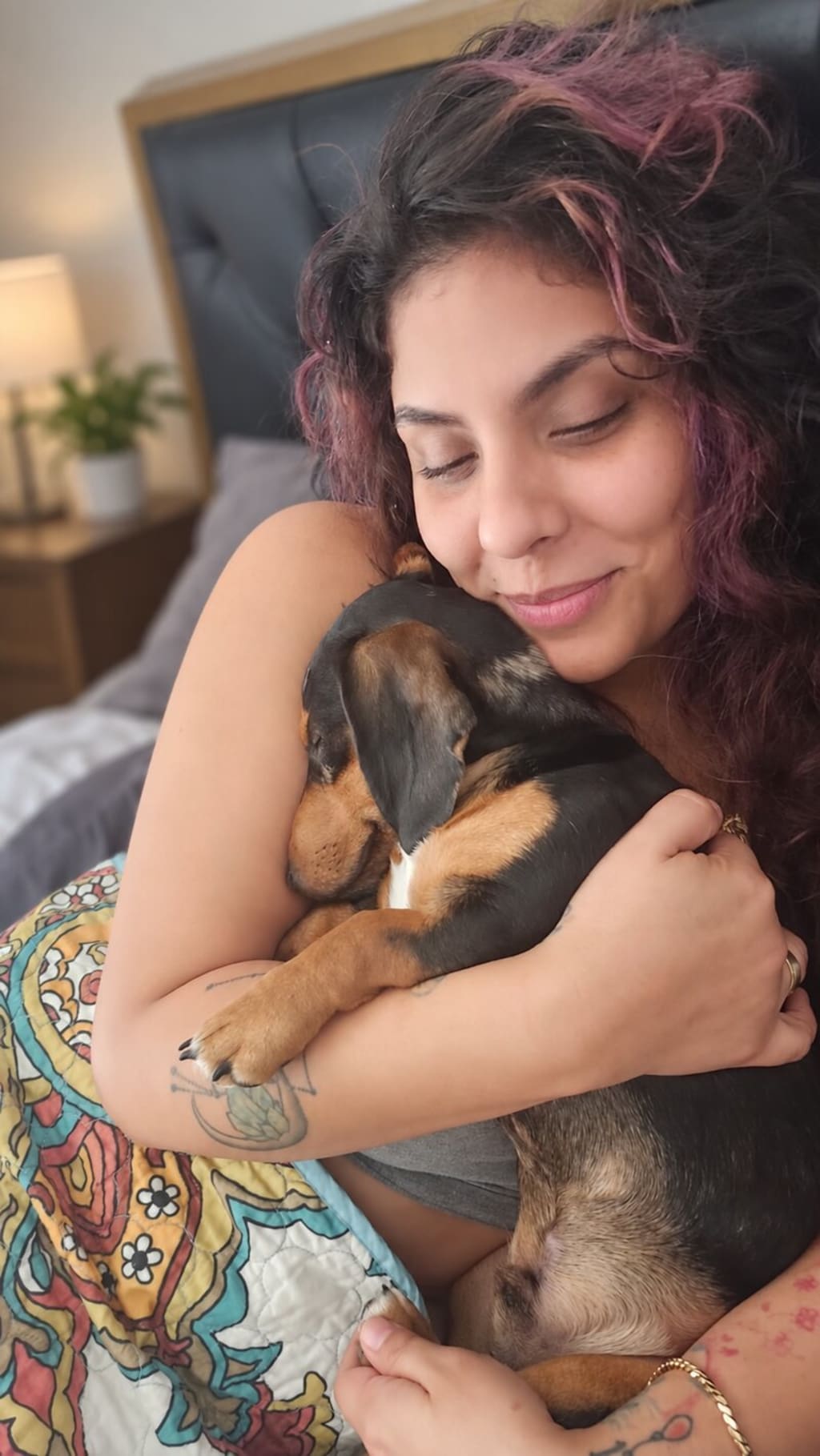
When I started looking for our next pup, I did so with purpose. D had found his perfect companion and future service-dog prospect through a rescue. Now, I wanted to find my own. Our Belgian Malinois, Mabel, is an incredible dog, but for me, her size, energy, and intensity can sometimes be more triggering than comforting. If you have ever experienced an animal triggering your nervous system, you might be reading this and thinking…
Really? Then why have a dog?
Because having a dog has saved my life more than once.
Saved. A. Life.
At the heart of the human-dog relationship is mutual protection. Dogs once helped protect people from outside threats, while humans provided food, shelter, safety, and care. Over time, that partnership became something deeper: we learned to look after one another. So I set out to find the right service-dog prospect. Along the way, I began talking to breeders because I already had a very specific breed in mind—one I believed could completely change my life.
The dachshund.
Unbeknownst to me, the dachshund community is basically its own little cult. They are fiercely devoted to the breed, and I quickly learned that finding the right dachshund through a rescue would not be as easy as I had imagined. That search led me to a breeder—or, more accurately, several breeders—as I tried to learn from the people who knew the breed best and understand what sharing my life with a dachshund would actually look like.
One breeder responded, "A dachshund?!? I didn't even know dachshunds could be service dogs." Then, seemingly curious, she asked, "Would you train one as an emotional-support animal or for medical support? I would love to learn more details."
The honest answer was far more personal than her question probably intended. My disability is psychiatric rather than physical, which means the support I need may not be immediately visible. As a young teenager, I was diagnosed with bipolar disorder. At 33, I was diagnosed with borderline personality disorder, ADHD, and PTSD. I have spent most of my life trying to understand and manage deeply personal struggles that are not easy to explain to someone I have just met.
Still, she had asked, and I answered with the first words that came to mind. I spoke honestly about self-harm and the behaviors I hoped a psychiatric service dog could be trained to interrupt. At the time, I didn't consider how alarming those words might sound to someone who had never experienced—or loved someone through — the same kind of struggle.
I say, "Yes, like an emotional support animal. Dachshunds can be trained to help owners with things like anxiety and depression, and stop them from self-harming habits. It's pretty cool how in tune they can be with their owners."
When she responds next, the woman who was sending me all of her socials, and excited about introducing me to puppies, replies, "I appreciate you being honest and transparent. Unfortunately, I do not think this particular pup is a good fit for that. She really needs a place to allow her energy and personality to shine! She is going to need a lot of stimulation by either young children, herding other animals like farm work, or a large pack of dogs to fulfill in a way that is best for her. I am sorry but I have to decline your application. Good luck on your puppy search!"
And I remember thinking, Wait… what?
I have five children. I live in the country. We had already raised and trained a Belgian Malinois on farmland. Cue the video of Mabel running alongside horses and riding on the back of a work truck.
Everything she described—a home filled with activity, stimulation, space, children, and other animals—already existed here. So what in my life suggested a dog couldn't thrive there? I couldn't help but wonder if the box I failed to check had nothing to do with my home at all. Maybe it was simply the fact that I had admitted I needed extra support.
I wasn't looking for an emotional-support animal whose presence alone would comfort me. I was looking for a psychiatric service dog trained to interrupt self-harming patterns, recognize when I am beginning to dissociate, and ground me when I cannot ground myself. That is what made her response so difficult to understand. It felt as though the moment I shared the most vulnerable parts of my mental illness, she assumed a dog could not live a full and fulfilling life with me.
I felt naked and judged.
Like so many people who struggle with mental illness, I felt as though I had tried to lay my heart bare and own my truth. I had allowed another person to see a part of me that was deeply personal, and what I heard in response was, "You are not enough."
I wanted to retreat into my shell. I wanted to yell. More than anything, I wanted to believe that she had declined my application for some reason other than feeling uncomfortable with my mental health.
Of course, I cannot know with certainty what motivated her decision. She may have genuinely believed that particular puppy's temperament would not be the right fit. Still, I had already had countless conversations with breeders, and she was the only person who asked such detailed questions about my mental health and then declined my application after hearing the answers. Whether that was her intention or not, the timing made the interaction hard to forget.
But I kept looking.
The more I researched dachshunds, the more I discovered: a rich history, a fiercely devoted community, and countless firsthand accounts of what life with the breed was really like. Friends even reached out and shared their experiences and love for the breed. Everything I learned made me feel even more certain that a dachshund could be the right match for me.
Then, most serendipitously, I found Mac. I knew almost immediately that we belonged together.
At eight weeks old, I brought home the cutest little toy-sized puppy brought to life. At first, though, it was a challenge. He was like having a brand-new baby, and I had already raised all of my babies. At times, I looked at him and thought, "What have I gotten myself into?"
That was when I had to remind myself why I wanted a dachshund in the first place. I was never searching for the easiest puppy.
I was searching for the right partner.
Living with borderline personality disorder is difficult to explain because sometimes I can't even make sense of what is happening inside my own mind. I don't sleep much, and my emotions can become so intense that they overpower everything I logically know to be true. A small change in someone's tone or behavior can feel like proof that I am unwanted, replaceable, or about to be abandoned. In those moments, I struggle to separate what I am feeling from what is actually happening.
I can go from feeling completely secure in a relationship to questioning where I stand in someone's life. I think in extremes—loved or unloved, safe or unsafe, wanted or unwanted—with very little room for anything in between. Sometimes I shut down and pull away, even when what I really want is reassurance and connection. Other times, I dissociate and feel detached from myself, my surroundings, or what is happening around me.
When my emotions become too overwhelming, I sometimes turn that pain inward. At this point in my life, that most often looks like compulsively picking at and touching my lips, although it has taken more painful forms in the past. These parts of me aren't easy to admit or explain. BPD can make my mind feel like an unsafe place to be, and it can be exhausting constantly trying to determine which thoughts I can trust.
So what does a person with BPD have to do with a dachshund?
More than you might think.
Dachshunds were bred to be brave, observant, persistent, and close to their people. They were expected to follow something into the darkness and refuse to back down. I needed a dog with that kind of determination—one willing to interrupt me instead of being easily dismissed when I begin to shut down or turn my emotions inward.
Mac's job will not be to cure my BPD or carry the weight of my mental illness. He will be trained to recognize certain patterns and respond. A nudge or paw can interrupt me when I begin picking at my skin. Physical contact can bring my attention back when I dissociate. When my emotions become too overwhelming, his steady presence reminds me that I am still here, still safe, and not alone.
But this relationship is not one-sided. Mac is not simply a tool for managing my mental health; he is a deeply loved member of a busy family. He has five children to play with, Mabel to wrestle and explore with, and plenty of space to run, sniff, dig, and experience the world around him. His days are filled with affection, activity, training, companionship, and opportunities to use both his mind and his instincts. His well-being matters as much as mine.
In return, Mac gives our family a different kind of purpose and connection. Caring for him creates structure and responsibility, and on difficult days, his needs give me another reason to get out of bed and remain involved in the life happening around me. He acts as a tether, helping keep me centered and connected to the people who matter most.
Sometimes that connection is created through the smallest moments. Mac can lie across my stomach and, through nothing more than his weight, warmth, and familiar presence, pull my attention away from intrusive and obsessive thoughts. His constant reassurance helps quiet the fear and uncertainty that often come with BPD. At night, we both settle more easily with the comfort of the other nearby.
The qualities that can make a dachshund stubborn or undesirable are some of the same qualities that made this breed feel right for our family. Mac is persistent, curious, involved in everything, and rarely far from the people he loves. He does not spend his life carrying my struggles. He spends it playing, learning, exploring, being adored, and having a purpose. When my own mind pulls me somewhere dark, he is persistent enough to follow me there—and determined enough to help lead me back out.
Needing support does not make someone dangerous, incapable, or unable to provide a full life for the people and animals they love. Sometimes it simply means that a person understands exactly what they need to remain grounded, present, and connected. So many people are living with struggles that cannot be seen from the outside. Those struggles are not meant to frighten anyone, but they may require a little more patience, reassurance, and understanding.
That is why I tell these stories. I hope that honesty can raise awareness, soften the assumptions we make about one another, and help someone else feel less ashamed or alone. We cannot fight every battle by ourselves, nor should we be expected to. We need the people we love—not to fix us, but to stand beside us while we learn how to keep showing up. And they need us too: not perfectly healed, never struggling, or completely self-sufficient, but present, honest, and still trying.
Maybe needing extra help was never a box I failed to check. Maybe it was just me being honest about what I need to keep showing up—for myself, for my family, and for Mac. Asking for support does not mean I have less love or care to give. Sometimes it is what allows me to give the best parts of myself to the life we share 💕
About the Creator
Karina Rasberry
stay open — be brave — write it all out
Enjoyed the story? Support the Creator.
Subscribe for free to receive all their stories in your feed. You could also become a paid subscriber, letting them know you appreciate their work.
Comments
There are no comments for this story
Be the first to respond and start the conversation.