review
Reviews of all the finer things in pet life.
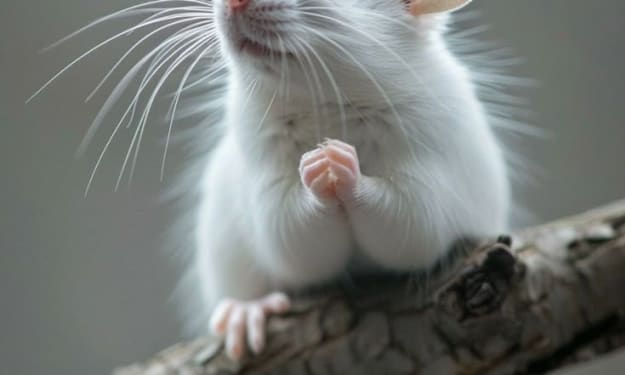
The mouse story
--- The Mouse’s Lesson Once upon a time in a lush green forest, there lived a small grey mouse named Milo. He was tiny, curious, and always getting into trouble. Unlike other mice who stayed in their burrows and avoided danger, Milo believed he was destined for something greater. One sunny morning, as the forest awoke with chirping birds and buzzing bees, Milo stretched his limbs and looked out of his hole. He yawned and said to himself, “Today is the day I go beyond the old tree stump. I’ve lived here long enough. I want to see the world!” His mother, old and wise, warned him. “Stay close, Milo. The world is full of dangers—cats, traps, and snakes. Your tiny paws are not meant to run far.” But Milo didn’t listen. He set off with a grain of rice tucked under his paw for lunch. He scurried past the tall grasses, hopped over the mushrooms, and finally reached the old tree stump. He stood proudly. “I’ve made it! Beyond the stump!” Suddenly, he heard a rustling sound. Out from behind a bush appeared a sleek, orange cat. Her eyes locked onto Milo, and she crouched down, ready to pounce. Milo’s heart raced. He turned and ran as fast as his legs could carry him. He zigzagged between roots and rocks, barely escaping the cat’s claws. Breathless and terrified, he dove into a hollow log. Inside the log, another animal stirred. It was an old owl who lived there. “Who dares enter my home?” the owl hooted. “I’m sorry, sir,” Milo panted. “A cat was chasing me. I had nowhere else to go.” The owl blinked slowly. “Curiosity brings you far from home, young one. But it also brings danger.” Milo lowered his ears. “I just wanted to explore. I thought I was brave.” “Bravery is not just going far,” said the owl. “It’s knowing when to go, and when to stay.” The owl offered Milo shelter for the night, and in the morning, the cat was gone. Milo thanked the owl and started his journey back. But he had gone too far and lost his way. The trees looked unfamiliar, and the sounds of the forest had changed. He wandered through the underbrush, frightened and hungry. His tiny grain of rice was long gone. Night fell again, and it started to rain. Cold and wet, he found shelter under a leaf and cried. Just then, he heard soft footsteps. A kind hedgehog approached and saw the shivering mouse. “Oh dear, you look lost,” said the hedgehog kindly. “I am,” Milo sniffed. “I left home to explore, but now I can’t find my way back.” “Come with me,” said the hedgehog. “I know this forest well. I’ll help you.” Gratefully, Milo followed the hedgehog. Along the way, he learned how to recognize different trees, listen to the wind, and smell the path home. The hedgehog shared his food and even carried Milo when he was too tired to walk. After three days, they reached the familiar tree stump. Milo cried tears of joy. “Thank you! Thank you so much!” The hedgehog smiled. “Always be curious, little mouse. But never forget your way back.” When Milo returned home, his mother hugged him tightly. “I was so worried,” she said with tears in her eyes. “I’m sorry, Mama,” Milo said. “I thought being brave meant going far, but I learned it also means knowing when to ask for help and when to come home.” From that day on, Milo still explored, but he prepared himself better. He learned from others, marked his path, and always remembered where home was. He became known as the wisest young mouse in the forest—not because he went far, but because he came back smarter every time. And so, Milo's tale became a story told to young animals all over the forest—a story about bravery, curiosity, and the wisdom of returning home. ---
By Animals Lifestyle2 years ago in Petlife
40 Photos That Prove Cats Accept Life With Hilarious Grace
I’ve always admired cats for their ability to take life in stride, but a recent find took that admiration to a new level. Titled "40 Pics Of 'Cats Accepting Their Lives' In The Most Hilarious Ways," this collection is a masterclass in feline nonchalance. Picture a cat sprawled across a laptop during a work call, utterly unfazed, or another perched atop a vacuum cleaner as if it’s a throne. These aren’t just photos—they’re a window into how cats turn the mundane into moments of pure comedy, and I couldn’t stop scrolling once I started.
By Faiz Bashir2 years ago in Petlife
The Art of Canine Sarcasm: Living With a Dog Who Thinks She's a Disapproving British Aristocrat
There comes a time in every pet owner's life when they realize their dog has developed more personality quirks than a Jane Austen protagonist. I used to think I owned a dog. Now I understand I'm merely staff in the royal court of Her Majesty, Princess Fluffybutt the First.
By Just One of Those Things2 years ago in Petlife
Can animals understand human language?
Can animals understand human language? Clever Hans a horse from early 20th century Germany captivated audiences with his apparent ability to understand human language solve arithmetic problems and even tell time. His talents seemed to suggest that animals could comprehend human speech and respond in meaningful ways. However a deeper investigation into Clever Hans' abilities led to a surprising discovery one that has shaped our understanding of animal cognition and communication ever since. The story of Clever Hans begins with his owner Wilhelm von Osten a former schoolteacher with a keen interest in mathematics and animal intelligence. Von Osten was convinced that animals particularly horses possessed untapped intellectual potential. Through rigorous training he taught Hans to respond to questions by tapping his hoof. When asked what two plus two was Hans would tap four times. If asked what day followed Monday he would tap once for Tuesday. To many spectators it appeared that Hans truly understood human language and numbers. News of the horse’s abilities spread quickly and he became a sensation across Germany. Scientists journalists and even government officials came to witness the remarkable animal eager to determine whether his abilities were genuine. After all if a horse could understand language it could revolutionize our understanding of animal intelligence. A psychologist named Oskar Pfungst took on the challenge of examining Clever Hans in detail conducting a series of experiments to determine how he arrived at his answers. Pfungst's findings were groundbreaking but not in the way von Osten had hoped. It turned out that Hans was not actually performing arithmetic or comprehending language. Instead he was incredibly skilled at reading subtle unconscious cues from his human questioners. When someone asked a question they would unknowingly give off slight changes in posture facial expressions or breathing when Hans reached the correct answer. These cues signaled him to stop tapping. In cases where the person asking the question did not know the answer Hans' accuracy dropped significantly.
By Adnan Rasheed2 years ago in Petlife
The fire fox
The Fire Fox is an extraordinary yet elusive variant of the common red fox, marked with a rare gene mutation that confers its unique appearance and superb qualities. This variation is so uncommon that it accounts for under 1% of all red foxes globally. This elusive creature has risen to prominence among wildlife enthusiasts and researchers despite its rarity.
By Rohitha Lanka2 years ago in Petlife
Reduce Your Consumption of Harmful Fats: A Guide to Eating Healthier
Reduce Your Consumption of Harmful Fats: A Guide to Eating Healthier Many of us consume more harmful fats than our bodies can handle in today's fast-paced world, where convenience often takes precedence over nutrition. Fats are an important part of a healthy diet, but not all fats are the same. Some fats, such as trans fats and saturated fats in excess, have been linked to an increased risk of heart disease, obesity, and other health issues. One of the best ways to improve your overall health and well-being is to cut back on unhealthy fats. What you need to know about harmful fats, how they affect your health, and how to make healthier choices are provided here.
By Khondokar Bakhtear Hossain2 years ago in Petlife