exotic pets
Exotic pets are wild animals gone domestic; explore the absurd, fascinating and sometimes illegal exotic pet industry.
6 Proven Methods to Make Your Dog Smarter
Step by step instructions to Make Your Canine More astute Is it normal for canines to learn new words and odd ways of behaving? It probably won't be simple, yet it should be possible. All canines have an essential degree of insight in view of their tendency:
By Mack Brown3 years ago in Petlife
Rodent life
Once upon a time, in a cozy little corner of a bustling city, there lived a kind-hearted and curious little rodent named Rodger. Rodger was no ordinary rodent; he had a unique passion for caring for his fellow furry friends. His days were spent exploring his home, a comfortable cage filled with toys, tunnels, and a warm bed made of soft hay.
By Alena Iavdoshak3 years ago in Petlife
How to Shoulder Train Your Bird
Whether you're a fan or a novice to the avian world, you probably know the tomfoolery in allowing your bird to stay nearby beyond its enclosure. In any case, letting your flying companion out requires some preparation and limits — for both bird and proprietor!
By Sobo Bright3 years ago in Petlife
Mario the Jumping Spider
Several years ago, I wrote about a spider in our house, who my partner and I called Yo-yo (the spider spent a lot of time descending and ascending their web strand, hence the name). Read more about Yo-yo here.
By Megan Baker (@thegothofsawpit)(@shadowsitheghoststrikebwr)3 years ago in Petlife
Majestic Giants: A Closer Look at Elephants
Majestic Giants: A Closer Look at Elephants Introduction: Elephants, the gentle giants of the animal kingdom, have captivated human fascination for centuries. With their remarkable size, intelligence, and complex social structures, elephants stand as a testament to the wonders of the natural world. This essay will delve into the fascinating world of elephants, exploring their physical characteristics, behavioral patterns, social dynamics, and the challenges they face in the modern era. I. Physical Characteristics: Elephants, belonging to the family Elephantidae, are the largest land mammals on Earth. They possess several distinctive physical features that contribute to their iconic appearance. Their most prominent feature is their elongated trunk, a versatile appendage capable of delicate manipulation as well as powerful lifting. The trunk, an extension of their upper lip and nose, contains an astonishing 100,000 muscles, enabling elephants to drink, eat, and communicate with exceptional precision. Another remarkable characteristic of elephants is their impressive tusks. These elongated incisor teeth, found in both males and females, serve various purposes. Tusks are primarily utilized for defense against predators, establishing dominance within the herd, digging for water, and stripping bark from trees. Unfortunately, these magnificent tusks have made elephants the target of relentless poaching, threatening their survival in the wild. II. Behavioral Patterns: Elephants exhibit a wide range of behaviors, showcasing their intelligence and complex social dynamics. They are highly social animals and live in close-knit family groups, known as herds or clans. The herd is usually led by the oldest and most experienced female, known as the matriarch, who guides the group in search of food, water, and protection. Communication plays a crucial role in elephant society. While they produce a variety of vocalizations, including trumpeting, rumbling, and roaring, a significant portion of their communication occurs through infrasound, low-frequency sounds that can travel long distances. Infrasound allows elephants to communicate over vast distances, often beyond the range of human hearing, facilitating coordination and social bonding within the herd. Furthermore, elephants display a range of emotions and exhibit behaviors associated with grief, joy, and empathy. They mourn their dead, displaying mourning rituals that include touching the body, caressing the bones, and standing in silence. Elephants also demonstrate compassion for injured or distressed individuals, providing support and assistance. III. Social Dynamics: Elephant society revolves around a complex social structure, characterized by intricate relationships and hierarchies. Female elephants remain within their natal herds for their entire lives, forming strong bonds with their relatives. These matrilineal groups consist of mothers, daughters, grandmothers, and aunts, fostering cooperation, learning, and protection of the young. Males, on the other hand, leave their natal herds during adolescence and either lead a solitary life or form bachelor groups until they reach sexual maturity. At this stage, males often engage in fierce battles for dominance and the right to reproduce with females. The victorious male becomes a temporary member of a female herd during the breeding season, and then returns to his solitary or bachelor lifestyle. The social dynamics within elephant herds are marked by care and cooperation. Young elephants are collectively raised by the entire female group, with older siblings and other relatives participating in their upbringing. This collaborative approach ensures the transfer of knowledge, social skills, and survival strategies from one generation to the next. IV. Conservation Challenges: Tragically, elephants face numerous challenges in the modern era, resulting in declining populations across the globe. Habitat loss due to human encroachment, deforestation, and agricultural expansion poses a significant threat to their survival. As their natural habitats shrink, elephants are forced into fragmented landscapes, leading to increased human-elephant conflicts. Poaching for ivory remains one of the most pressing issues. Despite international bans on ivory trade, demand for ivory products continues to drive illegal poaching, particularly in regions such as Africa and Southeast Asia. The loss of elephants not only disrupts the delicate balance of ecosystems but also diminishes the cultural and economic value that these magnificent creatures hold. Conservation efforts have been pivotal in protecting elephants. Organizations and governments worldwide are working tirelessly to combat poaching, improve habitat preservation, and promote community-based initiatives that foster coexistence between humans and elephants. Additionally, public awareness campaigns have shed light on the importance of conservation, encouraging responsible tourism practices and sustainable development. Conclusion: Elephants, with their awe-inspiring physical characteristics, intricate social dynamics, and remarkable behavioral patterns, continue to captivate our imagination. The challenges they face in the modern era demand our attention and concerted efforts to ensure their survival. By understanding and appreciating these majestic giants, we can strive to protect their habitats, combat poaching, and promote a harmonious coexistence between humans and elephants. Let us cherish these magnificent creatures and work towards securing a future where elephants can roam freely, enriching our world with their presence for generations to come.
By شركة الصقر3 years ago in Petlife
**Limited by Trust: The Astounding Fellowship Among Man and Pit Bull**
In a world frequently corrupted by bias and confusions, there arises an endearing story that delightfully highlights the pith of trust, friendship, and the force of looking past cultural predispositions. This is the motivating story of an improbable team: a man and his pit bull, whose phenomenal bond opposed customary standards as well as enlightened the genuine significance of kinship.
By Muhammad Naeem3 years ago in Petlife
10 CUTEST PUPPIES IN THE WORLD YOU WOULD LIKE TO ADOPT 🐼🐼
Gives birth to one to six cubs weighing no more than one kg m when tiger cubs are born they are blind and remain so for the first ten days then they are very vulnerable and highly dependent on their mother however thanks to the tiger’s milk which is very rich in lipids and proteins they gain strength and grow quickly but continue to live with their mother until the second year during that period they are suckled and protected by the female then they learn to go hunting with her before becoming completely independent before continuing do you know what year the world wildlife fund was founded long ng that dedicated to sustainable development and environmental protection a 1.951 b 1961 c 1971 answer before the end of the video the cub of this small mammal with spines is not bigger than a ball when born as it weighs only about 30 grams when the hedgehog puppy is born it has no bullies or initially and it is only a few hours after its birth that its light pink skin is covered with white quills and molly before the appearance of prickly spines that grow three weeks later to give birth to her puppies the hedgehog mother prepares a nest with leaves, twigs and grass the puppies are born blind and are nursed for two months by their mother who has five pairs of breasts this last takes care of her cubs during the first weeks until they are able to leave their nest this adorable animal and the cub of the deer, fallow deer or goat when born its weight does not exceed seven kilos however due to its weight the fawn and still unable to stand on its legs initially when it is standing it instinctively puts itself under the mother’s belly to nurse the mother nurses her puppy for about eight months she protects it and for this reason she does not hesitate to leave it alone to make it stay only out of danger when his paws get stronger and he can stand the young fawn can reach out to the others everyone loves pandas true then what about panda cubs their black and white fur and adorable looks make them real little ones puppets but did you know that these playful animals are born premature facts panda cubs are born during the period from July to September after a gestation period that can range from three to five months and yet when they are born they have nothing of the adorable puppets with white fur and black that we know their skin and pink is covered with only a few hairs the puppies are blind and weigh only about 100 grams and end up growing little by little by feeding and sleeping then their body starts to become covered in black hair after the seventh day then after a month their fur becomes thicker and white in some places only a few months later they begin to take their first steps outside their den although they feed on bamboo from six months onwards the panda cubs continue to breastfeed until they are weaning at one year what could be cuter than seeing a giraffe cub walking behind its mother in the savannah this little animal which measures no more than a meter during the first year is born most often during the months of December and May the giraffe can only give birth to one cub at a time rarely 2 after a gestation period that can last 15 months the birth of a giraffe cub seems like a miracle in fact during birth the mother giraffe stands upright and her body and stars l animal and pulls out its hind legs first before falling from about two meters in height when the baby giraffe is born it measures about two meters and its weight fluctuates between 40 and 80 kg moreover it already has the appendages of the skull which will form the future or sicoli which are covered with tufts of black hair usually after a few minutes he is already able to stand up and after an hour he has to stand on his still fragile legs to reach the mother’s udders which I was nourished with his very rich milk lipids breastfeeding can last up to 16 months but the baby giraffe can stay with its mother until the age of two and a half years hard to resist this little ball of hair with pointy ears with its cute appearance and fur all white the puppy of this wild canid that lives in the middle of the desert will surely make you fall in love with it while your hands the fennec mother usually gives birth between two and four puppies per birth between
By MARIO BUONCUORE3 years ago in Petlife
What to Do If Your Dog Gets Lost: A Comprehensive Guide
Losing a beloved furry friend can be a heart-wrenching experience for any pet owner. The fear and anxiety that come with a lost dog can be overwhelming, but it's crucial to act swiftly and effectively to increase the chances of a safe reunion.
By WE LOVE CATS AND DOGS3 years ago in Petlife
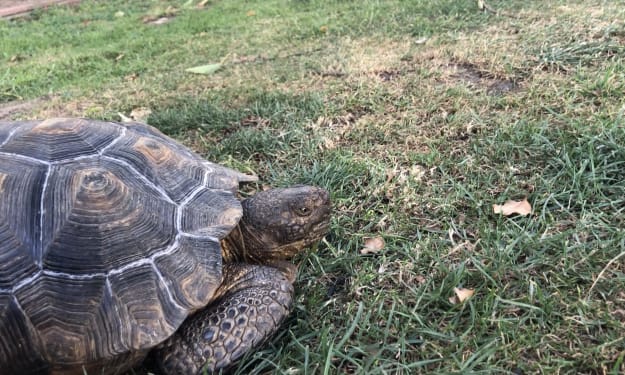
Joey: The California Desert Tortoise
It was a typical February day, I was working from home, busy on the computer. Evelyn called me. I picked up and our conversation was definitely not one of the top five conversations I would’ve expected. Not top 10, top 50, top 100. Pretty unexpected.
By Stephen Kramer Avitabile3 years ago in Petlife
Dog owner tips and tricks
When you are a responsible dog owner, you will never let your dog walk on hot concrete. Your shoes will protect your feet, but dogs' paws and sidewalks can feel burning hot in the summer. If you're going to shave your dog in the summer, stick to grassy areas. However, many people are unaware that a dog's fur protects its skin from the sun, preventing sunburns. Your dog will thank you if you stop taking it on the same routine walk every day. Dogs are curious creatures who enjoy discovering new things and exploring, so mix things up by taking different routes.
By Javel samuels3 years ago in Petlife