cat
It's been said that people that hate cats will come back as mice in their next life.
What is the Best Treatment for Fleas on Cats?
If your cat’s been scratching like there’s no tomorrow—or you spotted tiny black specks in their fur—yep, you might be dealing with fleas. It’s not just annoying for your feline friend—it can lead to real health issues. So let’s break down how to kick fleas to the curb and keep them from coming back.
By Thomas Mullerabout a year ago in Petlife
The School of Life
This is the story of a boy born in a small village—his name was Mihan. Though born into a humble family, his dreams were anything but ordinary. He saw life as a vast school, where each day offered a new lesson, a new realization.Mihan’s father was a farmer. He would go to the fields early in the morning, working tirelessly under the sun. His mother took care of the house and his younger siblings. From an early age, Mihan understood that life was not easy. Poverty, scarcity, and limitations surrounded him, yet he always searched for rays of hope within them.He wasn’t a top student in school, but he had a deep thirst for knowledge. His favorite subjects were Bengali literature and moral stories. He often thought, “There must be something meaningful I’m meant to do in this world.”One day, his teacher said in class, “Life is a school where the learning never ends. Those who truly want to learn will always find a way.” Those words struck deep in Mihan’s heart. From that day forward, he made a promise to himself: He would learn something new every single day.After completing 10th grade at the village school, Mihan wanted to go to the city for college. But due to his family's financial situation, many discouraged him. “What will you do in the city? Stay here and work,” they said. But Mihan knew that if he didn’t walk toward his dreams, they would remain nothing more than dreams.With a little money borrowed from his father, he left for the city. He found a tiny mess to live in, studied during the day, and worked at a shop at night. Every day was a battle—but the fire within him never faded.One day, during a college seminar, a guest speaker said, “Life is failure. But life is also about new beginnings. If you can’t ..do it today, you might do it tomorrow—only if you try.”Those words gave Mihan even more strength. He knew his struggles would be worth it. In between classes, he would sit in the library, reading stories of people who had turned their lives around, who had turned pain into purpose.After college, he got a small job at a local newspaper. His role was to gather stories and write columns. The beginning was humble, but Mihan gave his best to every word he wrote. His writing carried truth, emotion, and raw reality.One day, he wrote a feature called “A Farmer’s Diary,” .which was published in a national newspaper. People were amazed at how beautifully he portrayed the struggles and pride of a simple farmer’s life. That story went viral, and from there, a new journey began.Today, Mihan is a well-known journalist. He travels the country, collecting and telling real-life stories—stories of struggle, ..hope, courage, and humanity.But Mihan has never forgotten his roots. Sometimes he visits his old village school, sits with the kids under the same trees, and tells them, “Life will test you. Sometimes it will try to break you. But if you keep learning and moving forward, life will one day bow down to you.”One curious student once asked him, “Why did you work so hard? Why didn’t you give up when life was so difficult?”Mihan smiled and replied, “Because life is a school, and I am a student. I was never perfect, but I never stopped learning.”---Conclusion:Life teaches us every day—through our failures, struggles, love, and moments of silence. It is sometimes harsh, sometimes gentle. But those who respect each chapter of life, who keep learning through it all, never get lost.Mihan teaches us that life is not just about being big or successful—it’s about becoming wiser through learning. If you keep learning with heart and honesty, one day, life will lead you exactly where you’re meant to be….
By Sumaiya’s Wordboxabout a year ago in Petlife
To Kill a Mockingbird
To Kill a Mockingbird is one of the most loved novels in American literature. It was written by Harper Lee and published in 1960. The story is powerful, emotional, and full of important lessons that still matter today. Set in a small town in Alabama during the 1930s, the book talks about racism, injustice, courage, growing up, and the importance of doing what is right—even when it’s hard.
By Muhammad Hayatabout a year ago in Petlife
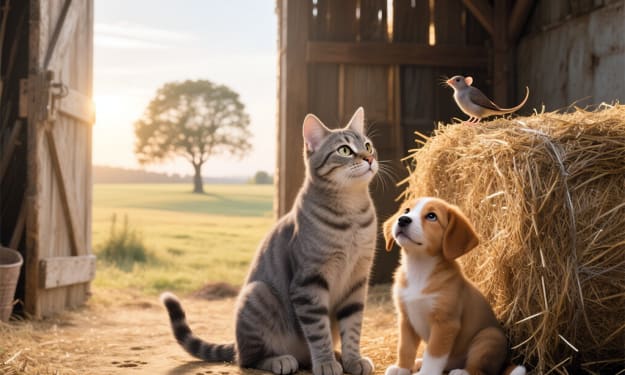
Breakfast Time (Feline and Avian)
Introduction We have a cat that visits a few times a day for treats. When he started, it was just once a day. He doesn't trust me but expects treats. This is just about how the pictures above came about, and you can see the video on my Facebook/Instagram post here:
By Mike Singleton 💜 Mikeydred about a year ago in Petlife
How to Teach Your Cat to Fetch
Cats are known for doing whatever they want, whenever they want, and paying little attention to what their owners want. It is true that they have a spirit of independence that places them in a class of their own. Having said that, your adorable cat is extremely intelligent and probably has picked up a few cool cat tricks, such as giving you a (cute) high five, coming to you when you call their name, and even playing a game of fetch. You only need to be patient and determined, and some tasty cat treats are always helpful. We inquired with the experts about including fetch in your cat's playtime.
By FurryFusionabout a year ago in Petlife
The dog story
On the edge of a small village nestled between rolling hills and deep forests, lived an old man named Karim and his loyal dog, Bruno. Karim had raised Bruno from a tiny puppy, and over the years, their bond had grown unbreakable. Bruno was no ordinary dog—he understood more than commands; he understood emotions. When Karim was sad, Bruno would rest his head on his lap. When Karim laughed, Bruno would bark joyfully and wag his tail with excitement. Every day, they followed the same routine. Karim would walk to the village square, sit on the same bench near the bakery, and feed Bruno bits of bread while chatting with the locals. The villagers loved watching them—a picture of companionship so strong that it warmed even the coldest heart. One day, Karim fell ill. The doctor came and said he needed to rest. But Karim, stubborn and set in his ways, insisted on going for his walk. “Bruno won’t like it if I skip a day,” he said with a weak smile. The villagers noticed how pale Karim looked, but none could convince him to stay home. That day, as always, Bruno trotted beside him, tail high and happy. They reached the bench, and Karim sat down slowly. He fed Bruno the usual crumbs, patted his head, and then quietly closed his eyes. At first, the villagers thought he was just tired. But when he didn’t respond, panic spread. The doctor was called, but it was too late—Karim had passed away peacefully, his hand still resting on Bruno's fur. Bruno didn’t understand death. He waited beside the bench, nudging Karim gently. When the ambulance came and took his master away, Bruno chased after it, barking and howling. But he couldn’t keep up. He returned to the bench, panting, confused, and alone. Days passed. Then weeks. Then months. Every day, Bruno returned to the same bench. No matter the weather—rain, snow, or scorching sun—he sat in the same spot, eyes watching the road, ears perked for the familiar footsteps that would never come. The villagers brought him food, made a small shelter for him nearby, and even tried to adopt him. But Bruno refused to leave. His loyalty kept him rooted to the bench where he had last seen Karim. Children would sit near him and pet him gently. Old women would whisper prayers for him. Tourists who heard the story would bring treats and take pictures. Bruno became a silent guardian of the bench—a symbol of loyalty and love. One winter night, a heavy snowstorm rolled into the village. The streets were empty, and the cold was brutal. In the morning, a baker found Bruno curled up on the bench, covered in a soft blanket of snow, his body still, eyes closed, a peaceful expression on his face—as if he had finally fallen asleep waiting for someone he loved more than life. The villagers buried Bruno next to Karim, in a quiet corner near the hills, where the sun shone warmly during the day. They placed a small stone with the words: “Bruno – The Dog Who Waited. Loyal to the end.” Years later, people still visited the bench. They would sit quietly, tell their children the story of Bruno, and reflect on the kind of love that asks for nothing in return. Statues were made, poems were written, and the legend of the dog who waited lived on. Because sometimes, the truest love is silent. It waits without complaint, without demand. Just like Bruno. dog story and and about the other day of my favorite things that are going to be a great day and night and I am so happy for you
By Animals Lifestyleabout a year ago in Petlife