
Scientists claim that for eight years, 200 wild chimpanzees in Uganda have been embroiled in a bloody "civil war," but they are unsure of the cause.
An explanation of chimp violence

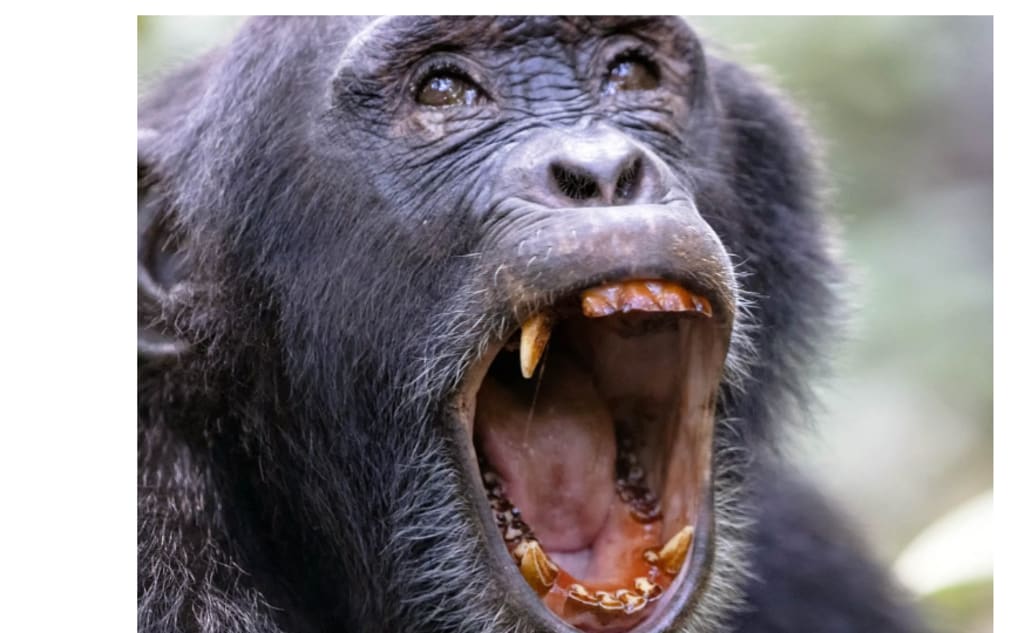
The first permanent break in a natural chimpanzee society has been documented by researchers, and it was followed by years of violence between erstwhile comrades. The research demonstrates that, even in the absence of the cultural indicators frequently employed to explain human conflict, strong social ties can shatter sufficiently to result in lethal group violence.
Where it all began
After years of cohabitation, a single chimpanzee population in western Uganda's Kibale National Park split into two opposing camps. Aaron Sandel of The University of Texas at Austin (UT Austin) traced the transition from a shared society to a permanent division based on the Ngogo chimpanzees' lengthy history.
When the divide was finished in 2018, the animals that had previously travelled, patrolled, and groomed together were no longer connected. This break raises the question of how such a vast society broke apart and elevates the chimpanzee violence beyond a tale of strangers fighting.
Life before to fracture
The Ngogo chimpanzees, the largest known wild population ever documented, lived in a single shared area for 20 years. Nevertheless, the chimpanzees maintained the cohesiveness of the larger society by hunting, grooming, patrolling, and mating across those hazy boundaries. The subsequent separation cannot be written off as typical chimp behaviour because irreversible splits may only happen around once per 500 years.
The fracture solidifies
When the western and central clusters stopped interacting and then avoided each other for weeks in 2015, the situation became more acute. Their ranges separated throughout the course of the following three years, and the last known baby born across the boundary was born in March 2015.
The community's center turned into a border once the separation held, and long-standing friendships ceased to be a source of safety. This was significant because, on its own, separation did not put an end to competition; rather, it redirected it toward erstwhile friends.
Raids become deadly
The Western group started coordinated raids into Central territory when the split became permanent in 2018. Researchers documented 24 attacks during a seven-year period, resulting in the deaths of at least seven adult males and seventeen newborns.
Infanticide, or the killing of infants, started to occur frequently enough in 2021 to result in several deaths annually on average. Because bodies are rarely found in deep forests, missing animals indicate that the death toll was likely higher.
Group size is inferior to cohesiveness.
One outcome stood out: although confronting a considerably larger rival, the smaller Western chimpanzee group was largely responsible for the violence, carrying out every recorded fatal attack.
Patrols may have been quicker, tighter, and more decisive than head counts alone indicated because of long-standing bonds among its core guys. Chimpanzee raids had previously been associated with territory gain rather than retaliation or complex ideology. Ngogo makes a more difficult point: once a social line solidifies, strong internal cohesion can overcome numbers.
An explanation of chimp violence
Due to the strained relationship maintenance between approximately 200 chimps and over 30 adult males, size may have been a contributing factor in the rupture. As the two groups ceased to share space and reproductive partners, competition for food and mating increased.
Prior to the breach, a number of influential people passed away, the leadership was replaced, and other social ties were later severed by a respiratory outbreak. Together, those blows demonstrate how a stable network might break down, but none of them establish a single reason.
Violence involving erstwhile allies
This episode demonstrates how chimpanzee violence can occur even among former companions, although chimpanzee hostility often targets outsiders. Here, a similar viewpoint on the divide reflected the idea that once membership changed, former friends became targets.
According to German Primate Center researcher James Brooks, Ph.D., "a hostile split among wild chimpanzees is a reminder of the danger that group divisions can present to human societies." Chimpanzees do not wage conflicts based on language, religion, or political ideologies, therefore the parallel has limitations.
Instructions devoid of culture
The case casts doubt on the widely held belief that violent divisions between communities may only develop after cultural markers. Even though these chimps lacked language, religion, or ideology, shifting connections nevertheless led to organised attacks and polarisation.
That contends that strained relationships and regional rivalry can accomplish more than people realise, but it does not eradicate human civilisation. Since daily estrangement can solidify disputes before slogans ever appear, any education for individuals should begin simple.
Researching the aggressiveness of chimpanzees
This tale could not have been captured in a short effort because the significant shift occurred over years inside an endangered eastern chimpanzee group. The killings, the progressive fracture, and regular living were all recorded at the same field site, making cause and effect evident.
Brooks noted, "The study also emphasises the significance of maintaining long-term field research sites and of preserving endangered species." Ngogo demonstrates how, in the absence of human ideas, a community can progress from amicable internal conflicts to hardened camps and finally to murderous raids. Because the fight is still ongoing and its conclusion could be just as important as its beginning, researchers are still keeping an eye on the forest.
About the Creator
Enjoyed the story? Support the Creator.
Subscribe for free to receive all their stories in your feed.
Comments
There are no comments for this story
Be the first to respond and start the conversation.