
What I Learned About User Behavior From Looking at Tube-Site Category Data
How do users browse, filter, and engage with content?
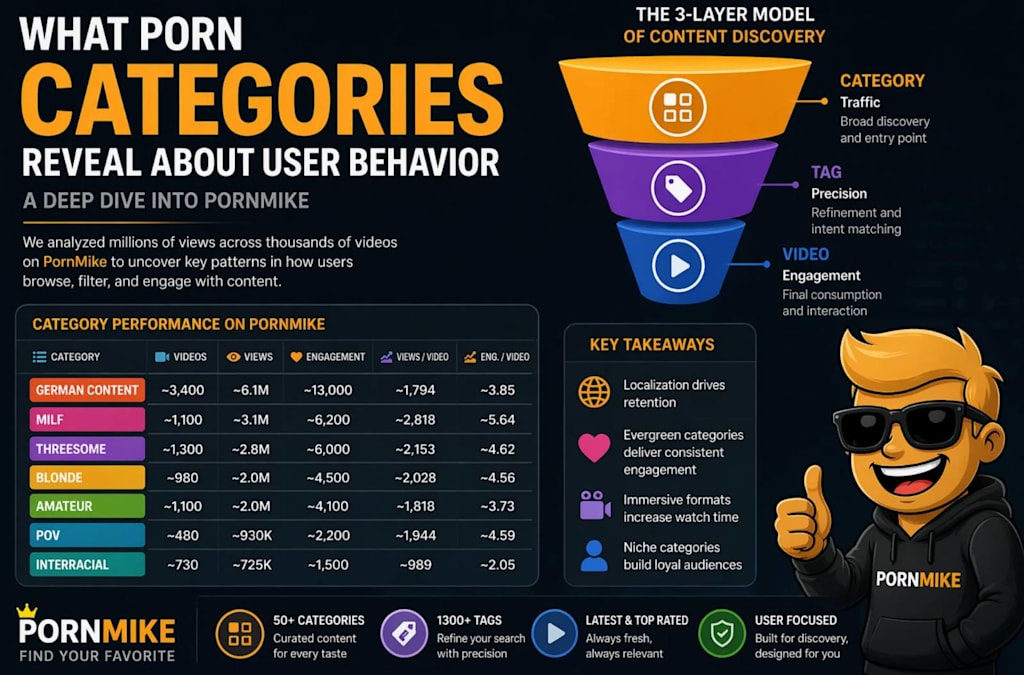
I spent some time looking at how a large tube-style content platform organizes itself — its categories, its tagging system, and the reported performance of different segments. I went in expecting to find a library. What I found instead was a behavioral funnel. The more I looked, the clearer it became that categories on these platforms aren't really about helping people find things. They're about shaping what people want in the first place.
Here's what stood out to me.
Categories are framed as navigation, but they function as intent capture
The surface story is simple: categories help users browse through Pornmike. But when I mapped out how the system is actually built — broad category pages at the top, over a thousand tags underneath, individual videos at the bottom — I stopped seeing a library and started seeing a funnel. Users enter through something broad and recognizable, get filtered through increasingly specific tags, and arrive at content the platform has optimized them toward. The platform isn't answering a question the user brought in. It's teaching the user how to ask.
That reframing matters. A library serves existing demand. A funnel manufactures it.
The data points toward immersion and perceived authenticity, not variety
A few patterns jumped out from the reported category performance.
POV content punches well above its weight. The library is smaller than other categories, but engagement per video and watch time are reportedly higher. The mechanism is obvious once you name it: first-person framing collapses the distance between viewer and screen. It's the same reason TikTok feels stickier than traditional video — the format itself is doing work on the nervous system.
Amateur content shows a similar pattern through a different mechanism. Users are reportedly drifting away from highly produced material toward content that reads as "real." I don't think this is a niche preference. I think it's the same authenticity shift visible across every media category right now — podcasts beating radio, creator content beating studio content, unfiltered beating polished. The platform isn't causing this trend. It's harvesting it.
Localized content — in this case German-language videos — reportedly has the largest library and the strongest retention. That tracks. Language and cultural familiarity reduce cognitive friction, and reduced friction means longer sessions. This is the least controversial finding in the whole dataset and probably the most generalizable: people stay where they don't have to translate.
The three-layer model is the part worth paying attention to
If I had to compress what I learned into one thing, it's this structure:
Category brings the traffic. Tag provides the precision. Video delivers the engagement.
Every layer is doing different work. The category is a wide net — it captures broad curiosity and high-volume search terms. The tag is a scalpel — it matches specific intent and handles long-tail queries. The video is the payoff — the place where watch time, session depth, and repeat visits get measured and fed back into the system.
What's worth noticing is that this isn't unique to adult platforms. It's the same architecture Netflix uses (genre → mood tag → title), the same Spotify uses (genre → vibe playlist → track), the same Amazon uses (department → filter → product). The tube-site version is just more naked about it, because the platform doesn't have to pretend it's selling anything other than attention.
What I'm actually uneasy about
The part I keep returning to is the feedback loop. Engagement metrics — watch time, session depth, return frequency — are treated in the source material as a sign of user satisfaction and a signal the platform should optimize for. But engagement is not the same as satisfaction. A slot machine has excellent engagement metrics. So does an argument on social media. What these numbers actually measure is how well the system has learned to hold someone in place.
When I read that "user satisfaction is now a key ranking factor," what I actually see is: "we've gotten better at measuring compulsion and calling it preference." The three-layer funnel is extremely good at taking someone who arrived with vague curiosity and walking them into something specific, repeatable, and habit-forming. That's not a discovery experience. That's a conditioning loop dressed as one.
What I take from this
Three things.
First, the architecture of a platform tells you more about its intentions than its marketing does. Categories and tags aren't neutral containers — they're the shape the platform wants user desire to take.
Second, the trends visible in this data (immersion, authenticity, localization) are not platform-specific. They're showing up everywhere, and anyone building for attention is either riding them or losing to someone who is.
Third, "engagement" has quietly become one of the most misleading words in product analytics. It describes what the system is doing to the user at least as often as it describes what the user is getting from the system. The tube-site case is a useful place to see this clearly, precisely because nobody involved pretends it's about anything else.
About the Creator
Enjoyed the story? Support the Creator.
Subscribe for free to receive all their stories in your feed.
Comments