
The Last Two Cards
Why Middle-Aged Men Are Either Trading Stocks or Fishing — and What It Says About Their Lives
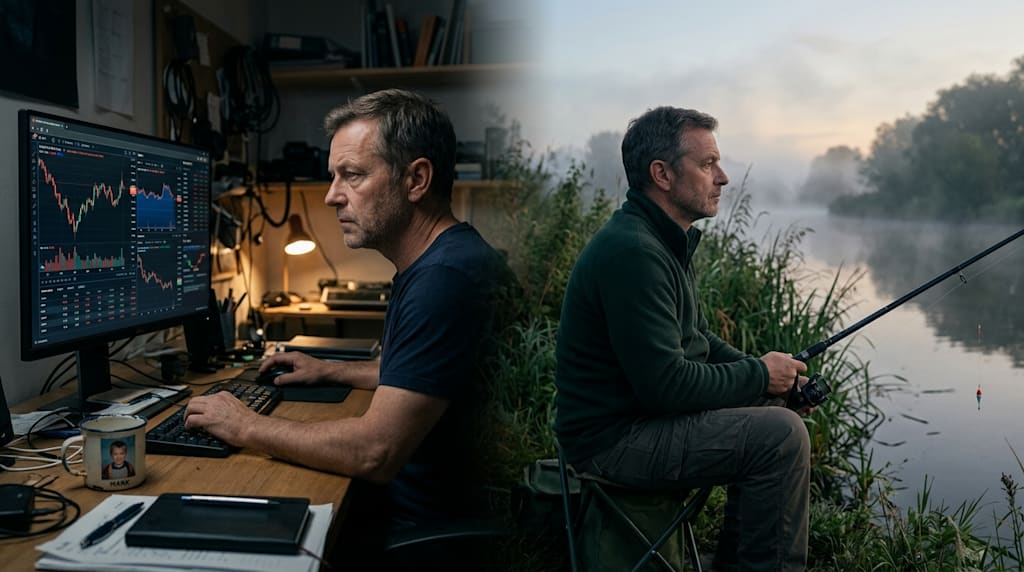
At three o'clock last Friday afternoon, when the market closed, Lao Zhang from the IT department leaned back in his chair and let out a long breath. On his screen, red and green daily K-lines crisscrossed; three of his watchlist stocks were in the red, two in the green. He minimized the window, and an unfinished weekly report popped back onto his desktop. At the same moment, Director Li from the sales department updated his WeChat Moments with a photo: a fishing rod slanted in its holder against green hills and clear water, a float standing upright on the surface, captioned "Waiting for good news." Someone commented below, "Any bites?" He replied with a single character: "Wait."
I stood by the water cooler, cup in hand, and thought: the men around me in their forties seemed to have been split by some hidden current—either buried in stock-trading apps or crouched by the riverbank. The former, in suits and ties, staring at blinking red and green numbers with the decisiveness of a general; the latter, in windbreakers and sun hats, sitting motionless for hours facing the shimmering water. On the surface, they looked like two different breeds, but peel back the skin and look at the bones—they were two remedies for the same predicament.
I
By the time a man turns forty, the names in his phone contacts have dwindled.
At twenty, his contacts were his social circle—calling up friends, partying every night; at thirty, they were his network—wining and dining, trading favors; at forty, they finally became just a contacts list—one hundred numbers, ninety of which he wouldn't dial once in an entire year. It wasn't that he had grown cold; it was that maintaining relationships took too much effort. Explaining his feelings had a cost, reading other people's moods demanded energy, and the two things middle-aged men had in shortest supply were exactly those.
Stock trading and fishing had one wonderful thing in common: both were solitary pursuits. No need to accommodate someone else's schedule, no need to match anyone's mood, no need to force enthusiasm for a dinner party. At five in the morning, he could carry his fishing rod out the door as stealthily as an assassin; late at night, he could sit in silence reviewing K-lines like a monk in seclusion. By the water, he was completely alone. The float stood still. Birds called in the distance, and close by the wind rustled through the reeds. His phone buzzed in his pocket; he fished it out and glanced at it—someone had @ed him in the work group chat. He locked the screen, shoved the phone back, and placed it face-down on a rock.
In these two activities, he finally didn't have to play a role. He didn't have to talk, didn't have to smile, didn't have to solve problems. He just sat there.
II
Looking squarely at a forty-year-old man's life takes courage.
At work, his forehead wrinkles had settled in; the promotion that should have come hadn't, and the demotion that shouldn't have come hadn't either. He had entered that long plateau phase, like a cable car stuck halfway up the mountain. In his marriage, the touch of his hand to hers had grown familiar to the point of unease—arguments no longer produced anything new, and even cold wars had become routine. As for his kids: he could still help with elementary-school math, but by middle school he was reduced to fetching tea and water; by high school, he couldn't even knock open their bedroom door.
His life was like a movie that had been spoiled. Every day was a copy of the day before; next week's schedule looked eerily identical to last week's. That level of certainty would suffocate any once-ambitious young man.
But the next bullish K-line in the stock market was unknown—and so was the next tug on the line underwater. He didn't know whether tomorrow's opening would gap up or gap down; he didn't know whether, when the float slowly sank and he lifted the rod, he would haul up a crucian carp, a common carp, or an old shoe. That "not knowing" was the only legitimate suspense left in the dull routine of a middle-aged man's life.
He typed in a sell order, clicked confirm. The system popped up: "Are you sure you want to submit?" He selected yes. Five thousand shares went through. He made 420 yuan on that trade. Not much money—but throughout the entire process, no one shook their head, no one said "let's think it over," no one asked him to "check with other departments." A meeting reminder popped up in the lower right corner of his screen; he clicked "snooze." Then he keyed in the ticker symbol for his next stock and began studying the five-minute chart.
He was gambling—not for money, but for the chance that fate might still toss him a little unexpected reward.
III
At the office, he couldn't go east if his boss said west; he had to smile when a client asked him to revise a document for the eighteenth time. At home, his kid demanded the latest sneakers, his wife complained that the toilet was clogged again, and his parents' medical reports flashed red alerts. He was like a kite torn by winds from all directions—the string held by others, blown wherever they pleased.
But the moment he opened his trading software, he was the one giving orders. How much position to take, whether to buy or sell, where to set the stop-loss—all decided by him alone. Even with only fifty thousand yuan in principal, at that moment he commanded the decisiveness of a general marshaling thousands of troops. Likewise, when he cast his line precisely into the gap between two patches of underwater weeds, adjusted the float, prepared the chum, and shaped the bait—every move was an unquestionable assertion of authority. In that circle less than a meter across, his word was law.
That sense of control was tiny—so tiny that only he himself knew about it. But it was enough to carry him upright through another ordinary day.
IV
The most extravagant luxury for a middle-aged man wasn't a watch or a car—it was solitude.
He pulled into the garage and turned off the engine. The dashboard lights slowly dimmed, leaving only the overhead reading lamp still glowing—yellow, casting its light on the steering wheel. He wasn't in a hurry to open the door. On the passenger seat lay half a pack of tissues and a gas-station loyalty card. He tilted the seat back a little, leaned against it, and closed his eyes. His phone didn't ring. Five minutes later, he opened his eyes, opened the door, grabbed his briefcase, and went upstairs.
But "sitting in the car doing nothing" looked strange to his family. "Let me check the market" and "I'm going fishing," on the other hand, were two universally recognized passes that required no explanation. When he said he was checking the market, his wife would silently bring him a cup of tea; when he said he was going fishing, the whole family would take it as his legitimate right.
That wasn't a hobby—that was a legal "mental exit visa" he had applied for. Sitting by the water, his mind empty except for the sounds of wind and water, he wasn't the pillar of the family in that moment—just a stone quietly baking in the sun. Sitting in front of the computer, staring at the K-lines, his mind full of the battle between bulls and bears, he didn't have to listen to his wife nag about school-district housing or endure his boss's glare. That was the mental enclave he had carved out for himself.
V
A twenty-year-old man believed in "doing"—thought that brute force could work miracles, that as long as he ran hard enough he could outpace everyone. It took a forty-year-old to understand that the second half of life was about "not doing."
Many things couldn't be changed by effort alone; in the face of larger forces, individual diligence was insignificant. He had stared at a stock for forty minutes, scanning the five-level order book back and forth, watching buy and sell orders cancel and replace each other. In the end, he did nothing. Didn't buy, didn't sell. The closing price was almost exactly what it had been when he first looked. He closed the software, picked up his cup, and took a sip. The water had gone cold.
The essence of stock trading was waiting—waiting for the wind to come, waiting for valuations to revert, waiting for cycles to turn. Most of the time, you just needed to hold your cash or guard your chips and do nothing. The essence of fishing was also waiting—waiting for the fish to enter the nest, waiting for that precise signal to strike. Lifting the rod and changing bait too often would only scare the fish away. That "waiting" was a middle-aged man's reconciliation with time. He no longer charged ahead recklessly; he had learned to maneuver with the market, to outwit the fish. That "slowness" wasn't dullness—it was an adjustment of rhythm after a moment of clear awakening: since he couldn't run anymore, he might as well sit down and let the world pass by.
VI
And yet, in the end, there was still a difference.
The stock trader hadn't given up. He still cared about offense—still believed that logic, technical analysis, insider tips, or the nation's fortune could lift him another step or two up the wealth ladder. There was fire in his eyes—the last spark of unwillingness to let go of worldly success. The fisherman, on the other hand, had already made peace with it all. He no longer wrestled with the world, no longer coveted that higher position or those extra zeros. All he asked for was this moment—a clear breeze, gentle ripples. There was water in his eyes—a quiet detachment from the turbulent world.
One was a wandering swordsman still roaming the jianghu with blade in hand; the other, a retired hermit who had sheathed his sword and sat alone by the river, sipping wine. But from my perspective as an HR professional, both deserved a toast. As long as a middle-aged man could still find something that lit up his eyes, something that made him willing to get up at five in the morning, something that let him sit alone for half a day without speaking—he hadn't yet been completely crushed by life. Stock trading and fishing: one reclaimed a sense of existence amid the roaring waves of numbers, proving to himself that he hadn't been kicked off the game table by the times; the other found a sense of belonging amid the still green mountains and clear waters, telling himself that even if he had been kicked off the table, he could still enjoy this stretch of sky and earth.
On Monday morning, I ran into Lao Zhang again by the water cooler. He was filling his cup with hot water—an old enamel mug printed with a kindergarten group photo, the child in the picture wearing two pigtails, most of the paint already worn off. I asked him if he had checked the markets over the weekend. He said he had looked for a while but made no moves. "Just wait," he said. Then he walked off with his cup.
At the other end of the hallway, Director Li came in carrying a courier box. He opened it to reveal a new spool of fishing line. He tore off the seal, pinched a length between his fingers, rubbed it, nodded with satisfaction, and tucked it back into his drawer.
They each closed their own door: one was a jungle of red and green flickering on a screen; the other, a silent abyss beneath the water's surface. The float and the K-line rose and fell—the rise was hope, the fall was the everyday. Silently, without fuss, they caught those tottering, unmoored middle-aged men and held them steady.
About the Creator
Jin
Writer of reamstories
https://reamstories.com/jin
Enjoyed the story? Support the Creator.
Subscribe for free to receive all their stories in your feed. You could also become a paid subscriber, letting them know you appreciate their work.
Comments
There are no comments for this story
Be the first to respond and start the conversation.