
The Hidden Engineering Behind a Good Golf Polo
Why a simple shirt is never actually simple once you look at how it's made
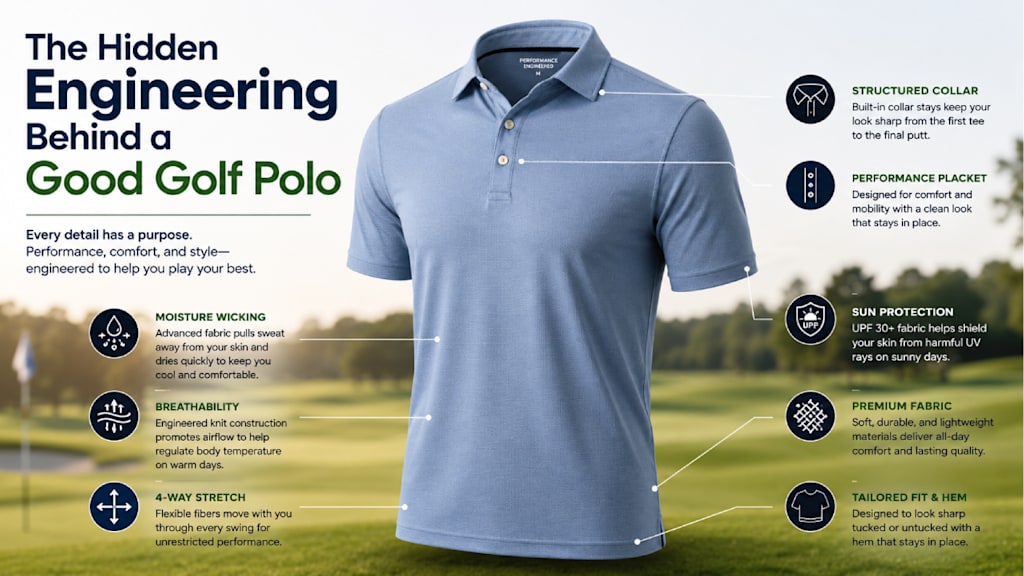
But spend time on a factory floor where these shirts are actually made, and the simplicity starts to look like the result of a lot of invisible decisions, not the absence of any.
It starts with the fabric, and the fabric is doing more than you'd think
A genuine golf polo is built from piqué knit — a weave with a slightly raised, textured surface rather than the flat smooth knit of a basic t-shirt. That texture isn't decorative. It creates small pockets of air between the fabric and the skin, which is what actually makes the shirt breathe during four hours of walking in direct sun. Swap in a cheaper flat-knit fabric and the shirt might look nearly identical folded on a shelf, but it behaves completely differently on a body in the heat.
Fabric weight matters too, and it's rarely discussed outside the factory. A heavier fabric holds its shape longer and resists wear better, but it also runs warmer. A lighter fabric breathes more easily but can show wear sooner. Neither is wrong — they're just suited to different climates and different golfers, and a good manufacturer should be having that conversation with a brand before production starts, not after a customer complains.
The collar takes more punishment than any other part of the garment
Think about what actually happens to a polo collar over its lifetime. Every time a player turns their head. Every wash cycle. Every time the shirt goes on and off. That collar is being pulled, creased, and stretched constantly, in a way the rest of the shirt simply isn't.
A collar built with the right interlining — the stiff inner layer that gives the collar its structure — and the right stitch density holds its shape for years. A poorly built one starts to curl and look tired within a single season, no matter how good the fabric underneath it was. It's one of the easiest things to get wrong and one of the hardest to notice until it's already happened.
Even the way a logo gets applied changes what you're actually buying
The choice between embroidery, sublimated printing, and screen printing changes more than just appearance. Embroidery sits as raised thread on the surface — durable, premium-feeling, but adding a small amount of weight and texture exactly where the stitching sits. Sublimation becomes part of the fabric itself, completely invisible to the touch, but it only works on certain fabric types and won't show up properly on dark colors the same way it does on light ones. Screen printing sits as a thin layer of ink, flexible and affordable at the right volume, but less durable over hundreds of washes than the other two.
None of these is "better" in the abstract. Each one is correct for a different brief, a different budget, and a different fabric — and a manufacturer who understands that will ask which one actually fits your situation instead of just quoting whichever method they happen to prefer running that week.
Why this matters more than it seems to
This is exactly why so many new apparel brands get blindsided by inconsistent quality when they switch suppliers chasing a slightly lower price per unit. The garment looks the same in a product photo. It is not the same garment. The differences live in the fabric construction, the collar interlining, and the decoration method — none of which show up in a quick glance, and all of which show up the first time a customer actually wears the thing in real conditions.
I think about this constantly working in apparel manufacturing, where the gap between "looks right" and "is right" is usually invisible until somebody actually wears it. It's also why, when brands ask me where to start, I point them toward a manufacturer who specializes in golf polo production specifically, rather than a general apparel factory that treats golf as just another product line on a long list. The fabric and collar decisions above are exactly the kind of detail a specialist gets right by default — and a generalist has to be specifically asked about, every single time.
About the Creator
Enjoyed the story? Support the Creator.
Subscribe for free to receive all their stories in your feed.
Comments
There are no comments for this story
Be the first to respond and start the conversation.