
The Biscotti on the Desk: Why Old-School Loyalty Still Outruns Supply-Chain Algorithms
A quiet story about a family metal shop, a handwritten payment extension, and the invisible fracture between relationships and efficiency.
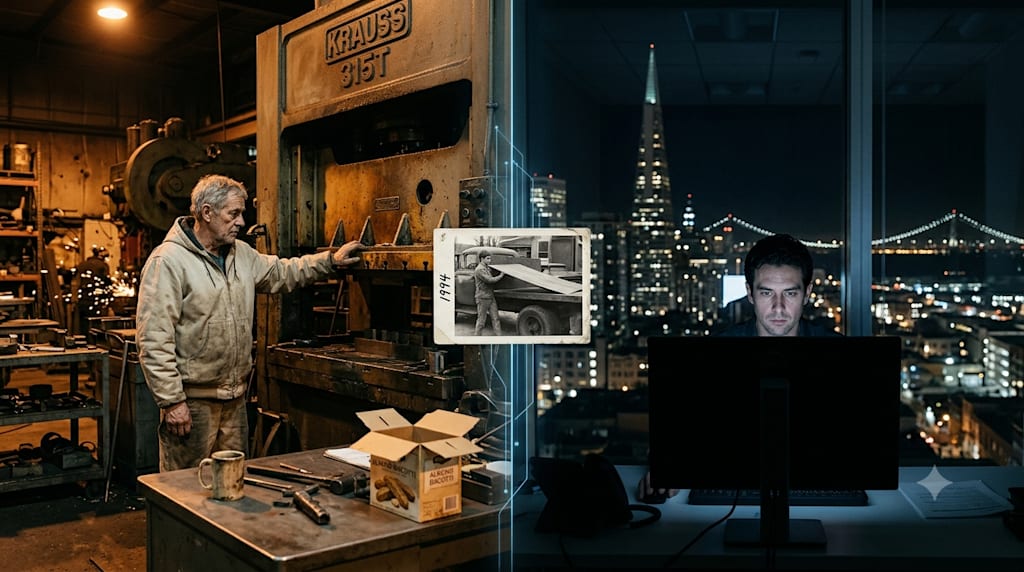
Arthur Whitman set the receiver back on the cradle and let his fingers rest on the edge of the desk for two seconds. Outside the window, Ohio snow was falling on the corrugated iron roof of the stamping shop, a fine, steady hiss like sandpaper on metal. He was seventy-three years old. He could tell the rhythm on the Krauss 315-ton press was slightly off: every ninth stroke, the return lagged by maybe three-tenths of a second. It was a good machine. Shipped from Stuttgart in 1987, older than his son.
The call had come from the purchasing director at Morain Medical. The man had been polite. They were “optimizing the supply chain,” he said. Starting next quarter, all stainless-steel bone-plate fittings would move to a new plant in Malaysia. Arthur didn’t ask why. Morain Medical was forty-one percent of his revenue. The numbers meant his payroll account wouldn’t last past the middle of February.
He pulled on his Carhartt jacket, worn pale at the elbows, and walked out onto the floor. The night shift was gone. The press was still warm. The air smelled of cutting fluid and iron dust. He stood next to the Krauss for a while and touched the back of his hand to the guide rail; oil temperature normal. It wasn’t the machine.
At nine the next morning, Elena Rossi walked into his office. She hadn’t called ahead.
Elena’s family had been in stainless sheet down in Cleveland for three generations. Rossi Metal Supply. Her grandfather came over from Genoa in 1953, built a name on precision rolling. Arthur had bought from no one else since 1991. Thirty-two years. She was a dozen years younger than him, grey curls pinned back with a tortoiseshell clip, her coat still holding the warmth of her car.
“I heard,” she said. She put something on his desk. Not paperwork, but a box of almond biscotti, homemade, the wax paper still faintly warm underneath.
Arthur didn’t touch the biscotti. He didn’t say anything. Elena pulled out the chair across from him and sat. From her handbag she took a manila envelope and set it beside the box. Inside the envelope was a revised payment agreement, stretching the net terms from thirty days to a hundred and twenty. Handwritten. Fountain pen. No stamp yet.
“This load goes on the truck tomorrow,” she said. She meant the twenty tons of 316L stainless sheet that had been sitting outside his warehouse for three days because Arthur had told the forklift driver to hold off, not knowing if he could cover the invoice. “I spoke with my bookkeeper. The next order ships first. The bill can wait until May.”
Arthur looked at the figure written in ink. A hundred and twenty days. This wasn’t business. This was her own cash floated on his breathing. His Adam’s apple moved. He pushed the paper back. “Elena, that doesn’t make sense.”
“When have I ever talked to you about making sense?” She stood and walked to the window, looking down at the press floor. “The fire in ninety-four. Your order. My father drove it to your back dock himself in the company truck. Nobody stood around asking what made sense.”
Arthur said nothing. He pulled the agreement back, took his fountain pen from his breast pocket, and signed. The nib scraped the paper with a small dry sound, like the lag on the ninth stroke of the press, the one you could miss if you weren’t listening.
That same afternoon, one-oh-seven Pacific time, Leo Whitman was eating a kale salad in front of his monitor at his office south of Market Street in San Francisco. His company was called NexaShield. Smartphone thermal modules. Four years in, six PCB suppliers rotated out.
His purchasing manager, Janet, leaned in the door. “Phoenix Circuits says this batch of flex boards is going to be delayed. Three weeks minimum. They’re retooling their San Jose line.”
Leo stabbed his fork into the salad container. “Who else is on the backup list?”
“Avalon Electronics, out of Austin. Eleven percent higher, but they can ship Monday.”
“Do it.” He didn’t look up from the scheduling screen. Janet nodded and shut the door. In the supplier management system, Leo found the entry for Phoenix Circuits, right-clicked, and changed the status to DORMANT. The system threw a confirmation box: “Notify supplier of status change?” He checked “Internal only” and hit confirm.
Phoenix had been his first board house. The founder’s name was Maldonado. Mexican-American. A couple of years back, on a trip to San Jose, old man Maldonado had brought Leo home for dinner. His wife made tamales. Tequila late into the night. Leo remembered the backyard. He remembered the kid’s soccer jersey swaying on the clothesline in the breeze. But none of that surfaced now. What surfaced was the schedule spreadsheet, the lead times, the eleven-point differential, and a ship date for Monday.
That evening he called his father. Arthur mentioned Elena’s visit, didn’t go into detail, just said, “Rossi extended the terms.”
Leo was quiet for a moment on his end. He understood what that meant. He just couldn’t understand why it was worth saying out loud. “Dad, she did it because your shop is still worth saving. If you were really done, she wouldn’t save you either. That’s not personal. That’s her discounting your future cash flow.”
Arthur didn’t argue. He hung up and walked back to the floor. The night shift was just starting, the press hammering again. The ninth stroke still lagged by three-tenths of a second. But this time he heard it differently. It wasn’t a mechanical fault. It was the die pausing a fraction longer on cold steel, the way an old man holds something on his tongue for a beat and then swallows it.
March came. Morain Medical did not come back. Two smaller accounts surfaced instead. Arthur’s payroll held. Elena’s 316L sheets became surgical instrument parts, shipped to Minneapolis. In May, Arthur sent a cashier’s check to Cleveland, paid in full. With it he enclosed a photocopy of a black-and-white photograph. It was from the summer of 1994. In front of the old Rossi Metal building. Elena’s father standing beside a Dodge truck. Arthur himself at forty, hair still dark, lifting a bundle of sheets from the truck bed. Nothing was written on the back.
Leo’s thermal modules landed a major order in the third quarter. Margins bumped seventeen points. The supplier list turned over twice more. Phoenix Circuits had sunk to the bottom of the system, the last note reading “Delivery instability,” the text a shade of grey slightly lighter than the rest. No one was ever going to scroll down to it again.
Late one night, Leo worked well past hours. He was alone in the office, the AC vent humming. He opened the supplier management system and, without knowing why, scrolled down. Page after page of names marked DORMANT. Some of them he couldn’t place anymore. Couldn’t remember which year he’d worked with them. He stared at the word Phoenix for a few seconds and closed the window.
Outside, the lights on Market Street ran in a clean, cold line. He picked up his phone to call his father, glanced at the time, and set it back down.
The screen went dark. The glass held a reflection of his face, still and expressionless, the dull silver-grey of a stamping cooling in the quench tank.
About the Creator
Jin
Writer of reamstories
https://reamstories.com/jin
Enjoyed the story? Support the Creator.
Subscribe for free to receive all their stories in your feed. You could also become a paid subscriber, letting them know you appreciate their work.
Comments
There are no comments for this story
Be the first to respond and start the conversation.