
Hermann Schmitz (†) - Condolences
The Posthumous Author

the most painful disagreement (in my opinion) in its irresolvable state. "I don't mean to offend you"—that's how you put it. For me, it was different. But that would lead us too far afield.
I was soon convinced that only a genius could have written such a work when, as a young philosopher around 1989/1990, I read The Present , the first volume of your System of Philosophy. I owe it to Gernot Böhme that I even became aware of you. He had become terribly agitated at a colloquium at Munich University when it turned out that none of those present, myself included, knew a philosopher named Hermann Schmitz.
I first met you in Seewiesen near Starnberg, at the Max Planck Institute for Animal Behavior. I believe it was in 1991. You were speaking about "Animals as Conscious Beings," and the reactions were disappointing. Apart from Professor Mittelstädt, the institute director, none of the biologists present seemed to have understood your lecture. No real discussion ensued, and the audience soon left.
I had trudged through the deep snow as an uninvited guest on that sunny winter day, wearing moon boots and a sheepskin coat, because a physicist friend had told me that you would be giving a lecture at the MPI. I mustered all my courage, but it soon turned out that it wasn't difficult to strike up a conversation with you.
You were an older man, but not yet old, tall, thin, wearing a tie and square metal-rimmed glasses. A bit reserved, but very open to genuine philosophical interest of any kind. I was just thirty, a young analytical philosopher struggling single-handedly through your system, feminist and full of life.
We kept talking. No one could bring themselves to ask me to leave. Finally, the Mittelstädts invited us in for coffee and cake, and the four of us chatted until nightfall. A year later, I heard a second lecture by you at the Munich Institute for Medical Psychology. Shortly afterward, I wrote to you, and the first, seven-year phase of our correspondence began.
What fascinated me about the New Phenomenology at the time were its novel systems of categories. They brought the dark continent of bodily sensations into the light for the first time; as well as the realm of feelings as atmospheres and the theory of surfaceless spaces connected to both. Suddenly, areas of phenomena with which I had positive practical experience became intelligible to me, but which, due to their unsatisfactory "energetic" theoretical language, were dismissed by many as esoteric nonsense: the diverse body psychotherapies originating from the youth of the 20th century and the embodied, atmosphere-rich ritual arts of the spiritual women's movement of the 1980s and 90s.
Secondly, I still admire the boldness and ingenuity of the ontological architecture of the New Phenomenology, which is inextricably linked to its theory of manifoldness. Why is this grand systematic design still hardly discussed? I find it breathtaking. Apart from Habermas with his theory of communicative action, which also functioned as a theory of modernity, hardly anyone among your philosophical contemporaries had dared to do anything comparable.
I knew and appreciated Habermas's work when I began reading The System of Philosophy. But when I compared it with your approach to elementary embodied experience, I noticed how rationalistic and logocentric the theory of communicative action was. It proceeds exclusively from types of knowledge, discourses, and speech acts, and fails to recognize the philosophical significance of the embodied, pre-linguistic foundations of our existence.
The New Phenomenology takes neither the side of monistic nor that of dualistic ontologies. Rather, it revitalizes this ancient opposition through its principle of the bipolar present. In doing so, it makes our proximity and kinship to animals comprehensible to us Europeans for the first time—a connection that had been erased by the course set by ancient Greek philosophy. In this way, the New Phenomenology corrects one of the most disastrous misdevelopments of the European worldview and understanding of humanity.
Like all of us, you too had your blind spots, Hermann. May I give an example? You almost completely ignored the patriarchal and androcentric nature of our culture. You refused to acknowledge your privileges as a white man. As a result, in my view, your work on the symbolic order wasn't radical enough and was open to criticism in some respects.
If I stood up to you here, it was only because I felt the strength of my mentors from the women's movement and some women who loved me behind me. There simply had to be female philosophers who wouldn't let you get away with patriarchal bias. I wanted to be one of those women.
But not this, but something else, is what I want my last word to you today, Hermann: my deep respect for the sacrifice of life's opportunities, and surely also of happiness, that you made for your philosophical work over six decades. The flip side of your extraordinary gifts was an unconditional obligation, from which you never shirked. In many ways, you lived like a monk, in order to do something that no one else could have done in your place.
Lou Andreas-Salomé was right when, in her essay Man as Woman (1899), she expressed her high regard for a certain type of man whom she particularly valued:
"... [he] forgoes a completely harmonious expression of himself in that interplay of all forces which keeps him beautiful, happy and healthy as soon as he can achieve a goal envisioned by a powerful specialization of his forces; the cause he elevates may, under certain circumstances, mutilate him, and it is precisely the fact that he was capable of this that makes him manly and great."
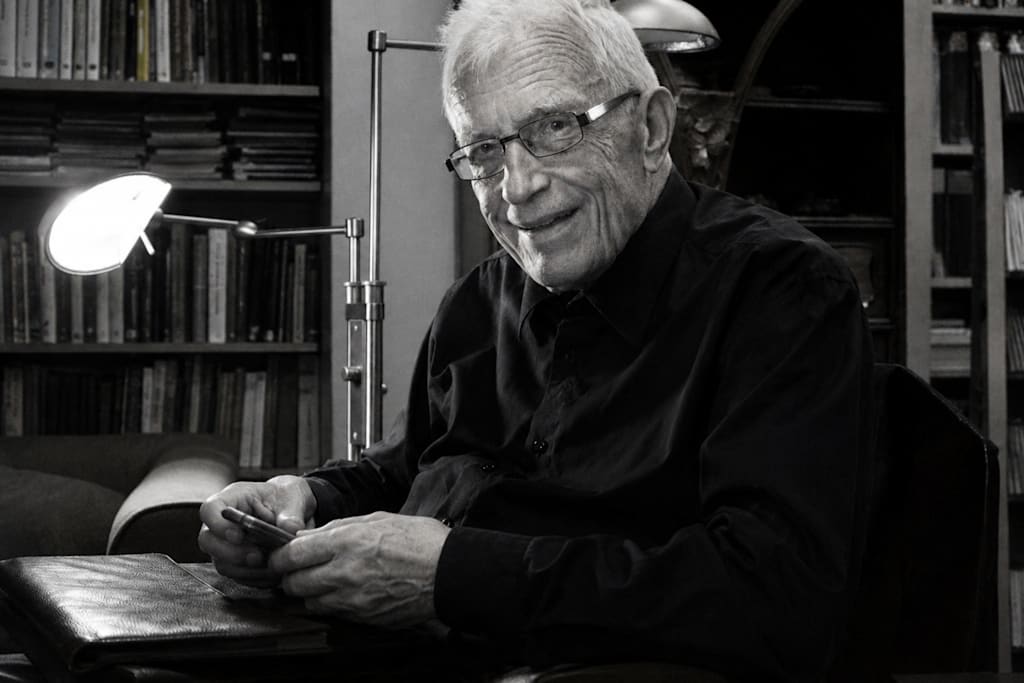
Since Hermann Schmitz's death, my memory of him has condensed into an image of even greater vividness – the forward-leaning posture, the lucid, friendly, inquisitive gaze, the genuine interest in substantive understanding without regard to the person, the constant task of reflecting on our place in our surroundings... all this has left a deep, indeed indelible, impression that has not only profoundly influenced my thinking but also my life's path.
I bid farewell to Hermann Schmitz with deep gratitude. May his life's work have a far-reaching impact.
About the Creator
Dr Adnan
medical doctor
Enjoyed the story? Support the Creator.
Subscribe for free to receive all their stories in your feed.
Comments
There are no comments for this story
Be the first to respond and start the conversation.