
Before John, There Was Wolf
How the Church erased a thousand years of naming freedom — and gave us Smith, Johnson, and a billion Johns.
I
If a learned ancient Chinese scholar, well versed in the art of naming taboos, had walked into a Merovingian Frankish market in the year 600, he would have found the barbarians' names rather agreeable.
Among the shouts he would have heard names like "Bealdwine" (meaning "bold friend"), "Hreodbeorht" ("shining glory"), and "Wulfsige" ("wolf's victory"). These were free combinations of two meaningful elements, much like Chinese two‑character names such as Xiuwen (cultured civility) or Zhenwu (martial prowess). You picked two good characters, put them together, and that was the parents' hope for the child. Nothing more.
He might even have thought that these blond, blue‑eyed forest dwellers were far more relaxed about naming than his own contemporaries back east, who had to go to such lengths as omitting strokes in writing the emperor's name to avoid committing a taboo.
But if that scholar had dozed off and woken up outside a Norman church in the year 1100, he would have thought his ears were failing him.
He would have heard almost nothing but "John," "Peter," "Mary," and "Anna." The entire street – no one had a name beyond a couple of dozen.
It wasn't that their parents were lazy. It was that they had no other choice.
II
In 313 AD, the Edict of Milan was promulgated. Christianity became legal.
What followed in Europe after the fourth century was this: the Germanic barbarians who had conquered Rome militarily now found themselves, in spirit, thoroughly reconquered by Rome's Christianity. The Franks, the Anglo‑Saxons, the Lombards, the Visigoths – one after another, they knelt before the baptismal font.
But when they knelt, they did not throw away their own names along with their old gods.
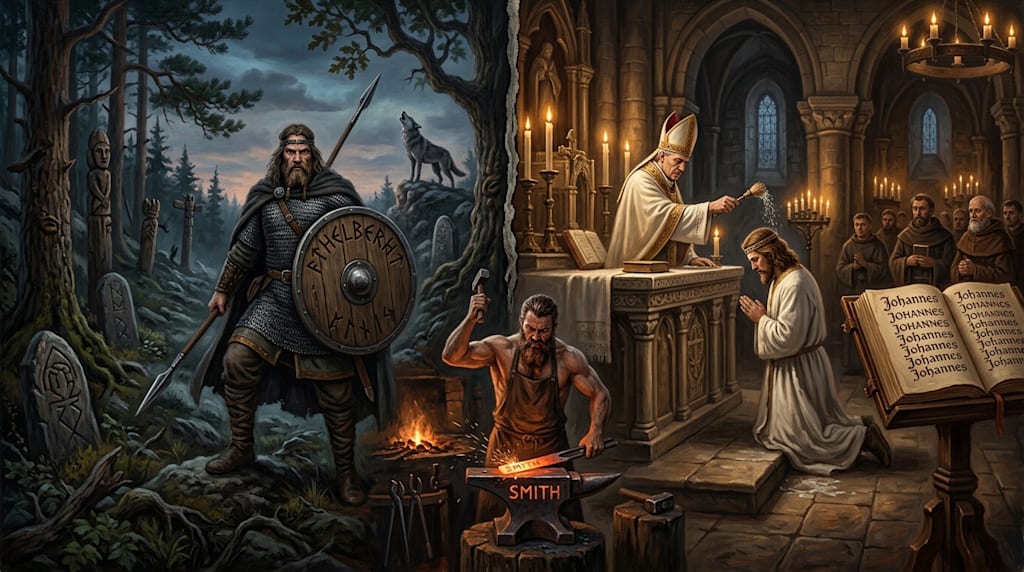
In 597, Pope Gregory I sent the missionary Augustine to the kingdom of Kent in England. King Æthelberht of Kent became the first Anglo‑Saxon monarch to be baptised. His name, Æthelberht, breaks down into "noble" and "bright" – a genuine Germanic compound name of the wolf‑and‑bear variety. After his baptism, church records noted him as "Æthelberht, also called John."
This was the dual‑track system.
Around the same time, the Frankish Merovingian royal house did the same. Princess Bertha brought her own personal bishop to Kent when she married King Æthelberht. She gave her daughter a purely Christian saint's name, "Mary," but her eldest son had to inherit the Germanic compound name "Eadbald" – "wealth" plus "bold," meaning "bold defender of property."
The reason: the father needed the eldest son to carry this name, rich in pagan colouring, to maintain legitimate rule over the traditional warrior class. The mother wanted her daughter to have a saint's name, to ensure her soul had connections in heaven.
A draft of a Frankish will from the seventh century contains this wording:
"I hereby bequeath the estate on the banks of the Loire to my eldest son Hreodbeorht, who is also known at the baptismal font as Johannes."
The judges who invented this parallel spelling were not motivated by any magnanimous cultural tolerance. It was simply to prevent relatives from later exploiting the ambiguity of "which son do you mean?" in inheritance lawsuits.
III
The dual‑track system lasted for about four hundred years.
Around 800, Charlemagne promulgated the Lex Salica Caroli, decreeing that all imperial subjects must use a single, unified identity in church registers and secular legal documents.
Charlemagne's own name, "Charles," derives from the Germanic element meaning "free man," but he used imperial authority to turn this otherwise common Germanic name into an exclusive royal brand. At the same time, he elevated "Louis" to the royal standard. Under the emperor's aggressive endorsement, nobles across the Frankish empire vied to name their sons "Charles" or "Louis" – which, at the time, was a politically very safe gesture.
But that was only the appetiser.
In 1563, the Catholic Church convened the Council of Trent. This council was not merely a religious manifesto against the Protestant Reformation; it was also an act of social control that reached deep into the cradle and the womb.
The new regulations were as follows:
Within days of birth, parents had to choose godparents – one male, one female, no more. Parents and godparents would present the infant in the church narthex before the parish priest. The priest would review the name proposed by the parents.
If it was John, Peter, Paul, Mary, Anna – approved.
If it was Jupiter, Venus, Hercules – rejected. Graeco‑Roman mythology was pagan.
If it was an ancient Germanic hero's name, or any local name containing elements like "wolf," "bear," or "spear" – rejected. Pagan colouring, immoral.
If the parents insisted, the priest had the authority to impose the name of the saint whose feast fell on the child's birthday, according to the calendar of saints.
Then the priest was required to take out the parish Liber Baptizatorum (Baptismal Register) on the spot and write in Latin: the child's saint name, the exact date of birth, and the legal names of the parents. Two copies were made – one kept in the church, one sent to the diocesan archbishop's office.
In those days, the secular kingdoms of Europe had no civil registry. This baptismal record from the church was a person's only legal proof of identity.
When the priest wrote the final entry and closed the leather cover of the register, a thousand‑year era of free naming officially came to an end.
IV
The consequences came swiftly.
From the late sixteenth to the eighteenth century, the European name pool had been compressed to about two hundred saint names. In some English parishes, the proportion of newborn males named "John" reached 40%; females named "Mary" exceeded 25%.
Imagine the reality: a parish had twelve adult men named "John." At Mass, when the priest said "John, come read the lesson," six men stepped forward at once.
The legal complications were even worse. A deed said "John owes five pounds." The creditor meant John the miller, but the debtor was John the smith's son. Same name. The court hit a deadlock. In inheritance cases, old John died, leaving seven sons, three of whom were also named John (distinguished by middle names or nicknames). To which "John" did the document refer?
This naming disaster slapped a brutal choice across European faces: you must invent a second name, on top of the first.
So people began distinguishing each other by occupation:
John the blacksmith → John Smith
John the baker → John Baker
John who lived by the hill → John Hill
By patronym:
John, son of old Tom → Johnson
Son of old Will (William) → Willson or Williams
By physical traits:
Red‑haired John → John Redhead
Tall John → John Longfellow
These "nicknames" were passed down from generation to generation and became fixed surnames.
The scarcity of first names forced an abundance of last names. The diverse systems of European surnames – occupational, locational, patronymic – were essentially born out of a name pool of only about two hundred options.
In 1803, Napoleon signed the Law of 11 Germinal Year XI on Names, codifying the matter into national law. It stipulated that when parents registered a newborn at the civil registry, they could only choose names found in the "calendar" (i.e., the calendar of saints) and "names of ancient historical figures." Any invented name, dialect name, or gender‑reversed name could be lawfully refused by the registrar.
This law ran in France for 190 years.
V
So the question returns: the Chinese observed naming taboos for millennia, refusing to allow anyone even to use a single character from the emperor's name. Westerners, on the other hand, not only avoid no such taboos but eagerly put saints' names on their own heads. Did they not find it offensive?
To answer that, we must first understand what the Chinese taboo was actually avoiding.
The root of the Chinese naming taboo lay in patriarchal hierarchy. The names of the emperor and ancestors were unique. That character, that pronunciation, belonged exclusively to that person, like a flag planted on a plot of land. For anyone else to mention it was an act of usurpation. This was prohibitive power. The closer a name stood to the sacred core, the more one had to walk around it.
The root of the Western practice of sharing saints' names lay in the Catholic doctrine of the Communion of Saints. Put simply: the saints in heaven are not cold, distant models; they are living, capable, and willing protectors.
When parents named their son "John," they were not grabbing the apostle by the collar and shouting "come down here." They were making a very humble gesture: place my child under your name, and please watch over him.
To share a name is to share protection.
The Council of Trent's enforcement of saint‑calendar naming had this same underlying logic. The priest was not trying to make everyone's name uniform (that was the observed result, not the intention). He was ensuring that from the moment each worldly newborn fell into the baptismal water, a legal‑theological bond of protection was established with a particular saint in heaven.
The Chinese practised avoidance – avoidance of offence. The Westerners practised approach – approach for protection.
Two paths that diverged at the source could not, after fifteen hundred years, meet at the same terminus.
VI
At the end of the twentieth century, the path was finally pried open.
In 1993, the French National Assembly voted to repeal Napoleon's Law of 11 Germinal. The lock that had kept French names confined to the calendar of saints for 190 years was removed. Parents regained the freedom to choose names. A baby in Paris could be called "Kevin," "Brian," or even "Melville" – provided the registrar confirmed it was not discriminatory or offensive.
In 2008, the German Federal Constitutional Court overturned, by precedent, the long‑standing rule that "a name must clearly indicate gender." Gender‑neutral names were permitted. The last barrier of Germany's centuries‑old naming law fell.
What did this mean?
Today, young parents registering a child's birth in Berlin, Paris, or London have regained the freedom that their Germanic ancestors possessed before converting to Christianity – the freedom to take a "wolf" and a "victory," put them together, and create a name that had never existed before.
After fifteen hundred years, Europeans had come full circle.
VII
One final image.
In 597, outside Canterbury Cathedral, King Æthelberht of Kent stood before Augustine, ready to kneel for baptism.
His Germanic name, Æthelberht, broke down into "noble" and "bright." His ancestors in the forests had used those two elements to call out to his grandfather, his great‑grandfather, his great‑great‑grandfather. This name belonged to the bloodline that had wandered between the Rhine and the Elbe.
As Augustine scooped up a handful of holy water, he said: "From now on, your name in heaven is 'John.'"
Æthelberht knelt.
But when he stood up, walked back into his wooden hall, sat upon his throne, and faced his warriors – he was still called Æthelberht.
The dual‑track system preserved one last complete body here. That body was later cut in half on the right by Charlemagne's code, stitched on the left by Trent's registers, and cast into a single iron plate by Napoleon's Law of Germinal.
Now the plate is cracked.
But every time we call out "John," every time we hear a German named "Hans," a Frenchman named "Jean," a Russian named "Ivan," or an Irishman named "Seán" answer "yes" –
what we are hearing, in truth, is one and the same sound:
The thud of Æthelberht's knees hitting the stone floor.
About the Creator
Jin
Writer of reamstories
https://reamstories.com/jin
Enjoyed the story? Support the Creator.
Subscribe for free to receive all their stories in your feed. You could also become a paid subscriber, letting them know you appreciate their work.
Comments
There are no comments for this story
Be the first to respond and start the conversation.