proposal
A marriage proposal is one of the scariest and most exciting things people ever do—stories, advice, and more live here.
Crazy Love
Crazy Love The "neoliberal" urban middle class, defined as those born in the late 1980s and early 1990s, is often regarded to have different matchmaking experiences. This is due to the fact that they are pushing the marriage age to the late 20s and early 30s, as well as the fact that technology is increasingly dictating how individuals experience romance. Swiping "right" or "left" and/or sending "interests" on matrimonial services, for example, are increasingly being used to initiate romantic and matchmaking encounters. People fall in love for companionship which is gradually shifting to something that people learn while they are already living together. This aspect alone has led to increase in number of failed marriages and relationships. In this passage I will present a love story of a person that I respect and grown to understand his decision making process. The first meeting between two potential spouses now necessarily takes place in the virtual world. Several young people are starting a conversation on matrimonial websites' chat features, or on WhatsApp, Instagram DM, or Facebook Messenger. This means that two people are getting to know each other while relaxing in their own homes or offices. My friend is true description of a youthful, neoliberal middleclass, who happen to embrace virtual dating. He met his wife on a dating site, where they began conversing right after she matched his aspects. My friend is a shy person and internet emotions brought relief to people like him, since they can easily overcome the hesitation and shyness with online/faceless interaction. With the growing number of online dating site, the original match makers like friends, parents, and relatives are being replaced by match making agencies. With match making agencies all over the internet, chances of going through the traditional courtship process diminish. My friend did not go through the hectic courtship process where before a man got the contacts of a girl he liked, went through thick and thin. Failing to take the process of courtship, diminishes the chances of learning the other partners characters which can later lead to regular disagreements. It did not take long before my friend was swept away by this lady, and at the age of 31, they started living together. If I recall very well it took less than five months from the time she replied his first text. Combining of two social networks is supposed to provide individuals with increased access to social resources, which is one of the frequently stated health benefits of marriage. Married people or couples that live together on the other hand, may not be taking advantage of these social resources to their full potential. Several have less interaction with their family, companions, and neighbors than their unmarried partners. Albeit wedded couples might turn out to be more detached as they turn to one another, challenges of combining two diverse sets of relatives and friends may also contribute to less contact a bigger social network. Therefore, when my friend started living with his girlfriend, they hardly had mutual friends because they met online and not through a mutual contact. The longer people are together, the more "interdependent" their friendship networks become, with mutual friendship being seen as a sign of relationship commitment. The notion is consistent with research that shows how loved ones might altogether affect heartfelt connections, both directly (by giving or keeping acknowledgment and backing for the relationship) and by implication (by going about as a sounding board for conjugal issues). The endorsement of a close relationship by network individuals is a strong indicator of its quality and steadiness, with female friends' approval appearing to be particularly crucial. Furthermore, opinions of affection and responsibility, just as relationship fulfillment and soundness, have been connected to continued positive help of the relationship from one's own and one's accomplice's network. Even the perception of a more supportive network help the marriage, as higher perceived social friendship network has been related to a lower aim for separation and detachment. The downfall of their relationship began after five years of living together. A relationship that had made me trust dating sites was on a rocky ground. My friend cited destructive conflict as the major reason for the downfall. Some hidden characters of his spouse started to show up right after they got their first born. Suddenly they were not in agreement even on slightest things like how to dispose their baby’s diapers. With constant disagreements in the house, he had no other option but to always get home late. Additionally, his wife was telling her close friends more about their marriage which made him uncomfortable. This emphasizes the role of gender in these interactions. Negative perceptions of the spouse, as well as solutions aimed at dissolving rather than improving the relationship, may trigger emotions of anguish among network members, particularly among wives' female confidantes. With everything out of the closet, they had no reason to push on with their relationship. My friend had to define what he felt was not right between them and recognized the conflicted emotions they were experiencing as a result of this predicament. The biggest puddle was practicing his mindset to ensure his words were not contradictory. Breaking the news on his intention to his spouse was the biggest challenge which he overcame eventually. The two agreed to give each other a break for some time while weighing their options. Taking a break from each other was the suitable solution rather than breaking up, since the two had not grown out love. They needed time away from each other for each to learn the others’ weaknesses and appreciate them. In conclusion, it evident that technology has had a huge impact on our social interaction. Gone are the days where people used to court for years before they live together. Courtship ensured that people took time in learning their partners before committing. Additionally, match makers are crucial for any relationship to thrive because the match makers are the mutual friends and they will do anything they can to keep their matches together. The perception of a supportive mutual friendship network help the marriage, as higher mutual friendship network support has been related to a lower aim for separation and detachment.
By Nicholas Mugambi2 years ago in Marriage
The Devotion System Reviews 2024: (Amy North) How to Make Him Obsessed with You
Introduction to The Devotion System If you're searching for love or trying to bring more harmony into your relationship, you've probably come across many relationship guides. But how do you know which one is worth it? Today, we’re diving into The Devotion System, a popular dating guide aimed at helping women understand the complexities of relationships, find true love, and foster genuine devotion.
By Corad Hernandez2 years ago in Marriage
How do twin flames mirror each other?
Each one of us has a twin flame, and we are destined to cross paths with our twin flame. Some people feel a bizarre sense of recognition, while others describe it as a feeling that they’ve known this person their entire lives.
By Jyotishgher Astrology2 years ago in Marriage
How do see a Boyfriend’s appearance in astrology?
I must say right away that the appearance of the future of the chosen one cannot be determined with 100% accuracy. But with the help of some clues, you can understand what it can be. Take a closer look at your surroundings - maybe your destiny is somewhere nearby?In astrology, you can determine a boyfriend's appearance by analyzing specific houses, planets, and signs in a natal chart. Here's a detailed breakdown of the key factors that influence a Boyfriend's physical appearance:
By Jyotishgher Astrology2 years ago in Marriage
Beyond the Sunset: A Love Story in the Valley of Dreams
I never imagined that my Kullu Manali trip would lead me to the greatest love story of my life. It was the end of October, when the air was crisp, and the mountains had already donned their white winter cloaks. I had always been a solo traveler, enjoying the serenity of the mountains on my own terms. But this time, something was different. Maybe it was the way the setting sun glowed against the snow-capped peaks, or perhaps it was destiny pulling me toward something magical.
By Ansh Dogra2 years ago in Marriage
I Am the Master of the Situation
I Am the Master of the Situation Life is a series of unpredictable events, a journey where certainty is a rare companion. We are often thrust into situations beyond our control, and in these moments, the belief that “I am the master of the situation” becomes our most powerful ally. This statement signifies the understanding that, despite the chaos around us, we possess the strength and resilience to shape our responses and, consequently, our outcomes. Being the master of the situation does not imply that we can control every aspect of life. Rather, it means that no matter what the external circumstances are, we can control our inner world—our thoughts, emotions, and reactions. It is about embracing the power of self-mastery, and through that, gaining the ability to navigate any challenge life presents. Consider the story of Nelson Mandela. Imprisoned for 27 years, he had no control over his external circumstances—he was confined to a cell, cut off from the world, and subjected to severe hardship. Yet, Mandela became the master of his situation by controlling his inner world. He did not let bitterness or hatred consume him. Instead, he used his time in prison to deepen his understanding, foster peace within himself, and envision a future where his nation could overcome the divide of apartheid. By mastering his response to his imprisonment, Mandela shaped the course of history, becoming an emblem of forgiveness and reconciliation. Another inspiring example is that of Malala Yousafzai. Shot by the Taliban for advocating girls' education, she found herself in a situation where her life could have easily been defined by fear or revenge. However, Malala chose to rise above the trauma. She mastered the situation by not only surviving but thriving, using her platform to amplify the voices of those silenced by oppression. Her inner strength allowed her to turn a personal tragedy into a global movement for education, particularly for girls in disadvantaged regions. Everyday people, too, demonstrate this mastery in small but profound ways. Think of a single mother struggling to raise her children while working two jobs. She cannot control the difficulties that come her way—the bills, the exhaustion, the endless demands of life. But by choosing not to give up, by facing each day with courage, she becomes the master of her situation. Her strength lies in her determination, in her refusal to be overwhelmed by circumstances she cannot control. Similarly, students preparing for exams face situations where they may feel overwhelmed by the pressure to succeed. They cannot control the difficulty of the questions, the competitiveness of their peers, or even the examiners' expectations. However, they can control their preparation, their discipline, and their mindset. By focusing on what they can influence, rather than being paralyzed by fear of failure, they become masters of the situation. Mastering the situation also means accepting that failure and setbacks are a part of life. No matter how much we prepare or plan, there will be moments when things don't go our way. The true mastery comes from how we respond to these setbacks. Do we let them define us, or do we rise again, stronger and wiser? In this way, the mastery of any situation is not about never failing, but about how we rise after every fall. One of the most touching examples of this philosophy can be found in the life of Professor Stephen Hawking. Diagnosed with ALS at a young age, Hawking’s body gradually became paralyzed, leaving him in a situation where most would have felt powerless. Yet, Hawking mastered his situation by refusing to let his physical limitations define his intellectual and emotional capacities. He continued to explore the mysteries of the universe, contributing groundbreaking theories and writing bestselling books, despite being unable to move or speak without assistance. His mind remained free, and through his mastery of his internal world, he made contributions to science that will echo for generations. On a more personal level, we all have moments when we feel overwhelmed by life’s demands—when work, relationships, and personal struggles seem too much to bear. It is in these moments that the decision to become the master of the situation is most crucial. We cannot change everything around us, but we can change our perspective. We can choose to face our challenges with resilience, hope, and a willingness to adapt. To be the master of the situation means to trust in our own strength, even when the odds are stacked against us. It is the recognition that no matter what life throws at us, we have the capacity to shape our destiny through our choices. Whether it’s facing illness, loss, financial hardship, or emotional turmoil, the power to navigate through lies within us. In conclusion, “I am the master of the situation” is not just a statement of self-empowerment; it is a way of life. It reminds us that while we may not control our external circumstances, we always have control over how we respond to them. In every challenge, there is an opportunity to grow, to rise, and to define ourselves not by what happens to us, but by how we choose to face it. The mastery of life is not in avoiding difficulties but in mastering ourselves through them, and in doing so, becoming the architects of our own futures.
By Dipak Pawar2 years ago in Marriage
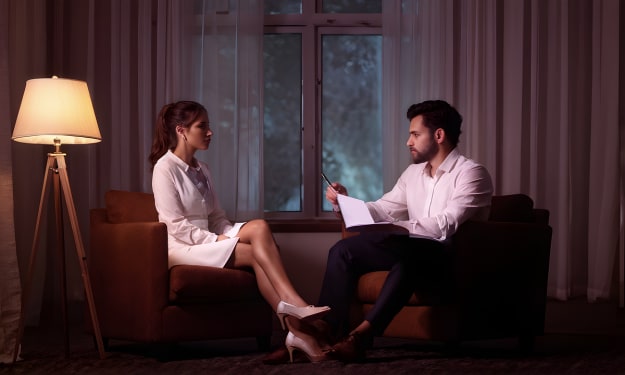
How girls show interests. AI-Generated.
When girls show interest in boys, they often do so in subtle and varied ways. These signs can range from body language to verbal communication, depending on personality, cultural background, and confidence level. Some girls may be more direct, while others may rely on more understated cues.
By Emil Mihov2 years ago in Marriage