
Why Google Search Has Become the New First Impression
The story people find when they search your name online can have a greater impact than the introduction you give yourself.

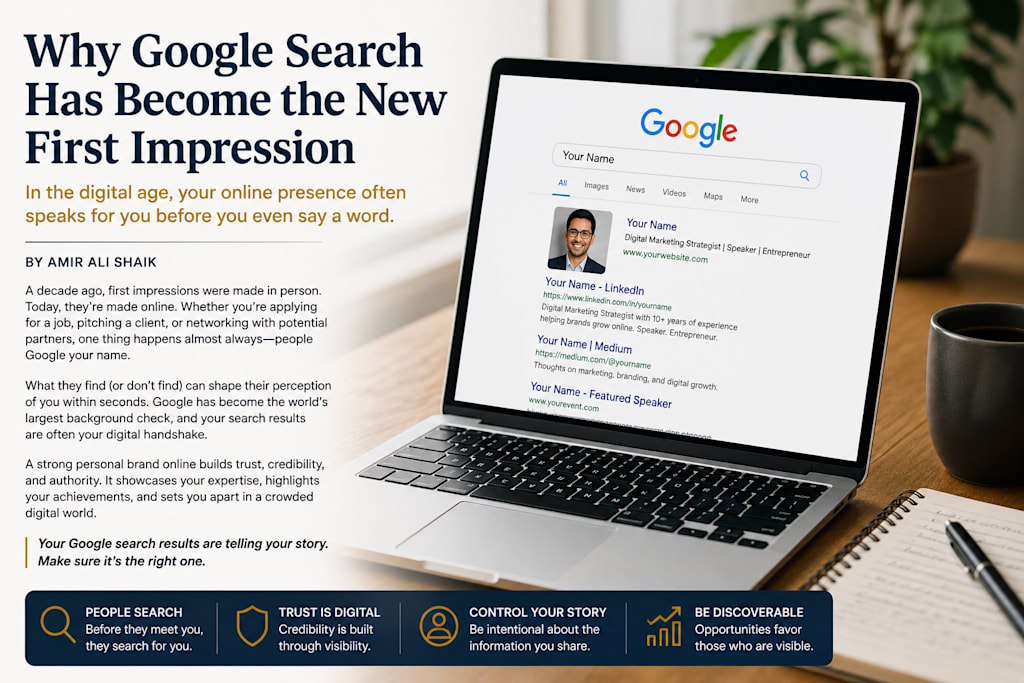
There was a time when first impressions were made in person. You met someone at an event, exchanged a handshake, introduced yourself, and slowly built trust through conversation. Today, that process often begins long before two people ever meet.
It begins with a search bar.
Whether applying for a job, pitching a client, seeking investors, or simply connecting with new people, many individuals are now searched online before they are contacted. A name typed into Google can reveal professional profiles, articles, social media accounts, business affiliations, and public achievements within seconds.
This shift has fundamentally changed the way personal reputation is formed.
In the past, a résumé, business card, or referral served as the primary source of credibility. While those tools still matter, they are increasingly supplemented by digital footprints. When someone searches for a person online, they are often looking for reassurance. They want to know who the individual is, what they do, and whether they appear trustworthy.
The absence of information can be just as impactful as the presence of it.
Imagine two professionals with similar qualifications and experience. One has a well-maintained online presence featuring industry contributions, professional profiles, and evidence of expertise. The other has little to no visible information available online. While both individuals may be equally capable, the first often appears more credible simply because there is more information available to evaluate.
This is one of the reasons personal branding has become increasingly important in the digital age.
Personal branding is frequently misunderstood. The term often brings to mind influencers, content creators, and individuals with large social media followings. However, personal branding is not necessarily about fame or popularity. At its core, it is about creating an accurate representation of who you are and what you do.
For many professionals, personal branding may be as simple as maintaining an updated LinkedIn profile, contributing insights within their industry, or ensuring that professional accomplishments are visible online. The goal is not self-promotion for its own sake. Rather, it is about reducing uncertainty for the people who may one day work with, hire, or invest in you.
Search behavior has become deeply embedded in modern decision-making. Employers routinely research candidates before interviews. Clients investigate service providers before signing contracts. Investors review founders before considering opportunities. Journalists search experts before requesting comments. These actions have become so common that they often occur without a second thought.
Google, in many ways, has become the world's largest reputation database.
This reality has created new opportunities as well as new challenges. On one hand, individuals have greater control than ever before over how they present themselves professionally. Through articles, websites, portfolios, and professional profiles, people can showcase their expertise to audiences far beyond their immediate network.
On the other hand, digital visibility requires intentional effort. Building a meaningful online presence does not happen automatically. It requires consistency, authenticity, and a willingness to contribute valuable information over time.
What makes personal branding particularly significant today is that it extends beyond entrepreneurs and public figures. Professionals across virtually every industry now operate in environments where online credibility matters. Engineers, consultants, designers, marketers, lawyers, educators, and healthcare professionals are all subject to the same reality: people search before they engage.
As artificial intelligence and digital technologies continue to evolve, the importance of online identity is likely to increase. Search engines are becoming more sophisticated, and information is more accessible than ever before. Future opportunities may increasingly depend not only on professional capabilities but also on how easily those capabilities can be discovered and verified online.
The concept itself is relatively simple. When someone searches your name, what story do they find?
The answer does not need to include viral content, thousands of followers, or widespread recognition. It simply needs to provide a truthful reflection of your professional identity.
In a world where introductions often occur digitally before they happen personally, Google search results have become more than a collection of links. They have become a modern form of first impression.
And first impressions, whether online or offline, continue to matter.
About the Creator
Amir Ali Shaik
Amir Ali Shaik is an Indian digital entrepreneur, business strategist, and actor who is currently based in Dubai, United Arab Emirates. Born on July 26, 2001, in Bengaluru, India.
Enjoyed the story? Support the Creator.
Subscribe for free to receive all their stories in your feed.
Comments
There are no comments for this story
Be the first to respond and start the conversation.