
Why Does Camera Placement Matter More Than Camera Quality in Home CCTV?
Smart Indoor Camera Placement for Families and Home Monitoring

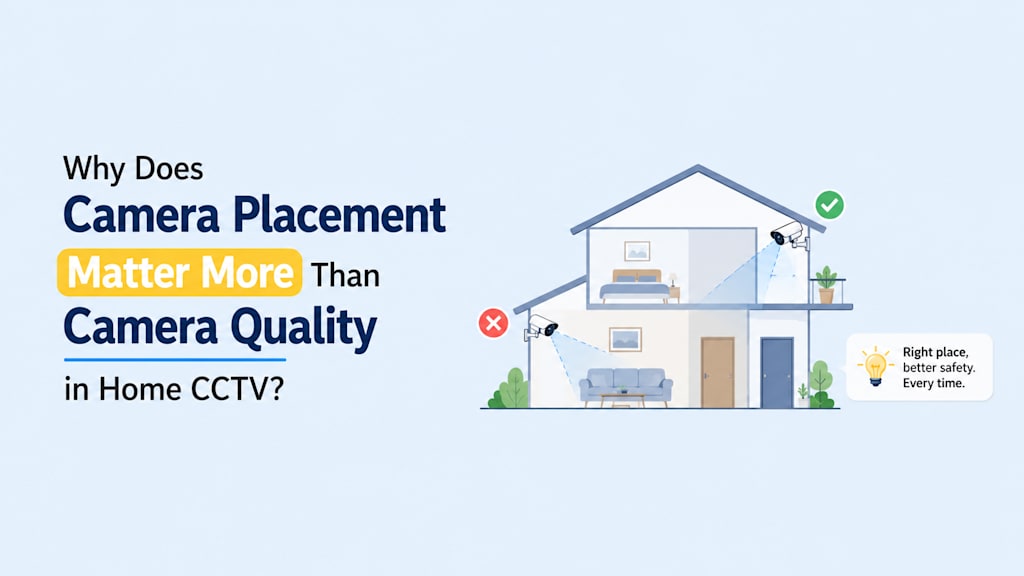
Most people buying a CCTV system spend the majority of their time comparing camera specs. Megapixels, night vision range, frame rate, and brand. These things matter, but they are secondary to one factor that rarely gets the attention it deserves - where the camera is pointed and how it is mounted.
A 4K camera installed in the wrong location will deliver crystal-clear footage of a wall or ceiling. A well-placed 1080p camera will capture everything you actually need. Placement is the single biggest variable in whether a CCTV system does its job.
The Most Common Placement Mistakes
Walk through any HDB estate or condo development in Singapore, and you will spot the same errors repeated. Cameras mounted too high and angled too steeply, so facial features are never visible. Cameras facing bright windows, which creates silhouette footage where you can see a person-shaped shadow but nothing else. Cameras pointing at entry doors from too far away, so a person appears as a small figure with no identifiable features.
These are not equipment failures. The hardware is working exactly as designed. The installation is simply in the wrong place.
How Entry Points Should Be Covered
The primary purpose of a home CCTV installation is to monitor entry and exit points - main door, back door, gate, and garage. For each of these, the camera needs to be positioned to capture a clear frontal view of anyone passing through.
For a main door, this typically means mounting the camera 2.5 to 3 metres high and angling it downward to capture face height at a distance of 1 to 2 metres from the door. Too high and the angle becomes too steep. Too far back and the subject is too small in the frame. A professional will measure this before drilling a single hole.
Coverage Zones and Blind Spots
Every camera has a field of view determined by its lens angle. Wide-angle lenses (110 to 130 degrees) cover more area but distort objects at the edges. Narrower lenses (60 to 90 degrees) provide more detail over a smaller area. Choosing the right lens angle for each location depends on what you are trying to capture and at what distance.
A common mistake is assuming one wide-angle camera can cover an entire open area like a carport or garden. In practice, the distortion at the edges makes it hard to identify people or objects reliably. Two cameras with narrower fields of view, positioned to overlap slightly, will deliver better results than one wide-angle unit covering the same space.
Lighting and Camera Placement Work Together
Night vision on modern cameras is impressive, but it has limits. Infrared night vision works well in complete darkness, but it struggles when there is a mix of artificial light and shadow, which describes most Singapore void decks, corridors, and gardens at night.
Placing a camera to avoid direct light sources in its field of view makes a significant difference. A camera mounted above a front gate should not be pointing into a street lamp. Ideally, it faces a direction where the lighting behind the camera illuminates the subject rather than blinding it.
Indoor Placement for Home and Helper Monitoring
Many families in Singapore install indoor cameras for child safety, elderly care, or to monitor domestic helpers. For indoor use, the height and angle considerations are different. A camera monitoring a living area or kitchen is most effective when mounted in a corner at ceiling height, angled to cover the whole room rather than a single spot.
Audio-capable cameras add another dimension to indoor monitoring. Positioning them where they can pick up ambient sound clearly - not directly under an aircon unit, for instance - improves the usefulness of the footage significantly.
Why This Connects to Your Whole Home Network Plan
IP cameras depend on your home network to transmit footage. A poorly structured network affects camera reliability just as much as it affects any other connected device. If you are planning a CCTV installation as part of a broader renovation, your home network setup Singapore professionals should be involved from the start.
Cameras in remote locations like car porches, gates, or storerooms need either wired Ethernet connections or strong WiFi coverage to those exact spots. If the network does not extend reliably to those areas, you will end up with cameras that go offline frequently or deliver choppy footage. Planning both together, network and camera placement, prevents those problems before they start.
What a Professional Site Survey Covers
A professional CCTV consultant does not arrive with a plan - they arrive to make one. A proper site survey for home CCTV installation covers:
- Walking every entry and exit point to identify optimal camera positions
- Assessing lighting conditions at different times of day
- Identifying potential blind spots and how to address them
- Checking cable run options to avoid exposed wiring
- Confirming network coverage at each proposed camera location
The output is a placement plan that tells you exactly how many cameras you need, where they go, and what type suits each location. This replaces the guesswork that leads to systems that look complete but miss the exact moment they were meant to capture.
The Upgrade Trap
Some homeowners who are unhappy with their CCTV system's performance buy higher-resolution cameras or add more units without changing the placement logic. The footage gets sharper, but the coverage gaps remain. More cameras pointed in the wrong directions still miss what matters.
Before upgrading any equipment, have a professional review your existing camera positions. Often, a repositioning and reconfiguration of what you already have delivers a better result than a hardware upgrade.
FAQ
How high should a CCTV camera be mounted at a front door?
Around 2.5 to 3 metres is the standard recommendation for residential entry points. This gives a clear downward angle that captures facial features without the image becoming too steep to be useful.
Do I need a camera inside my home if I have cameras at all entry points?
Entry coverage handles intrusions, but indoor cameras serve different purposes - monitoring children, elderly relatives, or household help. Whether you need them depends on your specific household needs, not just security considerations.
Can WiFi cameras replace wired ones for outdoor use?
WiFi cameras work well outdoors when network coverage is strong and stable at that location. For areas at the edge of WiFi range, a wired Ethernet connection is more reliable, especially for cameras that record continuously.
About the Creator
Nick William
Nick William, loves to write about tech, emerging technologies, AI, and work life. He even creates clear, trustworthy content for clients in Seattle, Indianapolis, Portland, San Diego, Tampa, Austin, Los Angeles, and Charlotte.
Enjoyed the story? Support the Creator.
Subscribe for free to receive all their stories in your feed.
Comments
There are no comments for this story
Be the first to respond and start the conversation.