
Which One Is Right For You: Hand Blender vs. Mixer Grinder?
Make your best choice between Hand Blender and Mixer Grinder, Read More
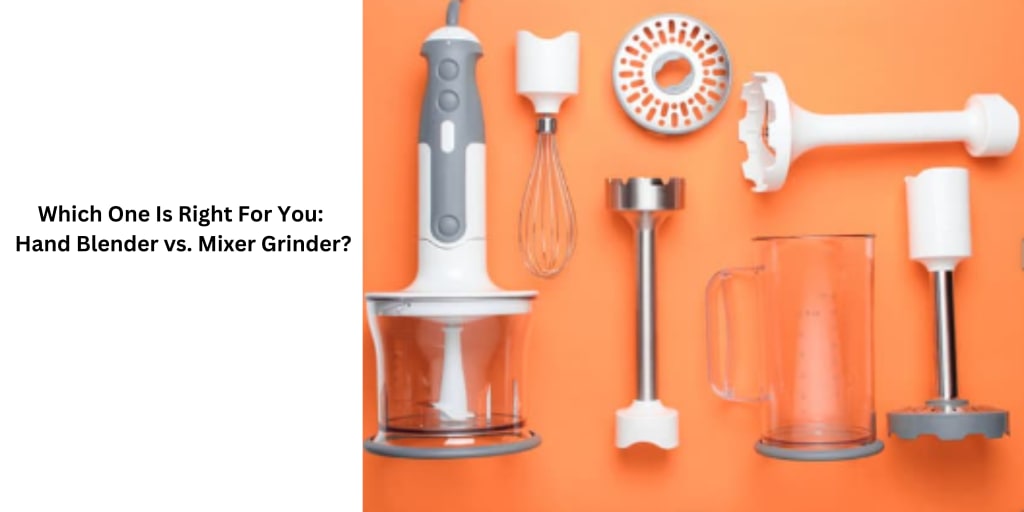
Kitchen appliances have become quite a need of the hour and have been part of every household since decades. However with all the variety of mixer grinders, blenders and models doing rounds in the market, one could perhaps be wondering what is best for their kitchen to upgrade to a more efficient and effective appliance. Choosing between a hand blender and a mixer grinder can be a tough decision if you are not sure what are the pros and cons of each and what could suit your requirement.
Let us explore here the features and capabilities of a mixer grinder and hand blender to understand them better.
Hand Blender
A hand blender is a slender, long appliance that has a motor at the bottom and a blending attachment at the top and is best used for blending, puréeing food and beverages directly in the pot or bowl, it is intended to be held in the hand. A hand blender is the ideal appliance for cramped or small kitchens due to its extreme compactness and can be stored anywhere.
Mixer Grinder
A mixer grinder is a powerful appliance with a motor and a blade attachment for grinding and mixing. It typically includes a variety of jars that can be used for a variety of tasks, like grinding spices, making chutney, and blending smoothies.
Here are few differences between each of them
1. Power Consumption
Power and capacity are two major distinctions between hand blenders and mixer grinders. Hand blenders from Orpat use less power of about 250-700W whereas mixer grinders typically use between 650W and 1200W. Orpat hand blenders are better suited for smaller tasks like blending a smoothie or pureeing some soup, crushing grains or nuts, dips for breads and pizzas and smoothies.
2. Size
The size of the jars that come with the two appliances is another difference. While mixer grinders come with a variety of jars of various sizes and shapes, Orpat hand blenders come with a single, narrow blending attachment.
As a result, mixer grinders are more adaptable and can perform a wider range of tasks, including juicing, making chutneys, and grinding spices. On the other hand, hand blenders are better suited for blending and pureeing because of their limited capabilities.
3. Usability
Hand blenders come with an advantage because they are light, simple to use, don't take up much counter space and can be stored anywhere. They are best used to make smoothies, soups, sauces and plunges. On the other hand, mixer grinders are larger, heavier, and are not as easy as blenders to use. They can grind whole spices, grains, and pulses and take up more counter space.
4. Price
Price factor is an element to consider while choosing a hand blender and mixer grinders. Typically, hand blenders are less expensive, costing between Rs. 500 and 3000 whereas mixer grinders can cost somewhere in the range of Rs. 2000-7000.
We saw here what hand blenders and mixer grinders are, and how they compare with one other in terms of essential factors to consider when making a purchase. A hand blender is a good option if you want a lightweight, easy-to-use tool for basic blending and pureeing tasks and a mixer grinder, on the other hand, might be a better choice if you need a more powerful appliance for grinding and mixing a wider variety of foods. Both come with their own pros and cons.
Orpat has some of the best mixer grinder and hand blenders collection for you to explore and make the choice. Login to orpatgroup.com and pick what suits your budget and needs the best.
About the Creator
Enjoyed the story? Support the Creator.
Subscribe for free to receive all their stories in your feed.
Comments
There are no comments for this story
Be the first to respond and start the conversation.