
Watching YouTube Videos Is Starting to Feel Different
AI summaries are changing how we deal with long videos, not by replacing watching entirely, but by helping us decide what deserves our attention.

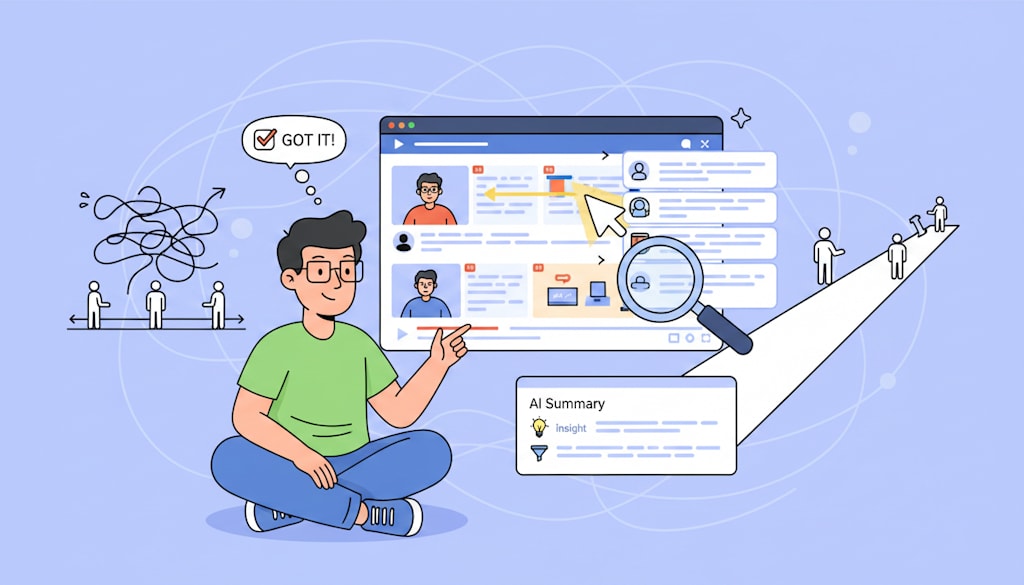
A year ago, most people used YouTube the same way.
Open a video.
Start watching.
Skip ahead.
Miss something important.
Scroll back.
Repeat.
It worked.
Mostly.
But after spending more time with long-form content lately, I’ve started noticing a different pattern.
The problem isn’t finding information anymore.
The problem is extracting it.
A 45-minute interview might contain three useful insights.
A one-hour podcast might answer a question in two minutes.
A tutorial might spend half its runtime covering things you already know.
The challenge has quietly shifted from access to efficiency.
And that changes how people interact with video entirely.
Long Videos Aren’t Actually the Problem
At first, I assumed attention spans were getting shorter.
Now I’m not so sure.
People still listen to three-hour podcasts.
They still watch lengthy documentaries.
They still binge educational content.
The issue is different.
People want control.
They want to decide where to spend their attention.
Not every video deserves a full viewing session.
Sometimes you simply want the key takeaways.
Sometimes you want to verify whether a video is worth watching at all.
That’s where video summarization starts becoming surprisingly useful.
The Transcript Matters More Than I Expected
What surprised me most wasn't the summary itself.
It was the transcript.
Having a searchable transcript with timestamps changes the experience dramatically.
Instead of dragging the timeline randomly, you can immediately jump to the section discussing the exact topic you're interested in.
A single sentence becomes a navigation tool.
A timestamp becomes a shortcut.
The video stops feeling linear.
It becomes searchable.
Almost like reading a document instead of consuming media.
That shift sounds small.
In practice, it saves a surprising amount of time.
Summaries Work Best as Filters
One thing became obvious very quickly.
AI summaries aren't replacements for videos.
They're filters.
A good summary helps answer one question:
"Do I need to watch this?"
Sometimes the answer is yes.
Sometimes the answer is no.
Sometimes the summary reveals exactly the information you were looking for.
Other times it helps identify the five-minute segment worth watching.
Either outcome is useful.
The value isn't necessarily in avoiding videos.
It's in approaching them more intentionally.
Browser-Based Tools Feel Less Disruptive
I’ve tested several approaches for summarizing YouTube content.
Browser extensions.
Desktop software.
Download-and-process workflows.
The solutions that felt most natural were usually the simplest ones.
Paste a link.
Wait a few seconds.
Read.
That's it.
No installation.
No exporting files.
No switching between applications.
Tools like AudioConvert fit naturally into existing workflows because they remove friction rather than adding features.
You stay in the browser.
The process feels almost invisible.
There Are Still Limits
Of course, summaries aren't perfect.
Some videos depend heavily on visuals.
Others rely on demonstrations, charts, or emotional delivery that transcripts can't fully capture.
Context occasionally gets compressed.
Nuance can disappear.
And sometimes a creator's personality is the entire reason people watch.
No summary can replace that.
But for educational content, interviews, podcasts, lectures, product reviews, and many business-related videos, the tradeoff often feels worthwhile.
Especially when time is limited.
The Real Shift Is Toward Information Navigation
After using these tools more regularly, one thing stands out.
The future probably isn't about watching less video.
It's about navigating video more effectively.
Search transformed websites.
Transcripts transformed audio.
Video seems to be moving in the same direction.
We're gradually treating videos less like streams of content and more like information libraries.
Searchable.
Skimmable.
Structured.
Easy to revisit.
Maybe that's the biggest change happening right now.
The most useful YouTube experience isn't necessarily watching faster.
It's finding exactly what matters faster.
About the Creator
Enjoyed the story? Support the Creator.
Subscribe for free to receive all their stories in your feed.
Comments
There are no comments for this story
Be the first to respond and start the conversation.