
Want to Refinance Your Home in 2026? Here’s How to Know When It Makes Sense
How to Evaluate Mortgage Rates, Home Equity, Closing Costs and Long-Term Savings Before Refinancing in 2026

For homeowners watching mortgage rates in 2026, refinancing can look like an obvious way to reduce housing costs. But a lower advertised rate does not automatically mean replacing your existing mortgage will save money.
Refinancing means taking out a new mortgage to pay off your current home loan. The new loan may have a lower interest rate, a different repayment period or a larger balance if you choose to take cash out of your home equity. Because the transaction includes closing costs and can reset your repayment timeline, homeowners should consider the full financial picture rather than focusing solely on the new monthly payment.
Lisa Lund, Mortgage Broker at Lund Mortgage Team, says homeowners should start by identifying exactly what they want refinancing to accomplish. A homeowner trying to lower monthly expenses may need a very different refinance structure than someone trying to pay off a home sooner or access accumulated equity.

That goal-first approach is particularly important in 2026, when refinancing opportunities can vary significantly depending on when the homeowner originally purchased the property or last refinanced it.
Why Homeowners Refinance Their Mortgages
Lowering the mortgage rate is probably the best-known reason to refinance a home. A homeowner who purchased when rates were substantially higher may be able to replace that mortgage with a lower-rate loan and reduce monthly principal and interest payments.
But refinancing can accomplish other goals.
Homeowners may refinance to shorten their mortgage from a 30-year loan to a 15- or 20-year term, potentially reducing lifetime interest expenses and building equity faster. Others refinance from an adjustable-rate mortgage into a fixed-rate loan because they prefer predictable payments.
A cash-out refinance offers another possibility. Homeowners with sufficient equity can replace their existing mortgage with a larger loan and receive the difference in cash. Those funds might be used for renovations, major household expenses, or consolidating higher-interest debt.
However, accessing equity also increases the amount secured against the home. The benefits, therefore, need to be weighed against the additional debt and financing costs.
Start With Your Current Home Loan
Before comparing refinance offers, homeowners should understand the mortgage they already have.
Gather your current interest rate, outstanding balance, remaining loan term and monthly principal-and-interest payment. Then compare those numbers with potential refinance scenarios.
This is where homeowners sometimes make an expensive mistake.
Imagine someone has already spent seven years paying down a 30-year mortgage. Refinancing the remaining balance into another 30-year loan could reduce the monthly payment, but it also extends repayment over a new three-decade period.
Holden Lewis, Senior Writer/Spokesperson at NerdWallet, who specializes in mortgages and homebuying, has highlighted this tradeoff when discussing refinancing into another 30-year mortgage. Extending the repayment timeline can provide immediate payment relief, but homeowners can ultimately pay considerably more interest over time.
Instead of comparing monthly payments alone, compare the remaining cost of your existing mortgage against the total cost of the proposed refinance.
Calculate Your Refinance Break-Even Point
One of the most useful numbers when evaluating a home refinance is the break-even point.
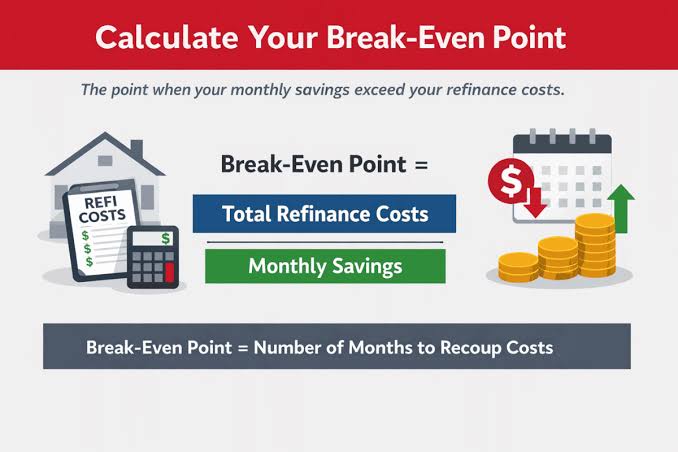
Refinancing isn't free. Depending on the loan and lender, homeowners may encounter origination charges, underwriting costs, appraisal fees, title expenses, recording fees and other closing costs. Recent estimates commonly place refinance closing costs at roughly 2% to 5% of the new loan amount, although actual expenses vary.
The basic break-even calculation is straightforward:
Total refinancing costs ÷ monthly savings = months to break even
Suppose refinancing costs $7,000 and the new mortgage saves you $280 per month.
$7,000 ÷ $280 = 25 months.
You would need to keep that mortgage for approximately 25 months before the accumulated monthly savings recover your upfront refinancing expenses.
If you expect to sell your home next year, that refinance probably isn't particularly attractive. If you expect to remain in the property for another decade, the long-term savings could be much more meaningful.
That's why the break-even calculation is more informative than simply asking whether mortgage rates have fallen.
How Much Does Your Rate Need to Drop?
Homeowners sometimes hear that mortgage rates must fall by a full percentage point before refinancing becomes worthwhile.
It's a useful rule of thumb, but not a universal rule.
Recent guidance suggests that a reduction of roughly 0.75 to 1 percentage point can make refinancing worth investigating, while even smaller reductions can sometimes work depending on the mortgage balance, fees and how long the homeowner expects to keep the property.
Consider two homeowners who both reduce their mortgage rate by 0.75 percentage points.
One owes $90,000.
The other owes $600,000.
Their potential dollar savings will be dramatically different even though their interest-rate reductions are identical.
Lund emphasizes personalized mortgage solutions rather than treating every borrower the same. Her team's refinancing guidance considers a homeowner's current mortgage, financial objectives and potential savings opportunities before evaluating which refinance structure may fit.
Your loan balance, credit profile, equity, closing costs and expected time in the home can therefore matter just as much as the headline interest rate.
Should You Choose a Shorter Mortgage?
Refinancing can also be an opportunity to rethink how quickly you want to own your home outright.
Suppose you have 25 years remaining on your mortgage. Instead of refinancing into another 30-year loan, you might consider a 20- or 15-year mortgage.
A shorter term usually means higher monthly payments, but more of your money goes toward eliminating the debt quickly. You may also receive a lower interest rate and substantially reduce the amount of interest paid over the life of the mortgage.
The tradeoff is cash flow.
A larger mortgage payment leaves less room in the monthly budget for emergencies, retirement contributions, investments, home maintenance and other expenses.
Another possibility is refinancing into a term close to your remaining mortgage period. A homeowner with 22 years remaining, for example, might investigate a 20-year refinance rather than automatically restarting at 30 years.
When a Cash-Out Refinance Could Make Sense
Rising home values over recent years have left many homeowners with substantial equity.
A cash-out refinance allows homeowners to convert some of that equity into accessible funds. Instead of refinancing only the remaining mortgage balance, the homeowner takes out a larger mortgage and receives part of the difference.
The money can potentially fund a kitchen renovation, roof replacement or another substantial home improvement. Some homeowners also consider cash-out refinancing to consolidate higher-interest obligations.
But equity isn't free money.
The amount withdrawn becomes mortgage debt secured by the property. Homeowners should compare a cash-out refinance against alternatives such as a home equity loan or home equity line of credit, particularly when their existing first mortgage carries an attractive interest rate.
Replacing a low-rate mortgage merely to access equity can sometimes increase borrowing costs across the entire mortgage balance.
Check Your Credit Before Refinancing
Your existing mortgage rate isn't the only rate that matters. The rate you can actually qualify for is what determines whether refinancing works.
Credit scores, debt-to-income ratios, income stability, property value and available home equity can influence refinance pricing and approval.
Before applying, review your credit reports and financial position. Paying down revolving balances, correcting credit-report errors and avoiding large new debts before applying could strengthen your borrower profile.
Then compare offers from multiple lenders or work with a mortgage broker who can evaluate different loan scenarios.
Don't compare rates alone. Examine the annual percentage rate, lender fees, discount points, closing costs, loan term and total interest expense.
When Refinancing May Not Be Worth It
Refinancing isn't automatically beneficial simply because a lender offers a lower rate.
It may make less sense when you already have an exceptionally low mortgage rate, expect to sell your home soon, have relatively little left on the loan or face closing costs that create an excessively long break-even period.
Refinancing can also be counterproductive when a homeowner repeatedly resets a mortgage to 30 years without considering lifetime interest costs.
A "no-closing-cost" refinance deserves similar scrutiny. The terminology doesn't necessarily mean the expenses disappear. Costs may effectively be recovered through a higher interest rate or incorporated into the loan.
Is Refinancing Your Home Worth It in 2026?
The answer depends less on predicting exactly where mortgage rates will go and more on understanding your own numbers.
Start with five questions: What is your current mortgage rate? What rate can you realistically qualify for? How much will refinancing cost? How much will you save each month? And how long do you expect to keep the home?
Then calculate your break-even point and compare the total cost of your existing mortgage with the proposed replacement loan.
For some homeowners—particularly those with higher-rate mortgages—2026 could present worthwhile refinancing opportunities. For others, keeping an existing mortgage and waiting may remain the better financial decision.
The strongest refinance isn't necessarily the loan with the lowest advertised rate. It's the loan that improves your finances after the fees, repayment timeline and long-term costs are taken into account.
About the Creator
Dan Woodland
Dan is a freelance writer and contributor who explores a wide range of topics, from business, entrepreneurship, technology, design, marketing, and finance to emerging trends, culture, and everyday ideas that spark curiosity.
Enjoyed the story? Support the Creator.
Subscribe for free to receive all their stories in your feed.
Comments
There are no comments for this story
Be the first to respond and start the conversation.