
The Women Who Knew Too Much
A deliciously dark Hollywood mystery

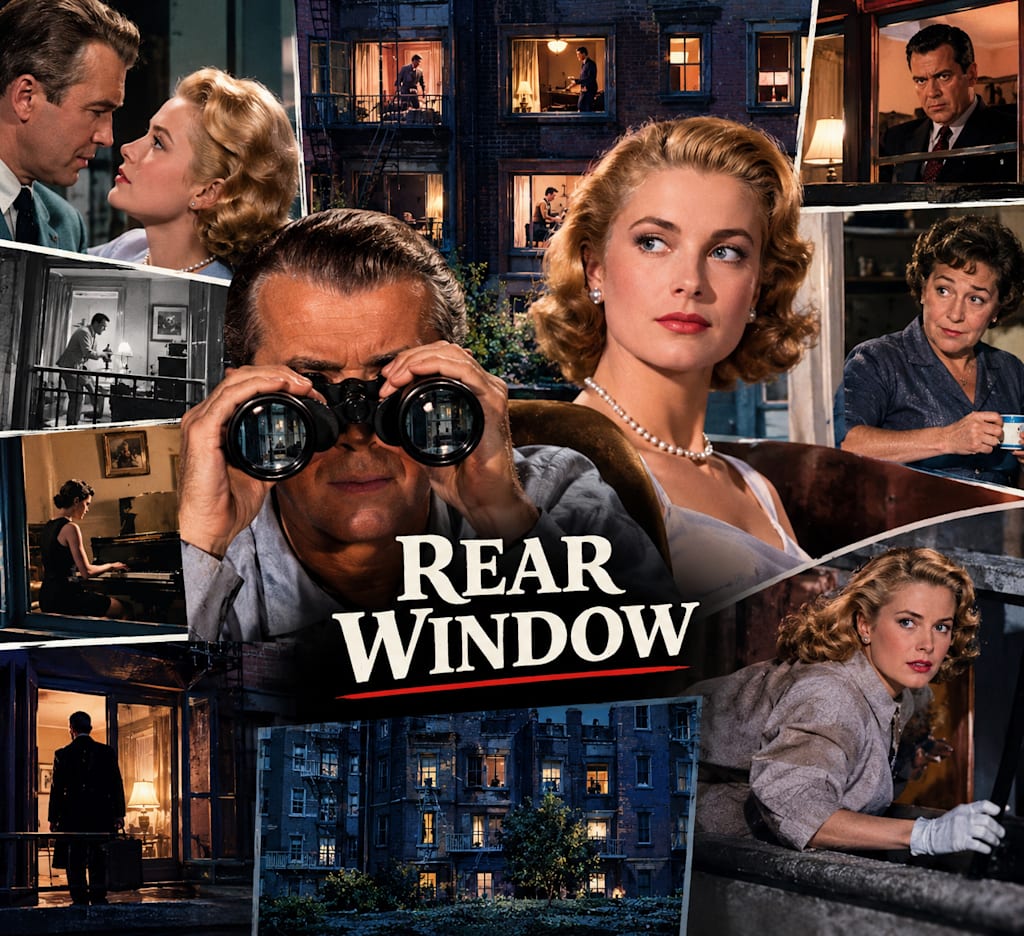
Grace Kelly is absolutely radiant in Rear Window, Alfred Hitchcock's wonderfully suspenseful 1954 thriller. The movie is based on a short story by Cornell Woolrich, but Hitchcock turns the simple idea of watching the neighbors into something much more complicated—and much more fun.
James Stewart plays L.B. Jefferies, a photographer stuck in a wheelchair after breaking his leg. With nothing better to do, he begins watching the people living across the courtyard.
And, naturally, he starts noticing things he probably shouldn't.
One neighbor practices piano. Another spends his evenings alone. A lonely woman keeps waiting for someone to come home. A newlywed couple disappears behind their curtains.
Then there's Lars Thorwald.
Thorwald's wife suddenly vanishes.
Jeff begins to suspect something terrible has happened.
His girlfriend Lisa, played by Grace Kelly, initially thinks he's simply bored and imagining things. But Lisa isn't the sort of woman who remains on the sidelines for very long.
That's one of the things I love about this movie.
Lisa isn't merely the glamorous girlfriend who visits Jeff's apartment to look beautiful. She becomes increasingly involved in the mystery, and Kelly gives the character a wonderful mixture of elegance, determination, and nerve.
There is a terrific contrast between Jeff and Lisa.
Jeff is physically trapped in his apartment but mentally roaming all over the courtyard.
Lisa can walk wherever she wants, but she has to convince Jeff that their relationship is worth staying for.
The supporting cast is equally memorable.
Thelma Ritter nearly steals the movie as Stella, Jeff's blunt and wonderfully practical nurse. She has the kind of dialogue that makes you wish she had been given even more screen time.
And Raymond Burr, playing Thorwald, is perfectly unsettling.
Hitchcock doesn't need to show us everything.
That's the trick.
We watch the courtyard from Jeff's point of view, seeing fragments of other people's lives through windows. Sometimes we don't know what we're looking at until much later.
The movie becomes a lesson in curiosity.
How much can you really know about someone by watching them?
And when does curiosity become an invasion of privacy?
Those questions feel surprisingly modern.
What makes Rear Window work so beautifully is that Hitchcock turns the audience into accomplices. We're doing exactly what Jeff is doing.
We're watching.
We're guessing.
We're waiting for something to happen.
And when it finally does, we realize we've been staring at the wrong thing—or perhaps the right thing—from the wrong angle.
Grace Kelly was already a major star by this point, and it's easy to understand why. She has an effortless screen presence that makes Lisa believable as both a sophisticated fashion figure and someone willing to climb into a dangerous situation when the moment demands it.
Stewart, meanwhile, is perfectly cast as the restless photographer who hates being confined but may have found his greatest adventure without leaving his apartment.
Some mysteries depend on explosions, car chases, and enormous sets.
Rear Window needs none of them.
It has a courtyard, a few apartments, some binoculars, and a man who simply refuses to mind his own business.
And somehow, that's enough to keep us watching.
Sometimes the most dangerous thing you can do is look too closely.
What makes the film even more fascinating is the way Hitchcock makes ordinary domestic life feel dangerous.
There is no haunted house. No remote castle. No monster hiding in the basement.
There are simply apartments.
People eating dinner.
People arguing.
People falling in love.
People living their ordinary lives behind closed curtains.
And yet, from Jeff's window, all of it becomes a mystery.
The courtyard almost feels like a miniature city. Every window contains another story, and Hitchcock gives us just enough information to make us curious about all of them.
The newlyweds are especially funny. Their window becomes a private little drama of its own, reminding us that Jeff isn't only watching a murder mystery. He's watching life.
That's an important part of the movie.
Jeff becomes so obsessed with Thorwald that he begins neglecting the people directly in front of him. Lisa, meanwhile, gradually proves that she isn't afraid of the danger Jeff has been observing from a distance.
When she finally enters Thorwald's apartment, the balance changes completely.
Jeff can watch.
Lisa can act.
And suddenly the man sitting safely in his wheelchair becomes the most helpless person in the entire story.
That reversal is one of Hitchcock's cleverest ideas.
The movie also has a wonderful sense of humor. Stella's comments keep the suspense from becoming too heavy, while Lisa's elegant appearance creates an amusing contrast with the increasingly dangerous situation.
But beneath all the entertainment is something darker.
We like watching other people's lives.
We do it at the movies.
We do it through television.
And today, we do it constantly through social media.
Rear Window was made long before smartphones and social networks, yet its central question still feels remarkably current:
How much of another person's life do we have the right to see?
That's why the movie remains more than an old Hollywood thriller.
It's a mystery, a romance, a comedy, and a warning about curiosity—all wrapped inside one courtyard.
And once you've looked through Jeff's window, it's surprisingly difficult to look away.
About the Creator
Behind the Curtain
"Exploring the untold stories and hidden truths. From royal rumors to cultural deep dives, Behind the Curtain brings you bold, insightful narratives that spark curiosity and conversation."
Enjoyed the story? Support the Creator.
Subscribe for free to receive all their stories in your feed.
Comments
There are no comments for this story
Be the first to respond and start the conversation.