
The Timeless Allure of Nature in Antique Jewelry
Echoes of Earth: How Natural Motifs Shape the Beauty and Legacy of Vintage Adornments

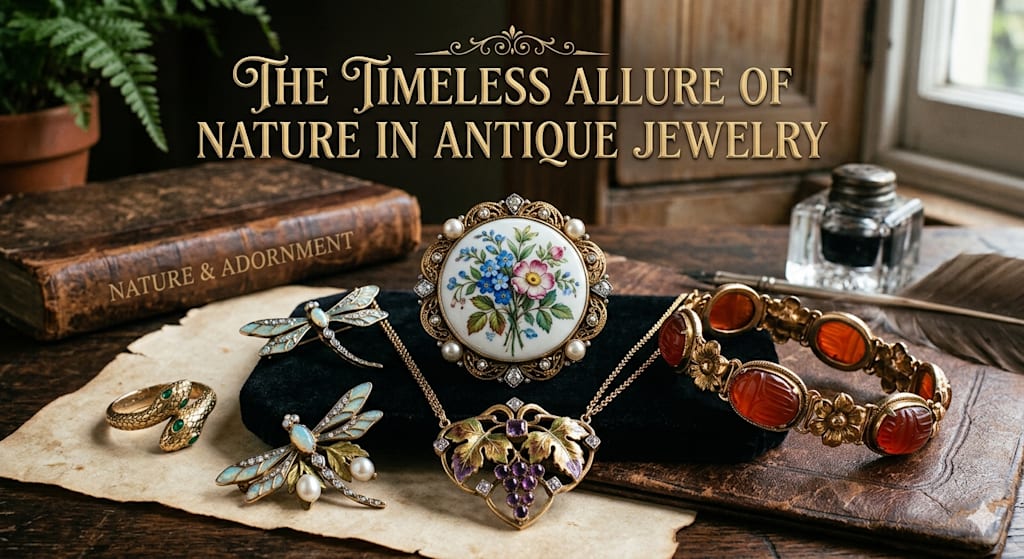
Nature has always been one of the most powerful sources of inspiration in jewelry. From delicate floral engravings to finely sculpted animal motifs, nature-inspired jewelry has captivated collectors for centuries. These pieces go beyond simple adornment, transforming gold, enamel, and gemstones into miniature works of art that reflect craftsmanship, imagination, and symbolism.
Among the most fascinating categories within antique jewelry are pieces inspired by the natural world: serpents coiled into rings, birds captured in brooches, dragonflies shaped in enamel, and flowers rendered in precious stones. These designs are visually striking, but they also carry deeper meaning. Across cultures and historical periods, animals and plants have represented transformation, strength, eternity, beauty, and freedom.
This artistic approach reached one of its most remarkable peaks during the Art Nouveau movement. The Metropolitan Museum of Art describes Art Nouveau as a movement inspired by the unruly aspects of the natural world, especially in the applied arts and design. This made jewelry an ideal medium for the style, because a jewel could become both wearable ornament and miniature sculpture.
Art Nouveau jewelry often embraced flowing lines, asymmetry, insects, flowers, birds, and other organic forms. A general overview of Art Nouveau jewelry notes that designs from the period frequently featured natural objects such as flowers, animals, and birds. This helps explain why dragonflies, peacocks, serpents, orchids, and female figures became so closely associated with the style.
Collectors today continue to seek out these pieces because they offer something modern jewelry often lacks: individuality. According to DSF Antique Jewelry antique jewelry specialists, nature-inspired jewels often stand out because they combine rarity, craftsmanship, and narrative. Unlike mass-produced modern designs, antique creations frequently reveal hand-finishing, subtle asymmetry, and artistic nuance.
Animal motifs are especially compelling. The serpent, for example, has appeared in jewelry for centuries and is often associated with eternity, renewal, and protection. Birds can evoke grace and freedom, while insects — especially dragonflies and butterflies — became iconic during the Art Nouveau period because of their delicate forms and symbolic associations.
One of the most famous examples of this artistic imagination is René Lalique’s “Dragonfly-Woman” corsage ornament. The Calouste Gulbenkian Museum notes that the piece was presented at the Paris Exposition in 1900, where Lalique’s Art Nouveau jewelry received great acclaim. The jewel combines the female figure with the insect form, showing how Art Nouveau artists transformed nature into fantasy.
Major auction houses also show the continued importance of nature-inspired jewelry. Christie’s has presented a Cartier diamond and lapis lazuli serpent brooch designed with a pavé-set diamond serpent, emerald eye, platinum, and 18K gold. This type of auction record demonstrates that animal-inspired jewelry remains relevant at the highest levels of collecting.
Museums offer another useful perspective. The Victoria and Albert Museum jewelry collection includes thousands of jewels and is one of the most comprehensive jewelry collections in the world. Studying museum collections helps collectors understand how craftsmanship, materials, symbolism, and historical context shape the value of antique jewelry.
Materials and techniques play a crucial role in bringing these designs to life. Enamel, widely used during the Art Nouveau period, allowed jewelers to create soft, translucent effects that recalled petals, wings, and natural surfaces. Gemstones such as emeralds, rubies, opals, and diamonds were chosen not only for beauty, but also for expressive detail — emeralds for eyes, opals for iridescence, and diamonds for movement and light.
Gold itself was often engraved, shaped, or textured to imitate the natural world. A lizard’s body, a bird’s feathers, a serpent’s scales, or the curve of a flower stem could all be suggested through careful metalwork. These details are what separate a simple decorative jewel from a true work of craftsmanship.
What makes nature-inspired antique jewelry especially appealing today is its ability to feel both historic and contemporary. A serpent ring made more than a century ago can still feel bold and modern. A floral pendant can remain elegant without feeling outdated. A dragonfly brooch can feel artistic, unusual, and wearable at the same time.
There is also a growing appreciation for jewelry as cultural history. As more collectors look beyond trends and focus on rarity, meaning, and craftsmanship, nature-inspired jewelry offers a compelling alternative to standardized modern designs. Each piece carries not only beauty, but also a connection to a specific artistic period and a particular way of seeing the world.
For anyone beginning to explore this field, the best approach is to study both design and context. Compare museum examples, auction records, and historical references. Victorian jewelry may emphasize sentiment and symbolism. Art Nouveau jewelry may focus on movement, fantasy, and organic form. Art Deco jewelry may stylize animals and plants into sharper, more geometric designs.
Ultimately, the fascination with nature-inspired jewelry lies in its ability to merge art and life. These jewels are not merely accessories. They are expressions of the natural world captured in precious materials. Whether subtle or dramatic, each piece reflects the enduring dialogue between human creativity and the beauty of nature itself
About the Creator
Enjoyed the story? Support the Creator.
Subscribe for free to receive all their stories in your feed.
Comments
There are no comments for this story
Be the first to respond and start the conversation.