
The Small Video Review Habit That Helped Me Stop Watching Everything
A practical look at AI video summaries, long-form content overload, and why understanding the key points first often saves more time than watching from beginning to end.

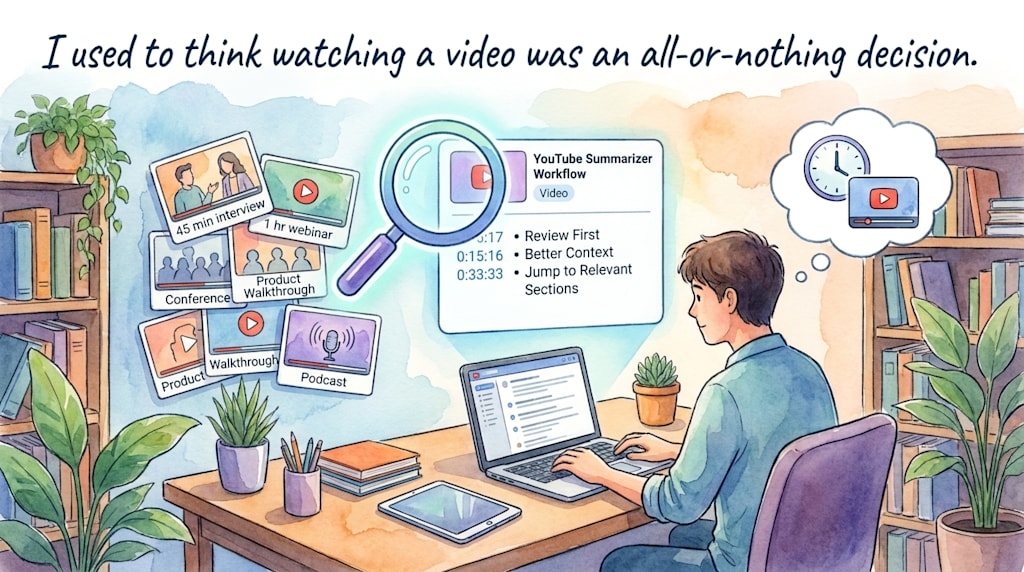
I used to think watching a video was an all-or-nothing decision.
If a video looked important, I watched it.
If it was too long, I saved it for later.
Most of the time, "later" never came.
That worked when I only watched a few videos each week. But once YouTube became part of how I learned, researched ideas, followed industry news, and picked up new skills, I noticed a problem.
I was spending more time deciding what to watch than actually learning from it.
A 45-minute interview.
A one-hour webinar.
A conference presentation.
A product walkthrough.
A podcast recording.
None of them seemed excessively long on their own.
Together, they became impossible to keep up with.
And the frustrating part was that many videos only contained a handful of points I actually needed.
That is when I started doing one small thing before committing to a video.
I generated a summary first.
Not to replace the video.
Not to avoid learning.
Just to understand whether the full recording deserved my attention.
Most Videos Do Not Need More Time. They Need Better Context.
There is a lot of advice online about productivity.
Watch videos at 2x speed.
Take better notes.
Create learning systems.
Build knowledge databases.
All of that can help.
But none of those methods solve the first problem:
How do you know a video is worth watching in the first place?
For me, the answer became surprisingly simple.
I started using a YouTube summarizer before deciding whether to watch the full content.
Instead of immediately opening a 60-minute video, I would review the transcript and summary first.
Often, that was enough.
Sometimes I realized the creator was covering information I already knew.
Sometimes the video answered my question in the first five minutes.
Sometimes the summary highlighted a section worth watching while the rest was less relevant.
The result was not watching fewer videos.
It was watching the right videos.
The Review Stage Is the Part Most People Skip
People spend a lot of time searching for content.
What should I learn?
Which creator should I trust?
What video explains this topic best?
But once a video appears in front of us, we usually jump straight into watching.
That is the step I started questioning.
Many videos are almost useful.
Almost relevant.
Almost worth an hour.
Almost what I need.
That "almost" adds up.
I would start watching.
Jump ahead.
Go back.
Search the comments.
Check the description.
Try to find the section everyone was talking about.
By the time I found the answer, I had already spent twenty minutes.
Now I review the structure first.
When I use a YouTube video-summarizer workflow, I can quickly see the major topics being discussed and whether the content matches what I am looking for.
The timestamps help even more.
Instead of scrubbing through the timeline manually, I can jump directly to the moments that matter.
That small change has removed a surprising amount of friction.
Different Tools Solve Different Video Problems
I do not think there is one perfect tool for every kind of video work.
If I need to save videos for later reading, browser extensions can help.
If I want detailed note organization, dedicated knowledge management tools make sense.
If I need full transcription for research or content creation, transcript-focused platforms are often the better choice.
For quickly understanding what a video contains, I have found that AudioConvert serves a different purpose.
The goal is not archiving.
The goal is not editing.
The goal is simply comprehension.
Paste the link.
Generate the transcript.
Review the AI summary.
Jump to the relevant sections.
Then decide how much of the video deserves deeper attention.
That distinction matters.
Sometimes I do not need another productivity system.
I just need a faster way to understand what is inside a video.
AI Summaries Are Helpful, But They Are Not Perfect
This is where expectations matter.
AI summaries can save time, but they are not substitutes for critical thinking.
A summary can highlight the main points.
It can identify recurring topics.
It can organize information into something easier to scan.
What it cannot always capture is nuance.
A speaker's tone.
A subtle argument.
An unexpected insight that appears halfway through a discussion.
That is why I treat summaries as a guide rather than a replacement.
If a video seems important, I still watch the original sections.
The transcript simply helps me get there faster.
In that sense, the best AI summary is not one that replaces the content.
It is one that helps me navigate it.
This Habit Saves More Time Than I Expected
The biggest benefit has not been speed.
The biggest benefit has been reducing uncertainty.
Before, I constantly wondered whether a video would be worth my time.
Now I can evaluate it in minutes.
If the summary looks useful, I continue.
If not, I move on.
That confidence has made it easier to consume educational content, industry updates, creator interviews, and long-form discussions without feeling overwhelmed.
I also revisit older videos more often.
Instead of rewatching an entire recording, I can review the transcript, find the relevant section, and refresh my memory quickly.
That turns content I already consumed into something much more reusable.
My Takeaway
The small habit is not "use AI to avoid watching videos."
It is this:
Understand a video's structure before investing your attention.
A transcript can reveal whether a topic is relevant.
A summary can highlight the key takeaways.
Timestamps can help you find important moments faster.
And a browser-based online YouTube summarizer tool can make the entire process feel less overwhelming.
For anyone who regularly learns through YouTube, that matters.
There is more content available than any of us can realistically watch.
The challenge is not finding videos.
The challenge is deciding which ones deserve our time.
For me, reviewing the summary first has become one of the simplest ways to make that decision.
About the Creator
Enjoyed the story? Support the Creator.
Subscribe for free to receive all their stories in your feed.
Comments
There are no comments for this story
Be the first to respond and start the conversation.