
The Small Feedback Review Habit That Made My Product Decisions Feel Less Random
A practical look at AI-powered feedback management, product roadmaps, and why organizing user requests often matters more than collecting more of them.

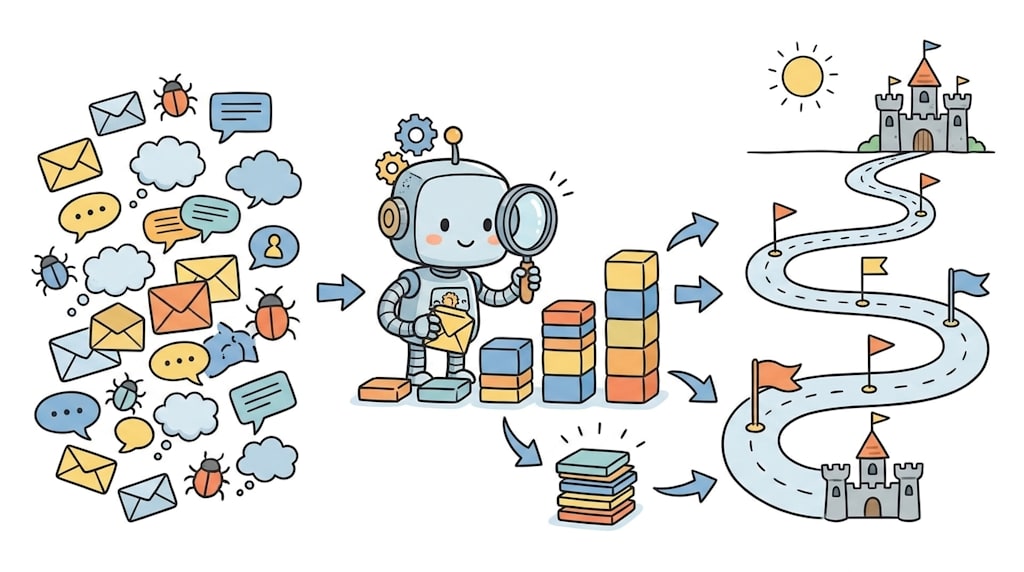
I used to think user feedback was either useful or useless.
If a request sounded clear, I wrote it down.
If it felt vague, repetitive, or too personal, I ignored it and moved on.
That worked when only a few people were using the product.
But once more users started showing up, I noticed something frustrating:
Most feedback was not actually bad.
It was just unfinished.
One message described a bug.
Another described confusion.
A third person asked for a feature.
After reading them carefully, I realized they were often talking about the same underlying problem.
None of those conversations looked important on their own.
Together, they were telling a much bigger story.
And in product building, missing that story can be expensive.
That was when I started doing one small thing before planning new work:
I began cleaning up feedback first.
Not writing long reports.
Not building complicated spreadsheets.
Not trying to measure everything.
Just basic organization.
Most Feedback Does Not Need More Analysis. It Needs Less Noise.
There is a lot of pressure to collect as much customer feedback as possible.
More forms.
More surveys.
More channels.
More requests.
But I do not think most teams suffer from a lack of information.
I think they suffer from fragmentation.
The same idea arrives through email.
Then support chat.
Then social media.
Then a community forum.
Then someone mentions it during a demo call.
Five conversations.
One problem.
Without context, it looks like five unrelated tasks.
With context, it becomes a clear priority.
This is not about creating more data.
It is about removing friction.
The Cleanup Stage Is the Part People Skip
People spend a lot of time talking about product strategy.
What should we build?
What feature will attract users?
What should we launch next?
What competitor should we watch?
All of that matters.
But the quality of those decisions depends heavily on the quality of the feedback behind them.
The strange part is that many product teams are already close.
Almost enough information.
Almost enough evidence.
Almost enough patterns.
Almost enough confidence.
That "almost" used to slow me down.
I would read the same requests over and over.
I would wonder if two users were describing the same issue.
I would forget that someone had already reported a problem months ago.
I would postpone decisions because everything felt scattered.
Now I treat feedback cleanup as part of the workflow, almost like proofreading before publishing a blog post.
Before planning, I ask:
Is this request unique?
Has someone already mentioned it?
Does it belong to a bigger pattern?
Can users see what is happening?
Will this still make sense a few months from now?
If the answer is no, I organize it first.
Different Tools Solve Different Problems
I do not think there is one perfect workflow for every team.
Simple notes work for very small projects.
Spreadsheets are fine when requests are manageable.
Project management software helps once tasks become more structured.
But feedback itself often behaves differently.
It keeps arriving.
It comes from different places.
It repeats itself in different words.
While experimenting with different systems, I spent some time using FeedLog.
What I liked was not that it accepted feedback.
Many products can do that.
The useful part was seeing similar requests grouped together while public roadmap updates and changelogs stayed connected to the conversation.
It made the whole process feel less like storing information and more like maintaining a relationship with users.
That distinction matters.
Sometimes I do not need another place to save comments.
I just want the existing ones to make more sense.
AI Is Helpful, But It Still Needs Human Judgment
This is where I think people should be careful.
AI can organize information surprisingly well.
It can find repeated topics.
It can reduce obvious duplicates.
It can surface patterns that are easy to miss.
But it cannot understand every business decision.
A feature requested by fifty people may not be important.
A complaint from one customer may reveal a much larger issue.
Context still matters.
Priorities still matter.
People still matter.
That is why I never assume an AI-generated summary is the final answer.
I read the original comments.
I check the details.
I look for edge cases.
I make sure the pattern actually reflects reality.
For product work, believable matters more than automated.
Users can usually tell when their feedback was actually understood.
They can also tell when it was simply processed.
The best kind of AI assistance is the kind people barely notice.
They just feel heard.
This Habit Saves More Time Than I Expected
The biggest benefit has not been making better reports.
The biggest benefit is that I hesitate less.
Before, I spent too much time wondering whether a request was important enough.
If it looked incomplete, I ignored it.
If it looked repetitive, I postponed it.
Now I have a simple rule:
If a piece of feedback points toward a real user experience, I organize it before deciding whether it matters.
That has helped me reuse old conversations, reconnect scattered requests, and notice long-term patterns that I probably would have missed.
It also changed how I think about product growth.
A team does not need every suggestion.
But it does need a system that stops good ideas from disappearing.
My Takeaway
The small life hack is not:
"Use AI to make product decisions."
It is this:
Before collecting more feedback, see if the existing feedback only needs cleanup.
A merged request can reveal a hidden trend.
A public roadmap can reduce repeated questions.
A visible changelog can strengthen trust.
An organized conversation can become a better product decision.
For anyone building products regularly, this matters.
Users already spend time telling us what works and what does not.
We do not need every request to become a feature.
But if someone takes the time to share an idea, it should at least have a chance to be seen clearly and intentionally.
That is the real value of modern feedback management for me.
Not perfect planning.
Just less noise.
Clearer signals.
And a little more confidence before deciding what to build next.
About the Creator
Enjoyed the story? Support the Creator.
Subscribe for free to receive all their stories in your feed.
Comments
There are no comments for this story
Be the first to respond and start the conversation.