
The Invisible Grille Was Tested Against a Push, Not a Pounce
The Pet-Safety for Every Invisible Grille Installation in Singapore

Every invisible grille sales pitch has the same demo. The installer leans into the mesh, sometimes gets a colleague to lean too, and lets you watch it hold. It's a good demo — it answers the question every parent asks first: can my child push through this? What it doesn't answer is the question a different kind of household should be asking, because nobody in the showroom is built to demonstrate it: what happens when something launches off the windowsill at full speed, claws first, at three in the morning?
That's the gap I keep running into when I talk to pet owners who've had invisible grilles installed. The product was engineered, tested, and sold against a human child's weight and push. A cat doesn't push. It leaps, hangs, and puts its entire bodyweight through four small points of contact — often exactly where a cable meets an anchor, the single weakest spot in the whole system. A dog doesn't test the mesh at all; it tests the frame, pawing and scratching at the same six inches near a latch, day after day, until powder coating that would have shrugged off a toddler's palm print for a decade starts to wear through in one.
None of this means the product fails pets. It means the industry sells one certification and stops talking the moment the conversation should really start. The safety claim on the box is true and also incomplete, and Singapore is about to have a lot more households finding that out. The cat-licensing transition that HDB and AVS opened in September 2024 closes at the end of this month — every pet cat now needs to be microchipped and registered through PALS, and for the first time, keeping a cat in a flat is something you do openly rather than around a rule everyone quietly ignored. That shift matters here: households that spent years managing cats discreetly are now thinking, often for the first time, about what "safe for a cat" actually requires at a window twelve floors up. Invisible grilles installed in the balcony for a toddler five years ago are inheriting a tenant they were never explained to protect.
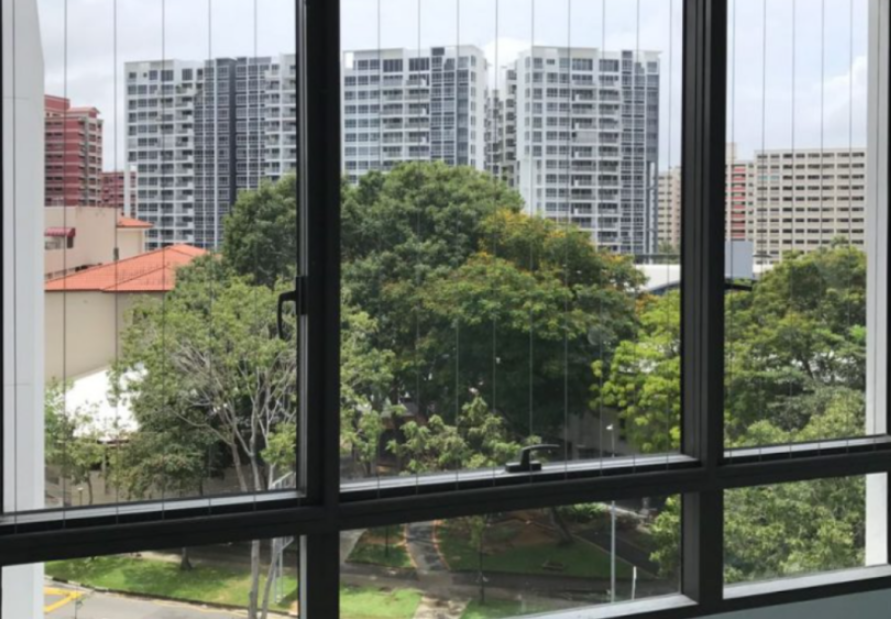
So the maintenance conversation needs to change shape, not just get longer. The basic care is still the basic care — warm water, a drop of dish soap, a soft microfibre cloth, wiped along the frame and then drawn along each cable in a single direction, dried afterward rather than left to sit. Monthly for a light pass, quarterly for a proper one, more often if you're high-floor, coastal-facing, or exposed to wind, which in this climate is most of the island most of the year. But a pet household is cleaning for a second reason beyond appearance: every wipe-down is the only close inspection the grille ever gets, and with an animal working the hardware daily, that inspection needs to look for different damage. Run a finger along the sheathing for splits where claws have caught and dragged. Check anchor points for the beginnings of a rust bloom, which reads first as a faint orange bleed, not visible flaking. Watch for the cable that's gone slightly slack — not from age, but from a cat's full weight taken against it mid-jump, over and over, in the same spot.
That last one is where I'd push back hardest on how these products get discussed. A slack cable is the most common pet-driven wear issue, and the most commonly mishandled by the owner who tries to fix it. Tension on these cables is a calculated spec, not a screw you tighten by feel — retensioning it yourself overstrains the anchor it's fighting against and voids whatever warranty was covering you. It's a call to the installer, not a Saturday-afternoon job, and every guide that treats invisible grille upkeep as pure DIY territory is quietly setting pet owners up to make that exact mistake.
There's also a substance question that never comes up in the child-safety literature but should in the pet one. Litter dust settles on nearby cables and holds moisture against the sheathing longer than open air ever would. A bird's droppings on a ledge-adjacent grille are acidic enough to etch a coating faster than a whole humid season does. None of this is exotic knowledge — it's the kind of detail any vet or long-time pet owner already half-knows — but it's absent from every installation manual I've read, because the manual was written for a child who doesn't produce ammonia or peck at powder coat.
The grille still does exactly what it was built to do. It's the upkeep instructions that haven't caught up to who's actually living behind them. As more flats formalise the cats that were always there, that's worth saying out loud before the wear shows up as a fall, not a stain.
About the Creator
Enjoyed the story? Support the Creator.
Subscribe for free to receive all their stories in your feed.
Comments
There are no comments for this story
Be the first to respond and start the conversation.