
The Hidden Costs of Remote Work (And How to Manage Them)
A closer look at how flexibility reshapes time, boundaries, and everyday life

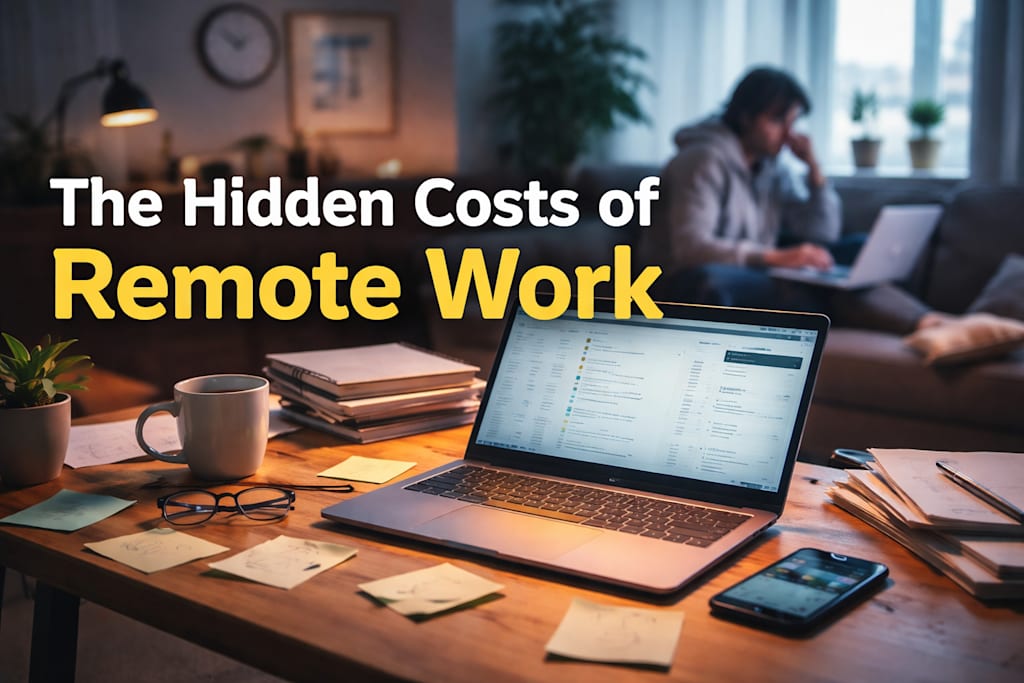
For years, remote work has been framed as a kind of professional utopia.
No commute. Flexible hours. The freedom to work from anywhere. On paper, it seems like an obvious upgrade from traditional office life. And in many ways, it is.
But beneath the surface, there’s a quieter reality—one that doesn’t get nearly as much attention.
Remote work doesn’t just change where we work. It fundamentally reshapes how we think about time, boundaries, and even our sense of self. And not all of those changes are positive.
The Illusion of “More Time”
One of the most common arguments in favor of remote work is the time saved from commuting. An hour here, two hours there—it adds up quickly.
But what actually happens to that reclaimed time?
In theory, it should translate into more rest, better health, or deeper personal relationships. In practice, it often gets absorbed back into work.
Without a clear boundary between “work time” and “home time,” the edges blur. Checking emails after dinner feels harmless. Finishing “just one more task” at night becomes routine. Over time, the workday expands—not because anyone explicitly demands it, but because it quietly can.
The result is a paradox: people feel busier, despite having more control over their schedules.
When Work Becomes Ambient
In a traditional office, work is contained within a physical space. You go there, you do your job, and you leave.
Remote work removes that container.
Your workspace might be your bedroom, your kitchen table, or a corner of your living room. There’s no clear “exit.” Work becomes ambient—always present, always accessible.
This constant proximity changes behavior in subtle ways. Even when you’re not working, part of your attention remains tethered to it. A notification, a message, a pending task—it’s all within reach.
Over time, this creates a low-level cognitive load that’s difficult to notice but hard to escape.
The Productivity Trap
Remote work is often associated with increased productivity, and in many cases, that’s true.
Fewer interruptions. More control over your environment. The ability to structure your day around your natural energy levels.
But this efficiency comes with a hidden cost.
When people realize they can be more productive, the expectation often shifts—internally or externally. What was once considered a full day’s work becomes the baseline. The standard rises, but the recognition rarely follows at the same pace.
This creates a subtle pressure to continuously optimize: better routines, better tools, better habits. Productivity stops being a means to an end and becomes an end in itself.
The Social Deficit
One of the most underestimated aspects of remote work is what it removes, not just what it provides.
Casual interactions—brief conversations, shared breaks, small talk—may seem insignificant, but they play a crucial role in how people experience work.
They create a sense of belonging. They provide moments of mental reset. They make work feel less transactional.
In a remote environment, these interactions don’t disappear entirely, but they become intentional rather than organic. You schedule meetings. You send messages. But the spontaneous element is largely gone.
For some, this is a relief. For others, it leads to a quiet sense of isolation that’s difficult to articulate.
The Responsibility Shift
Remote work shifts a significant amount of responsibility from organizations to individuals.
In an office, structure is built into the environment:
Defined working hours
Physical separation from home
Social cues that guide behavior
At home, that structure has to be created manually.
You decide when to start. When to stop. How to manage distractions. How to maintain focus.
For highly disciplined individuals, this can be empowering. For others, it can be overwhelming.
The challenge is not just doing the work—it’s designing the system in which the work happens.
The Blurring of Identity
Work has always been a part of identity, but remote work intensifies this connection in unexpected ways.
When your living space and working space overlap, it becomes harder to separate who you are from what you do.
A bad day at work doesn’t stay at the office—it lingers in your environment. Success doesn’t feel like something you leave behind—it follows you into your personal space.
This constant overlap can make it harder to mentally “switch off,” even during time that is supposed to be restorative.
What Actually Helps
Despite these challenges, remote work is not inherently flawed. But it does require a different kind of awareness.
People who adapt well tend to do a few things deliberately:
They create artificial boundaries—both physical and temporal. A specific workspace, a defined end to the workday, even small rituals that signal transition.
They resist the urge to fill every gap with productivity. Not all free time needs to be optimized.
They also acknowledge the social gap and actively compensate for it, rather than pretending it doesn’t exist.
Most importantly, they recognize that flexibility is not the same as freedom. Without structure, flexibility can quickly become another form of pressure.
Final Thought
Remote work is often presented as a simple upgrade: more freedom, fewer constraints, better balance.
But in reality, it’s a trade-off.
It removes certain limitations while introducing new ones—less visible, but equally impactful.
Understanding those trade-offs is what makes the difference.
Because the real challenge of remote work isn’t where you work.
It’s how you manage the parts of work that no longer have clear boundaries.
About the Creator
Eos Investment Alliance
Eos Investment Alliance is a global investment network focused on delivering strategic market insights and empowering individuals to achieve sustainable financial growth.
Enjoyed the story? Support the Creator.
Subscribe for free to receive all their stories in your feed.
Comments
There are no comments for this story
Be the first to respond and start the conversation.