
The "Healthy" Swap That Made Him Sicker
He ditched soda for zero-sugar drinks to lose weight. A year later, he gained 2 kilos and a shocking lipid diagnosis.
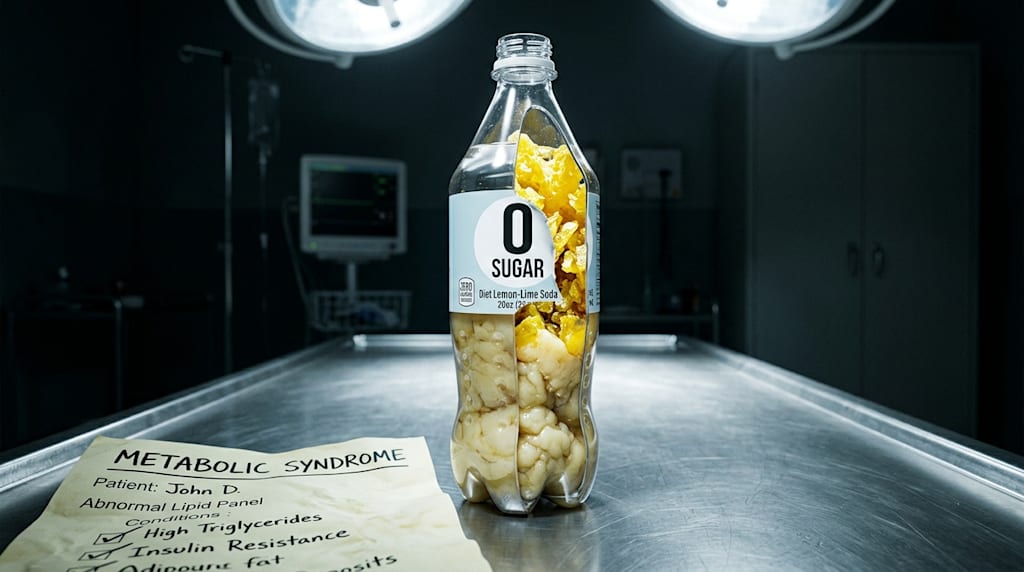
Mr. Sun, 27, stood in front of the convenience store cooler, one bottle in each hand. In his left hand, a cola, its surface beaded with condensation. In his right, a bottle of "zero‑sugar" sparkling water with a dark green label. He hesitated for five seconds, then put the cola back on the shelf. The sparkling water let out a crisp click as he twisted off the cap. The first sip was fizzy, the sweetness bursting on his tongue and then fading just as quickly, as if it had never been there.
That was back in January of last year. The words "overweight" on his physical exam report had pushed him to make this decision. He felt he had found the fulcrum of balance – between cravings and health, it turned out, there was only a line of fine print.
From then on, two or three bottles of "sugar‑free" drinks from different brands always stood on his desk. One in the morning, one after lunch, another during overtime. He no longer felt guilty about drinking something sweet. Sometimes, during afternoon tea break, he would stroll over to a colleague, hold up a bottle labeled "zero calories," and say with a grin, "See? I'm pretty tough on myself, aren't I?"
The colleague glanced at the ingredient list and said nothing.
Over that year or more, Mr. Sun's life didn't change much. He still ordered takeout, still gave in to late‑night cravings for fried chicken while scrolling through his phone. Only now he would chug half a bottle of sugar‑free tea afterward, as if to "cleanse" the meal. He still didn't exercise; the way he slumped on the sofa after work was exactly the same as a year ago. But his conscience was clear – he had given up cola, he was drinking healthy beverages, he hadn't done anything wrong.
This April, the annual physical came around again. He stepped onto the scale with a hint of anticipation.
The numbers flashed. Two kilograms heavier than last year.
He froze for a few seconds, thinking the scale was broken. He stepped on again. Same number. More jarring was the lipid panel: an upward arrow beside it, telling him bluntly: your blood has more of something it shouldn't.
Leaving the hospital, his girlfriend walked beside him, half a step apart. Without looking at him, she said, "I told you a long time ago – those things don't work."
He didn't answer. The bottle of "zero‑sugar" lemon tea he had just opened suddenly felt hot in his hand. He wanted to defend himself, wanted to say, "But it clearly says sugar‑free," but the words died in his throat. Because he knew how pathetic that would sound – like a man clutching the manual and refusing to admit the machine is broken.
Back home, he lined up all seven remaining bottles of "sugar‑free" drinks from the fridge on the dining table, took a photo, and sent it to a friend: "Book me an appointment. I want to go ask a doctor."
When Dr. Luo Yong, a specialist in endocrinology and metabolism at Nanjing First Hospital, saw him in the consultation room, two physical‑exam reports lay side by side on the desk. Dr. Luo didn't rush to flip through them. He asked first: "Do you normally drink water?"
"Yeah," Mr. Sun said, pointing to the bottle he had brought along. "I drink this."
Dr. Luo nodded, placed the two reports side by side, and tapped his pen on the lipid column. "How many bottles of these do you drink a day?"
"Three or four. Sometimes more."
The room fell silent for a few seconds. Outside in the hallway, a cart rolled past, its wheels rumbling over the tiles. Mr. Sun twisted the bottle cap open and shut again, the plastic threads making a scraping sound.
Dr. Luo didn't use phrases like "What does this tell us" or "It's worth noting." He simply put down his pen, looked Mr. Sun in the eye, and said, very softly:
"You thought you were running away from sugar. But your body has been paying your debts all along."
That afternoon, Mr. Sun sat in the consultation room for forty minutes. He listened as Dr. Luo explained three details he had never considered:
The first detail – the artificial sweeteners he drank reached his brain faster than sugar, but the blood glucose never came. After being tricked several times, his brain grew hungrier, more ravenous. So his lunch orders always included an extra portion of meat, and the afternoon fried‑chicken habit started during that period. He thought his willpower had weakened. In truth, his brain, repeatedly deceived, had begun to exact revenge by demanding more calories.
The second detail – the bacteria in his gut weren't happy. Those artificial sweeteners had killed off a fair number of beneficial bacteria. To survive, the remaining colonies started breaking down the sweetener residues, producing a substance called acetate. Acetate entered his liver, where it was used as raw material to synthesize new fatty acids and cholesterol. He hadn't eaten more fat, but his liver had been working overtime to stockpile it.
The third detail – he thought he was doing subtraction, but his body was doing an addition he couldn't see.
Mr. Sun didn't speak right away. He set the half‑finished bottle by the foot of his chair and asked, "So what should I drink now?"
"Plain water. Cold or hot – either is fine."
He stood up, folded the new exam report, and put it in his bag. As he walked out of the consultation room, his girlfriend was waiting for him on the bench in the corridor, holding two paper cups of plain water – no labels on the cups. She handed one to him.
He took it, took a sip. No taste. But he didn't frown.
That night, on his way home, he didn't stop at the convenience store downstairs as he usually did. Once inside, he pulled one of the seven remaining bottles from the fridge, turned it over, and, under the kitchen light, read the ingredient list word by word.
Erythritol, sucralose, acesulfame K, sodium citrate. He read each one aloud, then put the bottle back at the very back of the fridge and closed the door.
The next morning, he went to the office. He walked past the cooler without slowing down. At noon, a colleague invited him to join a group order for milk tea. He waved his hand and pulled out a thermos from his bag.
The colleague asked, "You quit?"
"It's not really quitting," he said. "Just changing the way I drink."
Later, when he told his girlfriend about the whole thing, he didn't use phrases like "I realized" or "I understood." He just crouched by the coffee table, took out the remaining bottles from the fridge, and poured them one by one into the sink. The water was loud, the fizz sizzling, the whole kitchen filling with the sweet, lemony scent of carbonation.
His girlfriend leaned against the kitchen doorframe, watching. She said nothing.
After the last bottle was emptied, he crushed the bottle flat, tossed it into the trash, stood up, and rinsed his hands under the tap. Then he turned around and said:
"Come with me tomorrow to buy some tea leaves."
The words were ordinary, the tone light – as if it were a trivial decision. But his girlfriend knew: this man had never drunk tea before. He thought it was too bitter.
Outside the window, it was late April. A spring breeze rustled the leaves of the pothos plant on the kitchen windowsill. He reached out and nudged the window a little shut. A gentle motion.
No grand conclusion. No summary. No "From then on, he lived a healthy life."
He just closed a window, and planned to buy two ounces of tea leaves tomorrow.
That was all.
About the Creator
Jin
Writer of reamstories
https://reamstories.com/jin
Enjoyed the story? Support the Creator.
Subscribe for free to receive all their stories in your feed. You could also become a paid subscriber, letting them know you appreciate their work.
Comments
There are no comments for this story
Be the first to respond and start the conversation.