
The Day My Jacket Saved My Skin — And Everything I Learned About Gear After That
What eleven years of riding, two crashes, and one very honest orthopedic surgeon taught me about motorcycle jackets

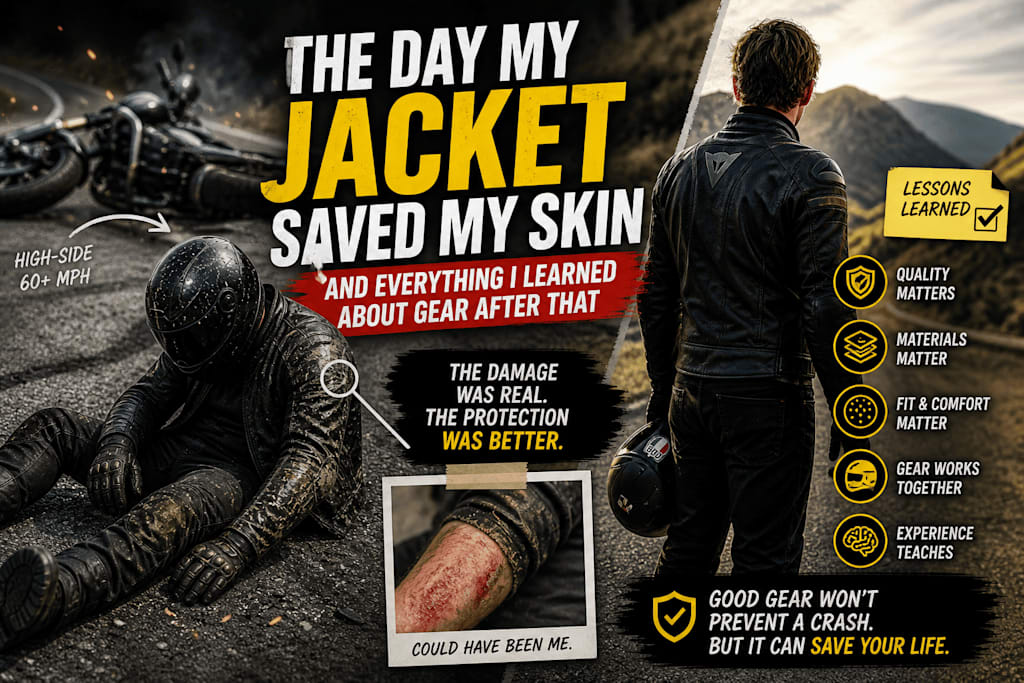
It was a Tuesday morning. Nothing dramatic about the day. I was filtering through slow-moving traffic on my way to work, the kind of commute I'd done a thousand times, when a car door swung open directly into my lane.
I went over the bars.
I don't remember the flight. I remember landing — left shoulder first, then rolling across the asphalt for what felt like three seconds but was probably less than one. I remember lying on my back looking up at a grey sky, taking inventory of my body. Hands: okay. Legs: okay. Shoulder: on fire, but moving.
I stood up. The driver was already out of the car, pale-faced and stammering apologies.
My jacket had a clean abrasion strip from the shoulder seam to mid-forearm. The leather was worn through in one spot about the size of a coin — almost to the liner, but not quite. The CE Level 2 shoulder armor had cracked clean down the middle from the impact. That's what it's supposed to do. Crack so your clavicle doesn't.
That jacket was a $380 piece of gear with 1.2mm full-grain cowhide, double-stitched seams, and rated armor in every zone. I'd almost talked myself into buying something cheaper the month before.
I think about that coin-sized patch of leather a lot.
What That Morning Changed About How I Think About Jackets
Before that crash, I thought about motorcycle jackets the way most new riders do — style first, price second, "protection" as a vague checkbox I assumed any branded gear satisfied. I knew leather was better than nothing. I knew I needed armor. That was about the extent of it.
After: I started learning what the specs actually mean. Not because I became a gear obsessive, but because I understood — in a very personal, very physical way — that this stuff is not decorative.
Here's what I wish someone had told me before I ever bought my first jacket.
Full-Grain Leather Is Not the Same as "Genuine Leather" — Not Even Close
The word "genuine" on a leather jacket label is one of the most misleading terms in the motorcycle gear industry. It sounds like a quality marker. It's actually a material grade — and it's near the bottom of the hierarchy.
Full-grain leather uses the outermost layer of the animal hide, fiber structure completely intact. This is the layer with the highest tensile strength, the highest abrasion resistance, and the longest service life. It's what quality motorcycle gear is built from. Surface isn't perfect — you'll see natural grain variations, small marks, slight color inconsistencies. That's not a flaw. That's what real hide looks like.
Corrected-grain leather has that top surface sanded away and replaced with an embossed, artificial grain. Looks uniform and almost too clean. The sanding removes the strongest fiber layer, which is the part that matters in a slide. It will abrade faster, split sooner, and fail under conditions that full-grain handles without issue.
Bonded leather is leather in name only — shredded leather fibers mixed with polyurethane binder, pressed into sheets. Legally qualifies as leather. Structurally closer to stiffened cardboard. Fashion brands use this constantly. It photographs beautifully. It performs terribly when asphalt is involved.
When I'm evaluating a jacket, I ask one question first: what is the grain type and thickness in Zone 1 — the shoulder and elbow areas? If the answer is anything other than full-grain at a minimum of 1.0mm, I'm looking at fashion gear, not protective gear. The sweet spot for real riding use is 1.2mm to 1.4mm full-grain cowhide. Below 1.0mm in Zone 1 fails EN 13595 high-abrasion zone requirements outright.
CE Ratings: The Numbers Behind the Labels
EN 1621 is the European standard governing impact protectors in motorcycle gear. Two performance levels exist, and the difference between them is not trivial.
CE Level 1 armor transmits an average force of no more than 35 kilonewtons on impact. CE Level 2 armor brings that down to 20 kilonewtons. That 43% reduction in transmitted force is the gap between a badly bruised shoulder and a fractured one at crash speeds that are entirely ordinary on public roads.
Standard armor placement in a motorcycle jacket covers shoulders and elbows. These zones are non-negotiable. What's consistently misrepresented is the back protector.
A jacket can carry CE certification legitimately while shipping with an unrated foam insert in the back pocket. The certification applies only to the shoulder and elbow armor — not whatever they've stuffed behind your spine. I've seen high-priced jackets from brands with strong reputations do exactly this. The product page says "full CE protection." The back protector says nothing, because it has nothing to say.
My routine now: I check the back protector spec specifically before buying anything. I want EN 1621-2 Level 1 at minimum. Level 2 if I'm buying a jacket for anything involving real pace. If the spec isn't listed, I assume it's foam and budget for an aftermarket spine protector separately — Knox, D3O, and Forcefield all make rated inserts that fit most jacket back pockets and cost between $60 and $120.
That crash where my shoulder armor cracked? The back protector in that jacket was EN 1621-2 Level 2. I didn't land on my spine that time. But I've thought about what would have happened if I had.
The Construction Details Nobody Photographs
Product photography shows you the jacket standing still. It doesn't show you the seam stitching, the liner attachment system, or the jacket-to-pant connection zipper — three construction details that affect crash performance more than most buyers realize.
Seam stitching is first. Double-stitched seams with bonded polyester or Kevlar-reinforced thread hold under the tensile forces of a slide. Single-stitched seams are a budget cut that shows up in the worst possible circumstances — the seam blows before the material fails, and you're suddenly exposed in exactly the areas the jacket was supposed to protect. The jacket my friend wore when he went down outside Cork City had single-stitch shoulder seams. He lost the seam on first contact and took road rash from shoulder to mid-back.
Pre-curved sleeves are the second detail. Your elbows maintain roughly 100 to 120 degrees of flexion when you're gripping the bars. A jacket designed for riding accounts for this in the sleeve construction — the sleeves are pre-angled to that position, which means elbow armor sits directly over the olecranon (the point of the elbow) at rest. In a straight-sleeved jacket, elbow armor migrates toward your forearm as you grip and lean. It looks fine standing in a showroom. It's in the wrong place the moment you sit on the bike.
The jacket-to-pant connection zipper is the third, and possibly the most underappreciated feature in motorcycle gear. A 20 to 24-inch circumferential zipper connects your jacket to your riding trousers, creating a single integrated system. In a forward crash or a highside, a jacket without this connection rides up — exposing the lower lumbar region, kidneys, and tailbone. This is a completely preventable injury that fashion-forward brands omit because the zipper adds cost, requires coordinating with trouser design, and doesn't show up in any photograph. It's the detail that tells you immediately whether a brand engineered for crash dynamics or for shelf appeal.
Race-Cut vs. Street-Cut: The Geometry of Where Your Armor Actually Lands
This is the conversation I wish someone had started with me in year one.
A motorcycle jacket is patterned around a body position. The question is: which body position? Race-cut jackets are designed for aggressive forward lean — the tucked posture of someone pushing hard on a sportbike or doing a track day. The front hem is shorter, the rear longer, shoulder seams sit further back, sleeves angle forward. In that position, armor is precisely placed. Stand upright in a race-cut jacket and everything shifts off-center.
Street-cut jackets are designed for upright or moderately forward riding. More volume in the torso, different shoulder geometry, longer front hem. Armor positions correctly when you're sitting naturally on a naked bike, an adventure tourer, or a cruiser.
The practical consequence: wearing race-cut for street riding means your shoulder armor is behind your shoulder joint the whole time. Wearing street-cut on track means it migrates forward when you tuck. In both cases, the armor isn't protecting the impact zone.
I keep two jackets in rotation for exactly this reason. For track days and aggressive canyon sessions, I run motorcycle racing jackets — purpose-built race geometry means protection stays on-joint in the position I'm actually riding in. For commuting, touring, and everyday street miles, I wear leather racing jackets — real leather construction, street-cut geometry, and a fit that holds up through six-hour days without armor drift or shoulder fatigue.
One jacket cannot do both jobs well. The geometry is genuinely different.
Fit Is Not How It Looks in the Mirror — It's How It Sits When You Ride
The single most common mistake I see at gear shops: buyers try on a jacket standing upright, look in the mirror, nod, and hand over a card.
The jacket fit that matters is riding fit — the position your body is in 90% of the time you're moving. Here's how I test every jacket before buying:
I adopt riding position. Lean forward, grip imaginary bars, stay there. In this posture, I check four things. First: shoulder seam placement — it should sit directly on the lateral point of the shoulder, the acromion. If it's pulling toward my neck, the cut or size is wrong. Second: elbow armor location — at riding arm angle, armor should center over the olecranon. If it's riding up my forearm, the sleeve geometry doesn't match my proportions. Third: rear hem drop — with both arms extended forward, the jacket back should not lift above my trouser waistband. Any gap there is unprotected lower back in a crash. Fourth: shoulder rotation — I roll both shoulders forward fully. No restriction means adequate stretch paneling and correct torso dimension. Binding across the upper back means the cut doesn't fit my frame.
If any of those four fail, I move on. Armor position is not adjustable after purchase.
The Honest Version of What to Ignore
Marketing language in the motorcycle gear space is particularly creative. "Genuine leather" we've covered. A few others worth flagging:
"Premium foam protection" means no CE rating — it's comfort padding, not impact armor. "Water resistant" means DWR surface coating that saturates in sustained rain inside 30 minutes, not waterproofing. "CE certified" without specifying the level or which zones are rated tells you almost nothing useful. "Lightweight padding" in armor zone descriptions almost certainly means unrated material.
Real protective gear tells you exactly what it's made of, which EN standards it meets, and the rating level of every armor piece. If that information isn't on the product page, it's either absent or worse than they want you to know.
What Eleven Years Taught Me
I've bought five jackets. Two were genuinely protective. Two were better than nothing. One was costume gear I got rid of after six months when I actually read what EN 13595 required.
The jacket that got scuffed on that Tuesday morning is still hanging in my garage. I keep it because the shoulder armor cracked exactly as designed — absorbing the energy that would have fractured my clavicle — and the full-grain leather held through a concrete-surface slide without failing.
That's what a motorcycle jacket is for. Not for looking good in the car park, though that's a reasonable secondary benefit. It's for the Tuesday mornings you didn't see coming.
Buy accordingly.
Ride your own ride. Gear up like you plan to keep doing it.
About the Creator
Enjoyed the story? Support the Creator.
Subscribe for free to receive all their stories in your feed.
Comments
There are no comments for this story
Be the first to respond and start the conversation.