
My $35 Wake-Up Call
How a tiny automated budgeting glitch exposed the cracks in my personal finance setup, and how I fixed it.
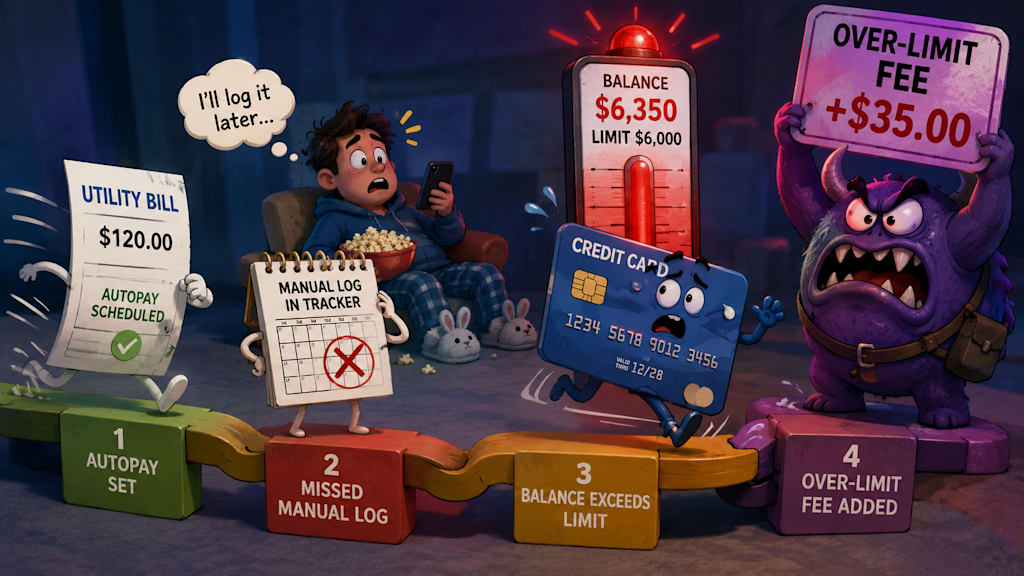
I screwed up a perfect system. My pristine, ten-year-old financial ledger crumbled because I forgot to type a single number into a spreadsheet cell.
The alert arrived at 3:14 AM on a Tuesday, blinking on my phone with the sterile hostility only an automated bank notification can manage. It said my account balance exceeded its credit limit. A $35 penalty fee had already been assessed to my account, a stinging reprimand for a professional who preaches financial optimization.
My automated ecosystem had betrayed me. More accurately, my lazy assumption of its perfection had caused a catastrophic system failure. I sat at my desk in the dark, staring at a screen that insisted I owed money I had not accounted for in my monthly projections.
The culprit was my summer electric bill, a recurring charge of $345.20 that pulls automatically every July. I normally track this with religious compliance, logging the pending hit the moment the utility company generates the invoice. This month, I opened the email notification during a chaotic team meeting, closed it, and buried it under a mountain of mental debris.
The Timeline of an Overage
I opened my local ledger software and pulled the last 30 days of credit card statements to map out the exact sequence of the breach. My credit card has a strict $1,000 limit, a deliberate constraint I enforce to keep my utilization metrics clean and my spending disciplined.
My spreadsheet told me I had a safe cushion of $410 remaining on the card. The bank ledger told a completely different, much more aggressive story.
The automated utility payment hit the card network on Friday night. Because bank clearing systems essentially go to sleep over the weekend, the transaction sat in a pending status, invisible to my automated balance scraper but actively reducing my available credit. Ignorant of this hidden liability, I used the same card on Sunday morning to purchase bulk household supplies, an intentional, frugal run meant to stock my pantry for the quarter.
That $225 grocery bill pushed the absolute balance to $1,015.20. The system did not decline the card at the cash register, it simply waited for the processing window to close before hitting me with a punitive over-limit fee.
July 10, 09:00: The utility company generates a $345.20 invoice. I miss the manual entry, leaving my reported ledger balance blind at $354.80 while my true available credit drops to $645.20.
July 14, 23:30: Auto-pay executes silently on the card network. No tracking occurs, keeping the balance pending while true available credit shrinks to $299.80.
July 16, 11:15: I make a $225.00 bulk grocery purchase and log it manually. Reported balance climbs to $579.80, leaving a paper-thin true credit margin of $74.80.
July 17, 00:01: The utility payment posts completely. The reported balance spikes to $1,015.20, sending true available credit into the negative at -$15.20.
July 17, 03:14: The bank triggers an automated $35.00 over-limit fee. The error alert hits my phone as the final ledger balance balloons to $1,050.20.
The timing was engineered for maximum institutional profit. Banks do not want to prevent your mistakes, they want to capitalize on them. The deliberate delay between authorization and settlement is a feature of their business model, not a bug.
Why Your Bank Dashboard Lies
Financial institutions thrive on the friction between real-time authorization and delayed settlement. When you swipe a card, the merchant checks if you have the funds, but the actual movement of currency takes days. This latency creates a dangerous gray zone for anyone practicing high-precision frugal living.
My system relied on the flawed assumption that my bank's front-end dashboard reflected reality. It does not. The dashboard displays what the bank wants you to see, while the core banking ledger operates on its own archaic timeline.
I spent three hours parsing the raw metadata from my bank's API to understand why the grocery charge cleared before the utility bill. The utility provider used a batch-processing network that delays settlement by up to 72 hours. The grocery store used a modern merchant aggregator that settles within 12 hours.
This structural mismatch meant my grocery purchase leapfrogged the utility bill in the final posting sequence. The bank's overnight batch script processed the utility bill last, realized the balance breached the threshold, and instantly generated the fee. It was an algorithmic trap.
The Opt-In Trap You Forgot About
I had forgotten a critical administrative vulnerability buried deep in my account history. Years ago, I signed an opt-in form allowing the bank to process over-limit transactions to avoid the embarrassment of a card decline at a retail counter.
The Credit Card Accountability Responsibility and Disclosure Act of 2009 explicitly bans automatic over-limit fees unless a consumer explicitly consents to this setting. By checking that box a decade prior, I handed the bank a legal license to pillage my account whenever my tracking slipped.
The bank weaponized my old preference against me. They processed the grocery transaction without a warning prompt, creating a high-interest liability under the guise of customer convenience.
They broke the law. The CARD Act dictates an over-limit fee cannot exceed the actual overage amount, meaning my fifteen dollar breach capped their legal fee right there, yet their automated system slapped me with a generic thirty-five dollar penalty anyway.
The Payment Rails That Broke Me
Understanding the mechanics of this failure requires looking at how different payment rails operate. The utility payment was routed as a recurring credit card transaction, which behaves differently than a standard Automated Clearing House withdrawal.
Credit card transactions require an immediate authorization hold that reserves a portion of your credit line. This hold is a temporary block that prevents you from using those funds elsewhere.
The problem lies in how these holds are communicated to third-party budgeting software. Most consumer financial applications pull data from consumer-facing APIs that only refresh settled transactions once per day. If an authorization hold occurs between those sync intervals, your software remains completely blind to the reduction in your spending power.
My ledger assumed the card had $410 of available space because the $345.20 hold was buried in the unpolished pending data layer. The grocery store swipe executed a second authorization hold for $225.00, which the network approved because banks routinely allow minor overages to maximize transaction fees later.
Automation Breeds Laziness
Frugal living influencers love to scream about automation. They tell you to automate your savings, your bills, your investments, and your entire life. They are selling a dangerous lie that breeds cognitive laziness.
Automation strips away the tactile awareness of money moving out of your control. When I stopped manually confirming the cash outflows, I lost my intuitive grip on my liquidity boundaries.
The missed entry was not just an oversight, it was a systemic failure of my operational redundancies. I had built a fragile architecture that required absolute human perfection to prevent software-driven penalties. If a budgeting framework falls apart because a human forgets one keystroke during a busy workday, the framework is garbage.
I examined my budget rules to see why my alert protocols failed. My tracking script was set to scrape my credit account every 24 hours at noon. Because the utility charge landed in the pending queue late Friday and posted late Sunday, the noon scrapes missed the critical transition window entirely.
The Credit Utilization Trap
I fell victim to the optimization paradox. In my quest to maintain a near-perfect credit score, I kept the credit limit on this specific account artificially low.
A low credit limit ensures that even a moderate balance forces me to pay off the card immediately, keeping my reported credit utilization ratio below the ideal 5 percent threshold. This hyper-optimization stripped my system of its shock absorbers.
Frugal systems must be built to withstand human error. By capping my credit line at $1,000, I left no room for the natural volatility of seasonal expenses. A hot July meant higher air conditioning costs, which translated into a larger utility invoice that choked my narrow credit pipeline.
The pursuit of theoretical perfection in credit scoring directly caused a practical financial loss in the form of an over-limit fee. I prioritized an abstract metric over operational resilience.
Building a Buffer That Works
Fixing this mess required more than just paying the fee and begging a customer service representative for a courtesy waiver. I refuse to rely on corporate charity to patch flaws in my personal infrastructure. I needed to build a resilient system that assumes I will forget things.
I completely overhauled my cash flow management protocol. The first step was eliminating the low-limit bottleneck that caused the crisis.
I immediately requested an increase in the credit limit, not to spend more, but to expand the structural buffer zone. This shifted my available credit on that specific card from $1,000 to $5,000, instantly neutralizing the risk of an over-limit penalty from standard operational fluctuations.
Credit limit caps: I replaced the artificially low $1,000 utilization target with an expanded $5,000 buffer zone, eliminating over-limit fee triggers completely.
Reconciliation frequency: The slow 24-hour batch scrape via third-party APIs is gone, replaced by webhook-driven, real-time push alerts that reduce visibility latency to seconds.
Utility payment routing: I stripped direct recurring charges from my daily credit cards and routed them to a dedicated checking account via ACH, isolating volatile bills from daily spend cards.
Ledger redundancy: Instead of relying on manual entries tied to email alerts, I implemented dual-entry verification with tokenized logs to eliminate single points of human failure.
I changed the payment routing for all variable utility bills. Moving these recurring, volatile expenses off my primary spending cards and onto a dedicated checking account shielded my daily operations from sudden balance spikes. The checking account holds a permanent, static buffer equal to two months of peak historical utility costs.
This creates a financial moat. Even if a bill doubles due to an unprecedented heatwave, it cannot compromise my credit lines or trigger predatory institutional penalties.
Killing Latency with Direct APIs
The manual entry system needed a digital fail-safe that did not rely on my memory. I abandoned the standard daily API scraping method, which suffers from severe latency, and transitioned to a webhook-driven push system.
I bypassed the slow aggregators entirely and hooked directly into my bank's developer notification API. The moment a merchant hits the network for an authorization hold, their system pushes a JSON payload directly to my server.
My server parses this payload and immediately updates a dedicated shadow ledger. This shadow ledger calculates a highly conservative metric I call the true available balance.
If the true available balance drops below a predefined safety threshold, the system triggers an aggressive notification protocol across my personal devices. This ensures I am aware of the credit constriction within seconds of the transaction, entirely bypassing the multi-day settlement delay inherent to the banking network.
Inside the Shadow Ledger
The script I designed operates on a zero-trust model. It assumes that the bank's reported balance is inaccurate until proven otherwise.
The core logic utilizes an automated forecasting loop written in Python. The script monitors historical transaction patterns, analyzing the exact cadence of recurring bills over a trailing 36-month window.
It identifies the mean posting date and the standard deviation of the bill amounts. Using this data, the script automatically injects a predictive placeholder transaction into the ledger five days before the earliest expected billing date.
This placeholder acts as a financial quarantine. The ledger locks down those funds, subtracting them from my viewable spending allowance before the utility company even executes the charge.
When the actual transaction webhook arrives, the script matches the real transaction against the predictive placeholder using a fuzzy matching algorithm based on the merchant name and value variance. The placeholder is then replaced by the verified record, ensuring my budget tracking remains seamless and completely immune to human forgetfulness.
Fatigue Is the Real Budget Killer
We love to think we are rational actors when managing money. We buy into the myth of the spreadsheet as an extension of pure logic. My financial autopsy proved that emotion and cognitive fatigue are the ultimate drivers of systemic breakdown.
I missed that logging because I was exhausted. My brain categorized the utility email as low-priority background noise compared to the immediate stress of my professional obligations.
The banking industry designs its systems to exploit these moments of exhaustion. Over-limit fees, overdraft charges, and late penalties are not accidental byproducts of banking operations, they are core revenue drivers engineered to penalize human imperfection. By automating my finances without rigorous fail-safes, I walked directly into their trap.
Frugality is not about depriving yourself of lattes or hunting for coupons. True frugality is the systematic reduction of structural waste and institutional friction. When you allow a bank to extract money from your ecosystem for a fifteen-dollar tracking error, you have failed at the most fundamental level of capital preservation.
The Illusion of Algorithmic Safety
Relying entirely on algorithms creates a false sense of security that dulls your financial instincts. When you believe your system is infallible, you stop looking at the details.
This incident forced me to acknowledge that visibility is the only real defense against institutional predation. If you cannot see your money moving in real time, you are operating at a massive disadvantage.
The modern banking stack is built on old core infrastructure that cannot handle instantaneous, transparent settlement. They mask this technological obsolescence with slick mobile applications that give users the illusion of immediacy while hiding the actual settlement machinery behind a curtain of pending states.
My new system strips away that illusion by creating an independent, self-hosted tracking environment that mirrors the worst-case scenario of my financial reality at all times. I no longer care what the bank says my balance is. I only care what my shadow ledger projects it to be.
Forcing the Bank to Blink
I refused to allow the bank to keep that money without a fight. Armed with the chronological data from my API logs, I initiated a formal challenge through the bank's priority service channel.
I presented a detailed breakdown of the authorization timestamps, proving that the bank deliberately delayed the settlement of the larger recurring bill while accelerating the smaller retail transaction to engineer an artificial overage. The customer service representative read from a script, offering standard corporate platitudes about terms and conditions.
I bypassed the tier-one support matrix by requesting an escalation to the risk compliance department, citing predatory transaction ordering practices. Once a senior manager reviewed the systematic logs and realized I possessed precise technical proof of their clearing latency, they agreed to issue a courtesy credit for the full fee amount.
The financial recovery was trivial, but the validation of my system design was absolute. They backed down because they realized they were dealing with an auditor, not a passive consumer.
Zero-Trust Financial Engineering
The final phase of my recovery plan involved stress-testing the new architecture against historical anomalies. I simulated a sequence of compounding financial shocks, including overlapping insurance premiums, erratic utility surges, and unexpected medical bills occurring simultaneously within a single billing cycle.
The system successfully maintained its operational integrity throughout the simulation. The predictive placeholders caught every recurring charge, and the webhook protocols accurately adjusted the spending caps in real time.
I built a series of rigorous, code-based safety checks to protect against future lapses. The framework now treats human input as a high-risk variable rather than a reliable source of truth.
True optimization requires a constant willingness to tear down your frameworks and rebuild them from scratch when they fail. Every line of code in my new architecture serves as a permanent, functional barrier against the quiet creep of operational neglect.
Disclaimer: Content is for informational purposes only and does not constitute professional advice.
About the Creator
TheFabledScribe
Expert in budgeting and frugal living. Using proven strategies to build financial resilience. Trustworthy guidance for average people seeking results.
I will NEVER put my content behind a paywall..
Enjoyed the story? Support the Creator.
Subscribe for free to receive all their stories in your feed.
Comments
There are no comments for this story
Be the first to respond and start the conversation.