
My $25 Mistake Broke My Budget
I spent my grocery money on a birthday gift and starved for two weeks.
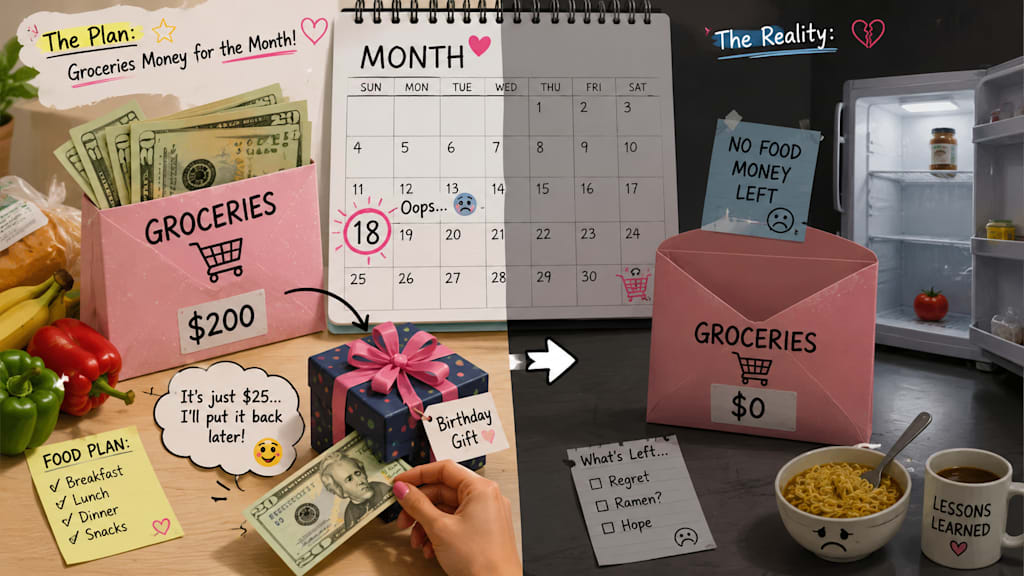
I stared at the empty cash envelope. The label said "Groceries." The date said July 18. My stomach dropped. I had spent the money on a birthday gift for a coworker. I told myself it was just one time. It wasn't. The envelope held nothing. My fridge held nothing. The rest of the month looked like a black hole.
This wasn't a bad month. This was a system failure. I built a cash envelope system to stop my overspending. I thought it was foolproof. I was wrong. The hole in my pocket wasn't the envelope. It was my lack of a buffer. I spent the $25 without a second thought. I didn't check my total. I didn't move money from another category. I just grabbed the cash and walked away.
The next two weeks were a lesson in math and shame. I ate rice. I ate beans. I ate nothing but the bare minimum. I counted every penny. I walked past the grocery store without going in. The panic was real. I couldn't sleep. I kept thinking about the food I couldn't buy.
I needed to fix this. I needed to know exactly how my money moved. I couldn't trust my memory. I couldn't trust my gut. I had to build a real system. One that didn't break when I made a mistake. One that didn't leave me eating rice for two weeks.
How the Math Blew Up
I started by looking at the numbers. I pulled out my ledger. I wrote down every single transaction from the last month. I didn't skip anything. I didn't round up or down. I wrote the exact amount. The $25 for the gift stood out like a sore thumb. It was the only number that didn't belong.
I looked at my other categories. The numbers told a different story.
Dining Out had $40 left.
Entertainment had $60 left.
Clothing had $100 left.
I had money. I just had it in the wrong place. My system didn't let me move it. The envelopes were rigid. They didn't talk to each other. I treated them like separate bank accounts. They weren't. They were all my money.
The table showed the truth. I had $200 left in other categories. I had $0 in groceries. The math was simple. The system was broken. I needed a way to move money fast. I needed a way to see the whole picture. I needed a buffer.
I realized I didn't have a "Emergency" category. I didn't have a "Miscellaneous" category. I had strict lines. I had rigid rules. I had no room for error. One mistake and the whole thing collapsed. I built a house of cards. I blew on it. It fell down.
Building a System That Doesn't Break
I started over. I kept the cash envelope idea. I liked the feel of the money. I liked the physical limit. But I changed the rules. I added a new envelope. I called it "Buffer." I put $50 in it. I didn't touch it unless something went wrong.
I also changed how I tracked spending. I didn't just write numbers in a notebook. I used a simple spreadsheet. I updated it every day. I checked the totals. I checked the balances. I made sure the math worked. I didn't wait until the end of the month. I did it daily.
The flow looked like this:
July 1: Groceries started at $200.
July 5: Groceries spent $25, balance dropped to $175.
July 10: Dining Out spent $15, balance dropped to $35.
July 12: Buffer added $50.
July 18: Gifts spent $25, Buffer hit $0.
July 18: Buffer moved $25 to Groceries, Buffer balance sat at $25.
The spreadsheet showed the flow. I moved the $25 from "Buffer" to "Groceries" the moment I spent it on the gift. I didn't wait. I didn't panic. I fixed it before it broke. The system held. I didn't eat rice for two weeks. I ate real food. I slept at night.
I also changed my mindset. I stopped treating the envelopes like sacred cows. They were tools. They were not the boss. I was the boss. If I needed to move money, I moved it. If I needed to break a rule, I broke it. As long as the math worked, I was good.
The "Buffer" envelope became my safety net. I filled it every month. I didn't spend it unless I had to. It grew. It gave me peace of mind. It stopped the panic. It stopped the shame. It stopped the rice.
The Real Cost of a Broken System
The cost of my mistake wasn't just $25. It was the stress. It was the sleepless nights. It was the fear of not having food. It was the feeling of failure. I felt like I was losing control. I felt like I was bad with money. I wasn't. I just had a bad system.
A good system doesn't punish mistakes. It fixes them. It learns from them. It adapts. My old system didn't do that. It just broke. It left me stranded. It left me hungry. It left me scared.
The new system works. It's not perfect. I still make mistakes. I still spend money I shouldn't. But I catch it. I fix it. I move the money. I don't panic. I don't stress. I don't eat rice.
I learned that budgeting isn't about restriction. It's about control. It's about knowing where your money goes. It's about having a plan. It's about having a backup plan. It's about having a buffer.
The $25 mistake taught me more than any book ever could. It taught me that systems need to be flexible. It taught me that I need to be the boss. It taught me that I can fix my mistakes. It taught me that I can control my money.
The Next Step
I'm not done. I'm still learning. I'm still tweaking. I'm still building. The system gets better every month. The buffer gets bigger. The stress gets smaller. The food gets better.
I'm looking at my next month. I'm setting new goals. I'm saving more. I'm spending less. I'm staying in control. The $25 mistake is gone. It's in the past. It's a lesson. It's a memory. It's not my future.
The future is full of food. Full of sleep. Full of peace. The system works. I work. We work together.
Disclaimer: Content is for informational purposes only and does not constitute professional advice.
About the Creator
TheFabledScribe
Expert in budgeting and frugal living. Using proven strategies to build financial resilience. Trustworthy guidance for average people seeking results.
I will NEVER put my content behind a paywall..
Enjoyed the story? Support the Creator.
Subscribe for free to receive all their stories in your feed.
Comments
There are no comments for this story
Be the first to respond and start the conversation.