
Most User Feedback Doesn't Actually Go Missing
Most Feedback Systems Feel Like Storage Rooms

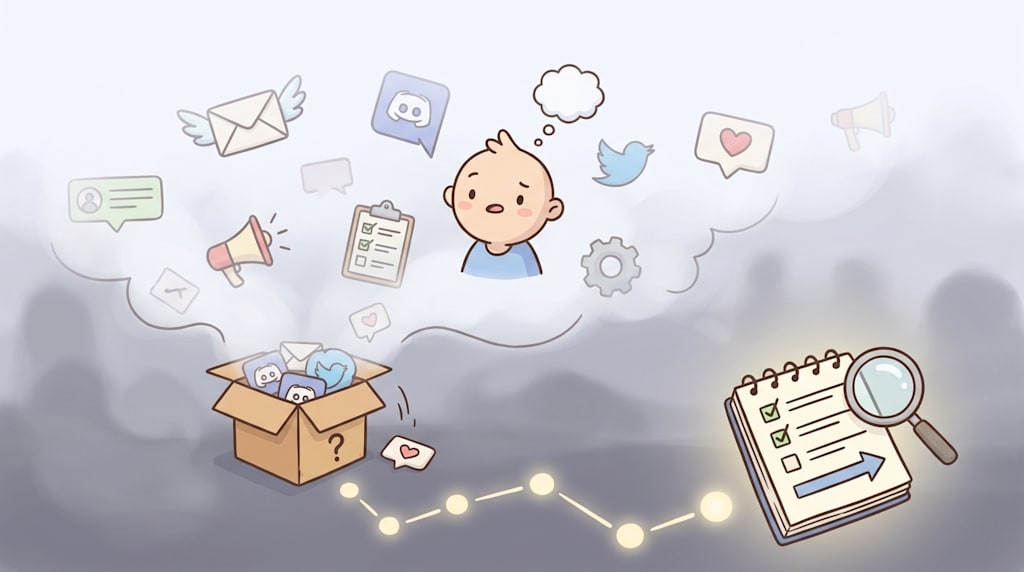
It just slowly becomes invisible.
Not because teams don't care.
Not because customers stop talking.
And not even because there aren't enough tools.
But because feedback today lives everywhere at once.
A support email.
A Discord message.
A comment under a product launch.
A feature request hidden inside a long conversation.
A frustrated tweet.
A survey response that nobody opens again.
At some point, every growing product runs into the same strange problem.
People keep sharing ideas.
The team keeps collecting them.
Yet somehow, everyone feels unheard.
I used to think the biggest challenge was gathering feedback.
Now I think the harder part is remembering what already exists.
Most Feedback Systems Feel Like Storage Rooms
A lot of products are surprisingly good at capturing information.
They're much less effective at creating continuity.
You submit something.
It disappears into a dashboard.
Someone labels it.
Maybe someone exports it.
Weeks later, another customer asks for exactly the same thing.
The cycle starts over.
Eventually, the company has hundreds of requests.
Customers think nobody is listening.
The team thinks they have too much to process.
Both sides are technically right.
Duplicate Requests Aren't Really the Problem
At first, I assumed repeated feature requests were a sign of bad organization.
Now I'm not so sure.
People naturally describe the same frustration differently.
One person says:
"I wish this was faster."
Another says:
"This workflow feels clunky."
Someone else writes three paragraphs explaining why they almost stopped using the product.
They're all pointing toward the same experience.
But unless someone connects those dots, they remain separate conversations.
That connection usually requires time.
And time is exactly what small teams don't have.
Public Roadmaps Change the Emotional Dynamic
One thing I've noticed is that users often don't expect every request to be accepted.
They mostly want evidence that it was seen.
A visible roadmap does something interesting psychologically.
It reduces uncertainty.
People can tell whether an idea is being considered.
Whether it's planned.
Whether it was rejected.
Or whether it's simply not the right priority.
Silence creates frustration.
Transparency creates patience.
That doesn't mean public roadmaps solve everything.
Sometimes they create expectations that are difficult to manage.
People may assume every visible request will eventually become reality.
It won't.
And that's probably okay.
Products need direction as much as they need feedback.
Changelogs Are More Important Than They Look
I ignored changelogs for years.
I thought they existed mostly for technical teams.
Then I realized I was checking them before deciding whether to stay with certain products.
A good changelog quietly answers a simple question:
"Is this thing still alive?"
Regular updates create a feeling of momentum.
Even small improvements matter.
Not because every change is revolutionary.
But because visible progress builds trust over time.
Ironically, many companies spend huge amounts of energy acquiring users while making their existing users guess what is happening.
AI Doesn't Replace Product Judgment
Recently, more feedback platforms have started using AI to organize incoming requests.
Honestly, that makes sense.
Reading hundreds of repetitive messages manually isn't a particularly creative task.
Grouping similar ideas.
Removing obvious duplicates.
Finding recurring themes.
Those are areas where automation can actually reduce noise.
But I don't think AI should decide what gets built.
Patterns are useful.
Context is still human.
A highly requested feature isn't automatically the right one.
Sometimes the loudest requests come from a small group.
Sometimes a niche complaint reveals a much bigger underlying issue.
Good product decisions still require interpretation.
The Best Systems Feel More Like Conversations
While trying different approaches, I found myself appreciating platforms that make feedback feel less transactional.
Instead of acting like a suggestion box, they create an ongoing relationship.
People can see progress.
Teams can explain priorities.
Updates don't disappear into private documents.
That loop feels surprisingly important.
I spent some time experimenting with FeedLog, an open-source platform built around that idea.
What stood out wasn't that it collected feedback.
Lots of products do that.
What felt different was the attempt to connect collection, organization, roadmap visibility, and product updates into one continuous flow.
The AI-assisted categorization reduced repetitive clutter, but the public-facing pieces were what changed the experience for me.
The process felt less like sending requests into a void.
And more like participating in a product's evolution.
Of course, there are trade-offs.
Open communication requires consistency.
A public roadmap needs maintenance.
Visible discussions create accountability.
Those things take effort.
No platform can automate trust by itself.
The Internet Has Made Expectations Faster
People are used to immediate responses now.
Messages are instant.
Notifications are instant.
Content is instant.
Product development isn't.
Sometimes the gap between those two realities creates unnecessary tension.
Users think nobody is listening.
Teams think nobody understands how long good work takes.
Maybe feedback platforms are becoming less about collecting ideas...
...and more about helping both sides understand each other.
Maybe the Goal Isn't More Feedback
This is probably the biggest shift in how I think about product building.
Most companies don't suffer from a lack of opinions.
They suffer from fragmented conversations.
The challenge isn't creating another place where people can leave requests.
It's making those requests visible, connected, and meaningful over time.
Because when people believe their voices disappear, they eventually stop sharing them.
And when that happens, products don't just lose feedback.
They lose one of the few honest signals they can still get from the people who actually use them.
About the Creator
Enjoyed the story? Support the Creator.
Subscribe for free to receive all their stories in your feed.
Comments
There are no comments for this story
Be the first to respond and start the conversation.