
I Asked a Chinese Chef Why His Recipes Say “A Pinch.” He Handed Me a Macaron.
The difference between “a pinch” and “5 grams” comes down to standardized ingredients, reversible processes, and whether your kitchen can taste as it goes.
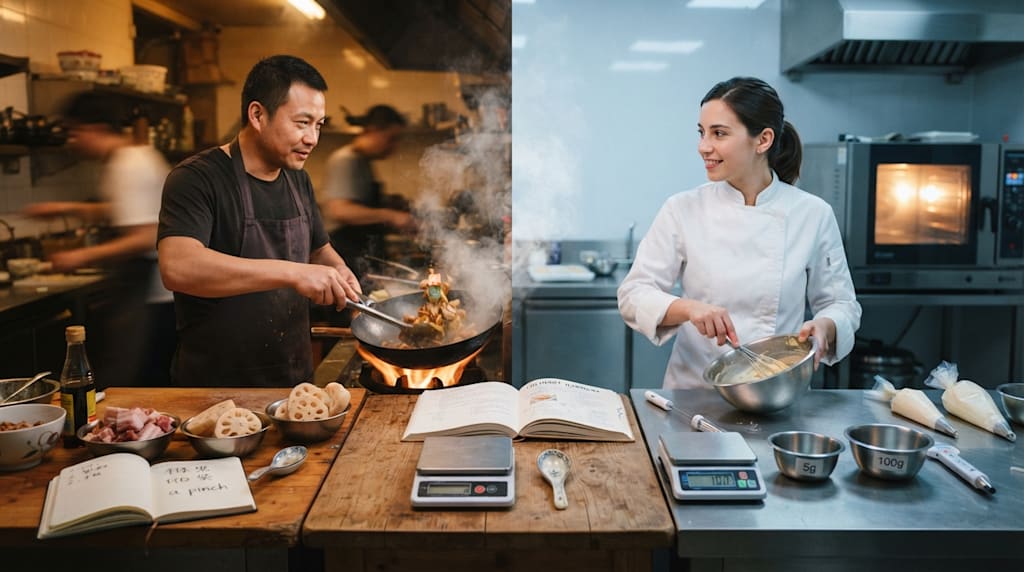
I
Chef Chen’s recipes never said anything but “a pinch.”
The first time Xiao Zhou saw that handwritten notebook, he thought he had picked up the wrong thing. Red-braised pork: pork belly, as needed; rock sugar, a pinch; soy sauce, as needed; a few slices of ginger; cooking wine, a pinch. That was it. He turned the page. Kung Pao chicken: chicken thigh, as needed; peanuts, as needed; dried chili, a pinch; Sichuan peppercorn, a pinch; sweet-and-sour sauce, as needed. He closed the notebook and asked, “Chef Chen, how much is ‘a pinch’?”
Chef Chen was cutting meat. He did not look up. “You add some. Taste it. If it is not enough, add more.”
Xiao Zhou had graduated from a Western culinary school. He was used to salt 5 grams, sugar 30 grams, butter 120 grams, cake flour 200 grams. Every page of his notebook was numbers. The first time he entered that kitchen, he watched Chef Chen stir-fry. A handful of salt. A handful of sugar. He panicked. He asked, “Aren’t you going to weigh it?”
Chef Chen said, “Weigh what? How thick is this meat? How big is this flame? How salty is this soy sauce? Can you weigh that?”
Xiao Zhou was not convinced. He went home and bought a digital scale. He translated Chef Chen’s recipes into grams. Pork belly 500 grams, rock sugar 15 grams, soy sauce 20 milliliters, ginger 5 grams, cooking wine 10 milliliters. He made it. Too sweet. He cut the sugar. Too salty. He cut the salt. The meat was dry.
He did it seven times. He failed seven times.
The eighth time, Chef Chen stood beside him and said, “Taste it.”
Xiao Zhou tasted it.
“What is missing?”
“Missing… sweetness?”
“Then add sugar. Do not weigh it. Add a spoon. Taste. Not enough, add more.”
Xiao Zhou added half a spoon of sugar. Tasted. Added a little more. Tasted. Done.
That night, Xiao Zhou made a decent pot of red-braised pork for the first time. He asked Chef Chen, “Why can’t your recipes be written clearly?”
Chef Chen said, “I did write it clearly. ‘A pinch’ is clear. If I tell you 15 grams, what you make will not be the same as mine. Your meat is not my meat. Your flame is not my flame. Your soy sauce is not my soy sauce. If you copy 15 grams, what you make is your 15 grams, not mine.”
II
Later, Xiao Zhou worked in a Western restaurant. He made macarons, precise to 0.1 gram. Egg white 100 grams, almond flour 100 grams, powdered sugar 100 grams, caster sugar 80 grams. Temperature 150 degrees, 12 minutes. Every time, success. He told Chef Chen. Chef Chen said, “Teach me.”
Chef Chen made macarons. First time, they collapsed. Second time, they cracked. Third time, he weighed everything, precise to the gram, and succeeded. He held the macaron and looked at it for a long time. “This one,” he said, “a pinch won’t do.”
Xiao Zhou laughed. “You have your day too.”
Chef Chen did not laugh. He put the macaron in a box and said, “Do you know why? Macaron ingredients are standardized. Almond flour is almond flour. Powdered sugar is powdered sugar. Egg white is egg white. You tell me 100 grams. I weigh 100 grams. What we make is about the same. Red-braised pork is different. The pork belly you buy has a different fat-to-lean ratio from mine. The soy sauce you use has a different saltiness from mine. Your flame is different from mine. You tell me 15 grams of rock sugar. I do it. It might be too sweet. It might not be sweet enough. In this pot, fifteen grams has no meaning. The meat, the flame, and the soy sauce are all different.”
Xiao Zhou said, “Then what do we do?”
Chef Chen said, “Taste. Taste, then add. Add until it is right.”
III
In a Chinese kitchen, the core action is tasting.
Stir-frying greens: add a little salt first, toss, taste. Not enough, add more. Red-braised pork: when the sauce has reduced halfway, taste for salt and sweetness, then decide whether to add sugar or salt. Stewing soup: skim the foam, taste, then decide whether to add ginger, wine, or pepper. This is a closed loop: add seasoning, taste, judge, correct, taste again. Since you can keep correcting during the process, you do not need to be precise to the gram at the start.
“A pinch” means add a little first, leave room. “As needed” means the target taste is the measure, not the number.
You buy a pork trotter and ask, “How many grams of rock sugar?” The question barely holds. How much does the trotter weigh? How thick is the skin? How fatty is the meat? How thick is the bone? Front trotter or back? The pig’s breed, age, feed, exercise. All different. You buy a lotus root and ask, “How much salt?” What month is this lotus root from? Is it starchy or crisp? How much water? How sweet? You pick up a bottle of soy sauce and ask, “How many milliliters?” Is it first-press or second-press? Is it high-salt diluted or low-salt solid-state? Is it southern sweet soy sauce or northern salty soy sauce? I do not even know how salty your soy sauce is. How can I tell you how many milliliters?
Once you introduce non-standard ingredients, grams lose their reproducible meaning. I can tell you that my pork trotter used 15 grams of rock sugar. You cannot buy the same trotter as mine. Maybe not even the other trotter from the same pig. If you copy 15 grams, your taste will not be the same as mine.
So Chinese cooking’s “a pinch” and “as needed” admit something: in a system where variables are not controlled, precise numbers are fake precision.
IV
Western cooking also uses “as needed.” English recipes are full of salt and pepper to taste; a pinch of salt; a knob of butter; a splash of wine; until golden brown; cook until tender. These expressions are no different in essence from Chinese “a pinch,” “as needed,” and “when the heat is right.” They also depend on experience. They also leave judgment to the cook.
Precision to the gram tends to cluster in a few areas: baking, pastry, sauces, chain restaurants, food industry, molecular gastronomy. The common features: standardized ingredients, fixed processes, need for reproducibility, and no or little mid-course adjustment. A chain fast-food restaurant in Beijing today, Shanghai tomorrow, London the day after, must give customers the same taste. It needs grams. A French pastry shop must make sure every macaron has a pretty foot. It needs grams.
But a French mother making beef stew also says “add a little red wine,” “a few sprigs of thyme,” “cook until the meat is tender.” An Italian grandmother making tomato sauce also says “olive oil as needed,” “a handful of basil.” So the split is not West precise, East vague. Standardized subsystems are precise. Non-standard wholes are vague. Reproducible modules are precise. On-site adjustment is vague.
V
Today’s Chinese kitchen is no longer ruled by “a pinch” and “as needed.”
Central kitchens of chain restaurants, hotpot base factories, braised-food factories, prepared-meal production lines: all must be precise to the gram. They must make every batch taste the same, keep food safe, and control cost. A hotpot base formula: beef tallow in grams, chilies in grams, Sichuan peppercorn in grams, doubanjiang in grams, spices in grams. All have strict ratios. A bun filling: salt, sugar, soy sauce, sesame oil, ginger-scallion water. Possibly precise to the gram. A chain fast-food Kung Pao chicken: the sweet-sour ratio cannot be one way today and another way tomorrow.
High-end Western kitchens increasingly talk about “taste and adjust.” Top ingredients are non-standard. Today’s fish is not yesterday’s fish. Today’s tomato is not yesterday’s tomato. A master chef will not be completely bound by grams. They look. They smell. They taste. They touch.
So nationality is the wrong dividing line. The useful questions are: Are the ingredients standardized? Is the process reversible? Can it be adjusted midway? Does the goal require exact reproduction every time? Is it an industrial kitchen or a home kitchen? Is it a beginner’s recipe or a master teaching an apprentice?
The answers decide whether you use grams or “a pinch.”
VI
Later, Xiao Zhou and Chef Chen worked together at a fusion restaurant. One dinner service, Xiao Zhou was in charge of Chinese dishes. He cooked by grams. The guest said, “The taste is off.” Chef Chen was in charge of Western pastries. He cooked by experience. The guest said, “Too sweet.” The two argued in the back kitchen. Xiao Zhou said, “Your ‘a pinch’ can’t be reproduced at all!” Chef Chen said, “Your grams don’t understand flexibility at all!”
After the argument, they were silent. Chef Chen spoke first: “Your macarons. I made them by grams. They worked. My red-braised pork. You made it by ‘a pinch.’ It worked too.”
Xiao Zhou said, “So?”
Chef Chen said, “Weigh when you should weigh. Taste when you should taste.”
That night, they wrote a new recipe together. Xiao Zhou wrote: Salt 5 grams (about one teaspoon; adjust after tasting). Chef Chen wrote: Salt, a pinch (about 5 grams; depends on ingredients).
The two recipe books sat side by side on the table. One’s numbers were a starting point. The other’s numbers were a reference. Neither replaced the other. On the table, the scale and the spoon stayed within reach.
About the Creator
Jin
Writer of reamstories
https://reamstories.com/jin
Enjoyed the story? Support the Creator.
Subscribe for free to receive all their stories in your feed. You could also become a paid subscriber, letting them know you appreciate their work.
Comments
There are no comments for this story
Be the first to respond and start the conversation.