
Corporal punishment in schools.
Spare the rod, spoil the child.

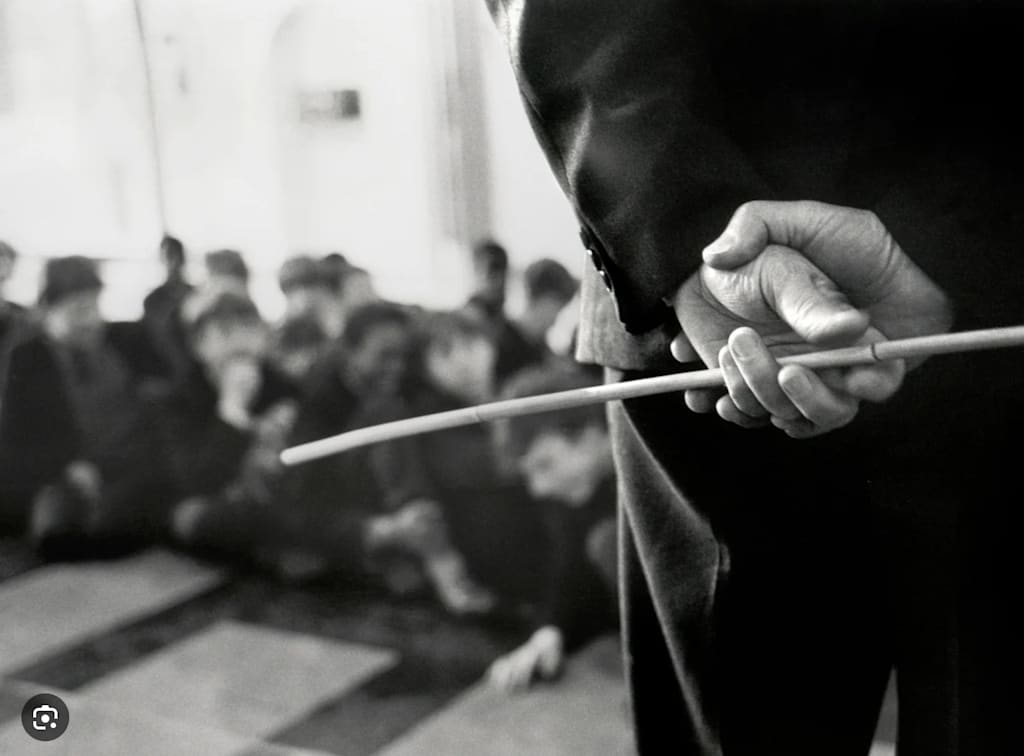
the 1970s, corporal punishment was a deeply entrenched, institutionalized norm in South African schools, heavily influenced by the authoritarian values of the apartheid state. Administered primarily with a cane, paddle, or sjambok, it was systematically used across all racial divisions to enforce strict discipline and unquestioning obedience to authority.
The Ideological FoundationApartheid & Bantu Education: Under the regime's Christian National Education policies and the Bantu Education Act, the state utilized physical discipline to keep black citizens subservient and to shape all students into passive, obedient subjects.
A Culture of Violence: Because the broader society was rooted in systemic oppression and violence, physical punishment in schools was generally taken for granted by both administrators and the majority of parents.
Administration and ApplicationTools and Targets: Teachers, often feared by students, wielded long, flexible wooden sticks (the "cane") or paddles. Boys were typically beaten on their buttocks, while girls were struck on the hands or legs.
Universal Practice: While corporal punishment was most excessively used in white single-sex boys' schools, it was broadly applied across all racial and gender lines—unlike in some Western countries, African girls were never exempted from beatings.
Resistance and DebateStudent Rebellions: As political resistance swelled during the 1970s—culminating in the 1976 Soweto uprising—student organizations increasingly targeted the brutal, authoritarian disciplinary regimes in their schools, connecting physical abuse to the wider injustices of apartheid.
Psychological Pushback: By the late 1970s, psychologists and progressive academics began heavily criticizing the practice. They warned that caning caused severe emotional damage, lowered self-esteem, and negatively impacted academic performance, rather than genuinely improving behavior.The widespread use of physical force in the classroom left a lasting impact on South African educational culture, though the practice was officially outlawed after the dismantling of apartheid in the democratic era.
The above article which I found online is broadly accurate, and I lived through it as a schoolboy. In elementary school in Rhodesia and high school in South Africa. However, I only have knowledge and first hand experience of corporal punishment in white only schools. As background, we wore school uniforms, boys wore blazers and white shirts with a school regimental tie. Girls wore dresses. When we boys broke a rule we were made to come to the front of the class and bend over in front of the students and the male teacher would cane us, from 1 minimum to 6 maximum canines on the buttocks. And the canines were not lightly inflicted ceremonial whippings, they were hard and severe , hard enough to draw blood .
I never saw a girl get slapped on the hand with a paddle, or at least I don’t remember.
If our infraction was more serious than just a lesser rule breaking offense, or if the teacher was a woman, us boys would be sent to the headmasters office for the punishment, and usually it would be the maximum of 8 canings.
I should not here that canings did have the intended result of deterrence, but it was viewed as a badge of honor or machismo by most boys. We would pen hash marks on our ties to record how many canings were inflicted on us over the school year, and of course the boy with the most won. Of course this contest was between the boys, not an official contest.
What occurred in black schools I have no knowledge of.
I look back on my school years with nostalgia, not just now after 46 years, but even when I came here to America and watched my son navigate school discipline. No corporal punishment at school, but that didn’t mean he escaped spankings at home.
General History of corporal punishment.
Corporal punishment in schools is the deliberate infliction of physical pain as a disciplinary response. Historically justified by the common-law doctrine in loco parentis (meaning "in place of a parent"), it evolved from extreme physical abuse in antiquity to a heavily restricted or completely banned practice today.
1. Ancient to Early Modern ErasAntiquity: The use of physical force in schools dates back to ancient Greece and Rome, where severe beatings and public humiliation were viewed as tools to build physical endurance and enforce obedience.
Medieval and Victorian Eras: In Europe, and later in English-speaking countries, the cane, tawse (leather strap), and wooden paddle were standard. Educators and society believed that discipline was synonymous with character building, famously stating "spare the rod and spoil the child".
2The U.S. Legal and Social Landscape20th Century Peak: Throughout the 19th and early 20th centuries, physical punishment was standard. Teachers were granted wide discretion to punish children, and it was even used as a tool of cultural assimilation in Native American boarding schools.
Landmark 1977 Supreme Court Ruling: In the case of Ingraham v. Wright, the U.S. Supreme Court ruled that school corporal punishment was constitutional, leaving the decision to use it up to individual states.
State Bans: Following the Court's ruling, a major push for children's rights began. States actively banned the practice, with 25 states enacting prohibitions between 1974 and 1994.
3. Current StatusWorldwide Consensus: The vast majority of the world views corporal punishment as a violation of children's rights. Organizations such as the American Academy of Pediatrics and the American Psychological Association completely oppose the practice.
State-by-State U.S. Policy: The U.S. has no federal ban. Instead, the practice remains illegal in 31 states and Washington, D.C.. Approximately 15 to 19 states (predominantly in the South and Midwest) still legally permit the paddling of students in public schools.
Demographic Disparities: Data collected by the U.S. Department of Education indicates that physical discipline is disproportionately used on male students, students of color, and students from lower-income backgrounds.
Current status of corporal punishment in America:
paddling and hand slapping with a paddle still occur in American schools. Corporal punishment remains legal in public schools across 17 states—primarily in the South and West—and in private schools in nearly every state. Tens of thousands of students continue to be paddled annually.
Where is it still used?Public school corporal punishment is legally permitted and occasionally practiced in:
The South: Alabama, Arkansas, Florida, Georgia, Kentucky, Louisiana, Mississippi, North Carolina, Oklahoma, South Carolina, Tennessee, and Texas.
The West/Midwest: Arizona, Idaho, Kansas, Missouri, and Wyoming.Note: The practice is most heavily concentrated in rural areas of Mississippi, Alabama, Arkansas, and Texas.How does it work?In schools that allow the practice, it generally involves an administrator striking a student on the buttocks with a solid wooden board or paddle.
Parental Consent: State laws and district policies vary; some jurisdictions require written consent from a parent before paddling a child, while others default to permitting it unless a parent specifically opts out.
Procedures: It is typically administered in the principal's office with another certified adult present as a witness.Who is most affected?Federal civil rights data shows that the punishment is not applied equally. Statistics indicate that students are subjected to physical discipline disproportionately if they are:Male: Boys are paddled at much higher rates than girls.Black: Black students are statistically twice as likely to be paddled or struck as White students.Disabled: Students with Individualized Education Programs (IEPs) or disabilities face a significantly higher risk of being physically disciplined.Current Status and ControversiesWhile the U.S. Supreme Court ruled in the 1977 Ingraham v. Wright decision that school corporal punishment is constitutional, the U.S. Department of Education strongly opposes the practice. Organizations like the American Academy of Pediatrics and the World Health Organization have called for a nationwide ban, citing lasting trauma and physical injury. Despite this, it remains an authorized disciplinary measure in local districts that view it as a quick alternative to suspension.
About the Creator
Guy lynn
I’m interested in history, space travel and the possibilities, Americana,( where I live now), Africa (Southern Africa, where I was born and raised), and I write about things that interest me ( bead history) and I hope will interest you.
Enjoyed the story? Support the Creator.
Subscribe for free to receive all their stories in your feed.
Comments
There are no comments for this story
Be the first to respond and start the conversation.