
Zhang Weijian Was Never a Low-Rent Stephen Chow
Two comic minds, two yardsticks, and why TV comedy needs its own measure
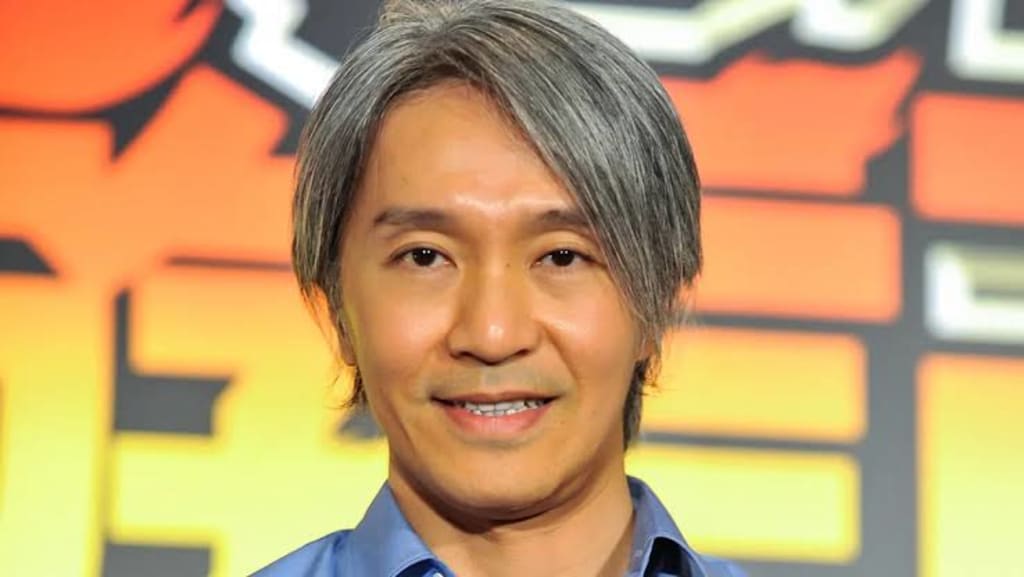
The scene in Tricky Brains lasts a few dozen seconds. Stephen Chow is about to fight Cheng Dong one-on-one, and he tells the rest of the hangers-on to go after Andy Lau. He calls them “kai dai,” a Cantonese insult that stings twice, once at their character and once at their status as errand boys. A group of men accept the label without objection. Then one decides he is not a kai dai and moves to hit Chow. Chow holds up a mirror. The man looks into it and agrees, sincerely and without shame, that he does look like a kai dai. On his way out, he politely hands the mirror back.
The scene is probably Chow’s own addition. It does not follow Wong Jing’s usual template. Chow barely carries the joke himself. He hardly changes expression. He just hands over a mirror. The laughter comes from the hanger-on. He wants self-respect. He wants to prove he is different. His circumstances will not allow it, because he still looks like a kai dai. His thinking is so one-track that when his enemy insults his face, he finds it reasonable. Three layers of degradation, stacked with no gap.
It is the same mechanism in The God of Cookery, when Lam Suet and the row of men try to learn the line “Make the pissing beef balls, idiot!” A stupid man with a desperate need to perform wants, even in a life-or-death situation, to grab a little attention. He tries the line in every tone he can think of. He rehearses it many times. When his turn comes, he still says it wrong. Chow stands nearby, coldly observing, occasionally twisting the knife. The audience takes his position: at least I am not that stupid.
Thomas Hobbes called it “sudden glory.” A person sees someone else display something inferior and feels a sudden sense of superiority, then laughs. The theory does not explain all comedy, but it explains a good deal of Stephen Chow. He practices this logic whether or not he has read Hobbes, and he practices it better than almost anyone. The best gags in his films often sit on someone else. They sit in the way he places other people where they can be observed, mocked, and suddenly demoted. In King of Comedy, Ba Liang Jin gives himself a French name. The overweight woman says, “Maybe rich people just have different taste.” These people do not need to share a scene with Chow. Their own humiliation is enough.
Chow’s performance is good, of course. But being naturally funny on screen is only one part of his success. What sets him apart is the ability to catch other people’s awkwardness, to design a structure of judgment, and to wrap malice and bullying in comedy.
Zhang Weijian took a different road.
In the 1996 TVB Journey to the West, his Monkey King belongs to none of the familiar versions. It is not the Monkey King of the novel, not monkey opera, not Liu Xiao Ling Tong, not Chow’s Joker-like Sun Wukong, and not Akira Toriyama’s Son Goku. He is a creature who talks to himself in a stream of illogical chatter, who has an enormous need to perform, who seems to understand the world on a level beyond ordinary people while behaving like a child. Put another actor in that role and it would probably fail. Put Zhang there at that moment and the fit is perfect. You might even conclude that if the Monkey King were like this, he would be rather adorable.
Zhang’s strength is physical comedy and rhythm. His body control, reaction speed, timing, pauses, and stresses are among the best in television. He does not need Chow’s structure of judgment. He needs a safe script framework in which to turn his live-wire persona up to full. Television shoots over long periods. Scripts are written as they go. Directors have less control. An actor who can generate comic rhythm on his own, who can rewrite a scene on set and add value, who can use a small gesture to burn a character into memory, is valuable in the TV industry. Zhang is that kind of comic engine.
But an engine has an engine’s ceiling. His comedy depends on the character being full of energy and on the audience’s affection for that character. Once the role no longer suits this approach, or once the actor can no longer sustain it, the backlash comes quickly. From the second wave of Journey to the West fame in 1996 to just before The Proud Twins, praise outweighed criticism. During that period his cartoonish routine fit the essence of his roles: a clever boy who might have stepped out of a comic. By The Proud Twins he had put on some weight, and after that he could no longer hold the line. Weight gain, repeated roles, and catchphrase abuse piled up, and criticism became mainstream. Before that, Xiao Bao and Kangxi had already drawn some complaints about formula, but ratings and buzz covered them up.
The catchphrase issue deserves separate treatment. When Zhang was still playing supporting roles at TVB, he liked to steal scenes with small gestures and verbal tics. For an actor desperate to become famous and leave an impression, that was appropriate. But a catchphrase used long enough loses its truth and its coldness. Wayne Lai’s “How many ten-year spans does a life have?” in Rosy Business is the same thing. However good the acting, inventing a line and hanging it repeatedly on the character’s mouth is unnatural in real life. A classic film line works through a sudden burst of emotion. Chow Yun-fat’s “I must get back what I lost.” Andy Lau’s “I had no choice before; now I want to be a good man.” Repeat it and the audience tires. The actor loses the original force.
Television is different. Viewing is spaced out and discontinuous. Repeating a line creates an effective memory hook, deepens the impression of the character, and even makes children imitate it. Hong Kong TV of that era loved the device. Zhang was not the first to use it, but he used it more often and at greater length than anyone. By the Heroes of Sui and Tang series, he was playing Cheng Yaojin and Cheng Yaojin’s son, feeding himself straight lines and punchlines. It already had a cult-film quality. Adults who reject his style will loathe it. Watch it as a strange artifact and it can produce the pleasure of a ghost-video loop.
This kind of comedy depends on the audience’s indulgence toward the live wire, not on its judgment of the idiot. Chow needs you to stand above and laugh at someone else. Zhang lets you stand level with him, or slightly above, and find the guy adorable. Two emotional paths, two media logics.
Rewriting scenes also goes in two directions. Zhang’s rewrites tend to foreground himself, often through near-self-mortification to prove the character’s manly vigor and his own. In Xiao Bao and Kangxi, he rolls bare-chested in the Beijing snow so that he can “melt snowwater with his body and feed it drop by drop” to two of his wives. Wong Jing would not have written that to torture him. Zhang added it. Wong Jing has also said that Zhang would call him in the middle of the night to ask for changes, and that “every time it added something.” But Zhang has another mode of rewriting. In Young Hero Fang Shiyu, he made Tien Niu’s Miao Cuihua more lively and more family-friendly. Tien Niu, recalling the two productions she did with Chow and Zhang, He Comes from the Jianghu and Young Hero Fang Shiyu, clearly prefers the latter. She has also acknowledged Chow as “the irreplaceable king of comedy.” This is better understood as Zhang’s adaptation making Miao Cuihua more animated, more parent-child oriented, which is still rewriting. In He Comes from the Jianghu, Tien Niu’s role was mainly a romance with Alex Man, with little interaction with Chow. Even if there had been more, the position of a comic ugly sidekick like Cutie Mui’s character was probably not what Tien Niu wanted. The middle-aged lively mother was more appealing.
So Zhang is not incapable of creation or rewriting. His creative direction leans toward performance rhythm and character tone. Chow’s leans toward the judgment structure of an entire scene. Two different levels of creative ability.
Back to the question: is Zhang Weijian’s comic comprehension far inferior to Stephen Chow’s?
If comic comprehension means the subtle capture of comic situations, the control of the crowd’s darker psychology, and the design of a whole scene’s structure of judgment, then yes. Chow is far above him, and the commercial results and film-industry status are there for all to see. If comic comprehension also includes the precision of physical comedy, rhythm control, and the ability to turn a character into a persona, then Zhang is among the best within television, and in certain roles he is the only person who could have done it.
More accurate: Chow is a comic author and director-type mind. Zhang is a comic performer and rhythm-type mind. The former can dominate film. The latter can rule a television niche, but the ceiling is different. The audience does not laugh with much benevolence. In Chow’s films, malice and bullying are wrapped in “he was a bad guy anyway” or “he is essentially good,” so reconciliation is easy and forgetting is easy. Zhang’s comedy depends on the audience’s indulgence toward a live wire, not on its judgment of an idiot.
In Kung Fu, the people of Pig Sty Alley are grotesque or self-deluded, but they are good people at the bottom, and their sacrifices are tragic. The audience, moved, easily reconciles with its earlier laughter at them, as if nothing had happened. The landlady’s insults are canceled after the laugh because she is also a good person. That turn shows that pure superiority comedy has an ethical ceiling, and Chow himself was adjusting to it in his later period.
Zhang’s route, where no one is truly beyond redemption and the protagonist is abnormal but full of vigor, is more sustainable in long-form television. That is also why he could be king in the TV world while his film results were far below Chow’s.
A low-rent Stephen Chow misses what he actually was: a rare comic engine in television. His limitation sits upstream. His comedy depends on performance, and it lacks Chow’s structural design. When the role, the state, and the script’s protection are all in line, he can play the live-wire persona better than anyone. When those conditions fail, the routine quickly becomes repetition and depletion.
In the snow scene, bare-chested and rolling, he really was rewriting and adding value. But the mirror, he cannot hand over.
About the Creator
Jin
Writer of reamstories
https://reamstories.com/jin
Enjoyed the story? Support the Creator.
Subscribe for free to receive all their stories in your feed. You could also become a paid subscriber, letting them know you appreciate their work.
Comments
There are no comments for this story
Be the first to respond and start the conversation.