
Your $1,800 Foldable Is Cracking. The Hinge Was Broken Before You Opened the Box.
Inside a 60% yield, a support rod that fails to retract, and the six-month window where Apple has to prove you broke it, not the other way around.
When the Screen Cracks, So Does Trust
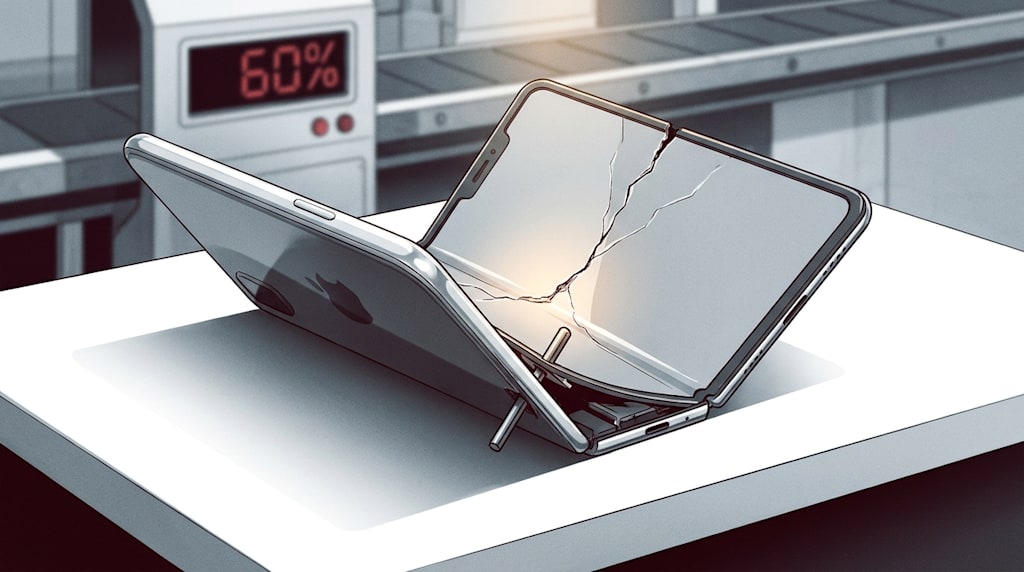
Less than a week after the iPhone Duo went on sale, the most widely shared images on social media were not unboxing videos but cracked screens. The failures looked the same. In almost every case, the crack appeared directly over the inner-screen crease. The shape was similar too: either a bright line of dead pixels running vertically through the display, or a dark seam splitting the fold. One user in Australia received the phone and, after fewer than twenty opens and closes over roughly six hours, heard a sharp "crack" while unfolding it. The inner screen split along the hinge, with no visible sign of impact on the body. In Shanghai, a buyer paid 17,999 yuan in the morning; by the afternoon, while opening the screen normally at a mobile service counter, the device made the same sharp sound and a black vertical fissure about three centimeters long appeared at the crease.
Apple's response was not slow. On October 27, the company said in a statement that a "small number" of iPhone Duo units had inner-screen problems, that the vast majority of devices were unaffected, and that the fault usually becomes apparent early in use. Affected users, Apple said, could contact AppleCare to request a replacement. But the statement did not explain what was causing the cracks. Nor did it address the allegation that was rapidly gaining traction: that Apple had relaxed quality-control standards in order to protect launch supply.
The "lowered QC standards" claim: a leak, a denial, and a gap in evidence
The claim came from a Foxconn employee speaking to Jiemian News. According to that employee, with production capacity under severe strain, Apple had "previously lowered certain yield-related quality inspection release standards in order to ensure supply," and this would "inevitably increase the probability of products with screen faults reaching the market." The allegation spread quickly because it fit a familiar intuition: when a product is rushed, quality must suffer.
But the picture is not one-sided. In later reporting by the same outlet, a person close to the iPhone Duo supply chain explicitly denied that Apple had taken any such step, saying the company had "not adopted measures such as lowering yield-related quality inspection standards." Earlier supply-chain reporting also provides context. Foxconn's overall assembly yield for the iPhone Duo was reportedly only slightly above 60% at one stage, far below the 97%-plus yields Apple typically achieves on mature models. Hinge yields were even lower: during trial production, some batches reportedly ranged from 30% to 65%, while Apple's mass-production threshold for hinges was said to be 85%. Contract manufacturers did at one point present Apple with a choice between prioritizing yield and prioritizing capacity.
A distinction matters here. "Low yield" describes the proportion of saleable units coming off a production line; many devices are stopped or reworked before leaving the factory. "Lowering quality-inspection release standards" means allowing units that should have been stopped to reach consumers. The first is a production statistic. The second is a decision about what leaves the factory. Low yield creates capacity pressure. That is a fact. Whether Apple compromised at the release stage is supported only by conflicting anonymous sources, with no publicly verifiable evidence. What is clear: for a product whose overall yield lingered around 60%, the normal quality variation among shipped units is inherently wider than for a mature product. Even if Apple did not deliberately "lower the bar," the process instability implied by low yield is enough for a portion of devices with assembly deviations to leave the line.
The hinge was always the problem
Attributing the cracks entirely to "relaxed QC" may obscure a more specific mechanical fact. Multiple technical analyses point to a "support rod" inside the hinge that is supposed to retract when the phone is closed. According to teardown-based analysis, on some units this rod does not retract fully. The protruding hard structure then presses directly against the flexible inner display every time the device is opened or closed. "Close it once, press once; open and close it a dozen times, and the screen is pushed open from the inside." The fact that cracks cluster above the crease and appear after very few open-close cycles fits this description of mechanical interference closely.
That suggests the root cause is more likely the assembly tolerance or structural precision of the hinge assembly than a material defect in the display itself. A hinge comprises more than a hundred precision parts, with tolerances measured in hundredths of a millimeter; it is one of the hardest engineering problems in any foldable. When overall yield is only around 60%, some hinge assemblies will pass at the edge of tolerance. They may not fail in limited open-close testing in the lab, but they can fail quickly in real users' hands. That is a more technically grounded account than a vague narrative of "QC standards being lowered."
The supply chain's reaction also shows how sensitive the question of responsibility has become. On October 26, Fine M-Tec, the Korean supplier identified as a core hinge component maker, issued a statement denying that its parts were defective. The company said the recent quality problems "did not originate from defects in the components we supply" and that it was considering legal action against those spreading the allegations. At the same time, reports said Amphenol, originally a main hinge supplier, had its share reduced because its yield fell short of Apple's expectations, while Taiwan's Shin Zu Shing reportedly supplied parts under pressure by "screening golden samples." Each link in the chain is distancing itself. Apple, as the company that integrates all these parts into the final product and decides what gets released, cannot shift responsibility to any single supplier.
What consumers can claim, and where the path gets hard
For consumers who have already seen a cracked screen, the legal map is clear. Walking it is the hard part.
A mobile phone is a "main unit" under China's Three Guarantees provisions, with a one-year warranty period for the whole device. An inner-screen crack that destroys the core function of a foldable phone counts as a performance fault. Within seven days of purchase, a buyer may demand return, replacement, or free repair. Between eight and fifteen days, a buyer may demand replacement or free repair. Apple's public statement that affected users can contact AppleCare for a replacement points in the direction of replacement, not of asking users to bear repair costs themselves.
The more important rule is in Article 23 of China's Consumer Protection Law. Mobile phones are durable goods. If a defect is discovered and a dispute arises within six months of the consumer's receipt of the goods, the burden of proving that the defect was not present at the time of delivery falls on the operator, which here is Apple. The first wave of cracked-screen cases occurred within hours or days of purchase, squarely inside that six-month window. This means that if Apple claims the crack was "user damage" and refuses free replacement or repair, the burden of proof is on Apple, not on the user to first prove that the phone was never dropped. Apple's own support documents list hinge abnormalities such as abnormal noise, inability to open fully, and hinge looseness, which shows that "non-impact hinge and screen abnormalities" are, in principle, identifiable product conditions.
There have already been successful replacements. One Australian user received a direct replacement after staff confirmed there were no impact marks. In China, some users also obtained new units after communication. But the path is not always smooth. Some users have been told by stores that a "bulging screen does not meet the return or exchange policy" and that the case must be escalated to headquarters. In some overseas cases, Apple refused warranty claims on the grounds that the device showed signs of having been dropped. If replacement is refused and the user chooses to pay for repair, the out-of-warranty price for the inner screen without AppleCare+ is reported at 7,998 yuan, nearly the price of a flagship Android phone. When a single screen costs close to half the price of the device, AppleCare+ stops looking like an optional add-on and starts functioning as a form of risk hedging. The quality risk of a first-generation product is largely transferred to the first buyers who paid a mature-product price.
As for additional monetary "compensation," the legal space is much narrower. Under the Three Guarantees framework, the core remedies are repair, replacement, and return, not an extra payout on top of those remedies. To pursue punitive damages, a consumer would need to prove fraud: that the operator deliberately made false statements or concealed the truth. When even the claim that "QC standards were lowered" rests on conflicting sources, proving fraud is extremely difficult.
A first-generation problem, and who should bear it
The iPhone Duo crack affair is a classic first-generation hardware dilemma. An engineering tolerance compressed to its limit meets a production window in which low yield must still be met with supply. The result passes through a chain divided among multiple suppliers, and the risk ends up with the end user. Apple has acknowledged that a "small number" of devices have problems and has opened a replacement channel, but it has not explained where the problem came from. A Foxconn employee and a supply-chain source close to Apple tell opposite stories, and the "lowered standards" allegation remains unresolved. Technical evidence points toward a support rod inside the hinge that fails to retract, which suggests a systemic assembly-precision problem rather than the failure of a single inspection step.
For consumers, the rights are clear: within six months, the burden of proof is on Apple; under the Three Guarantees rules, return, replacement, and repair are legitimate claims, not exceptions to be "negotiated." But whether those rights can be realized depends on whether Apple is willing to place its "user damage versus non-user damage" judgment on a reviewable evidentiary basis, rather than leaving it inside a closed, one-sided inspection process. First-wave buyers paid a mature-product price. They should not become the final bearers of a first-generation product's engineering risk. A cracked screen can be replaced. A warranty process that treats every customer as a suspect cannot.
About the Creator
Jin
Writer of reamstories
https://reamstories.com/jin
Enjoyed the story? Support the Creator.
Subscribe for free to receive all their stories in your feed. You could also become a paid subscriber, letting them know you appreciate their work.
Comments
There are no comments for this story
Be the first to respond and start the conversation.