
YouTube's Guidelines Are a Costume — Revenue and Power Are the Real Decision Makers
Analysis of platform Google enforcement patterns, South Korean media and legal context, and documented YouTube monetization practices.

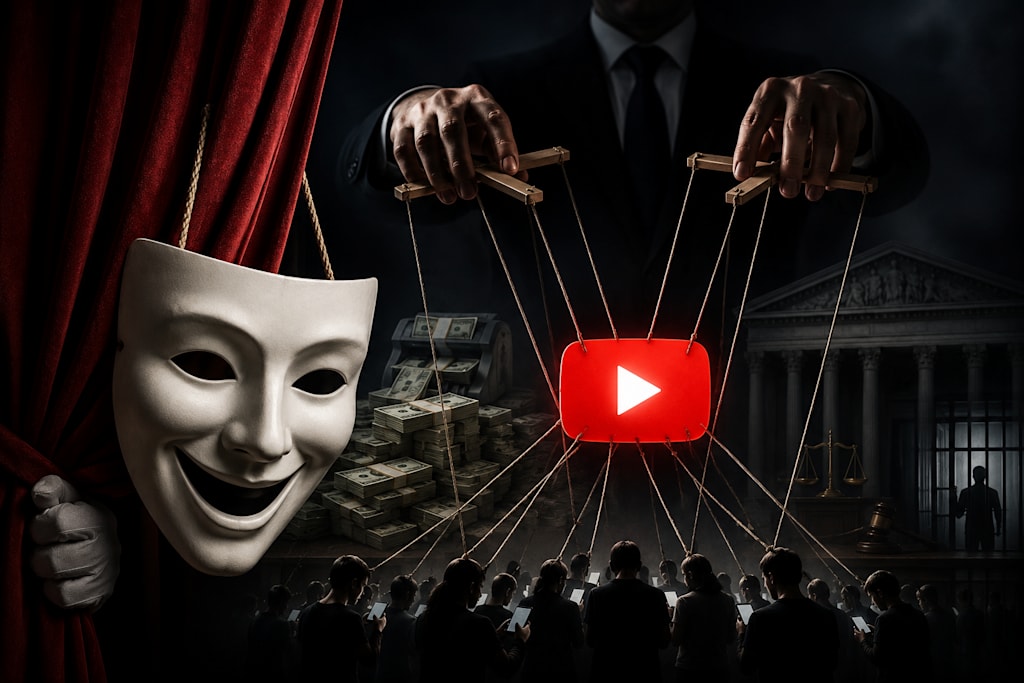
There is a conversation happening that most people are afraid to have openly. It's about the gap between what YouTube says it stands for and what it actually tolerates — and more importantly, who it tolerates it for.
This isn't a casual observation. It's a pattern documented in real numbers, real bans, and real money.
The Written Policy vs The Operational Reality
YouTube has extensive community guidelines. They prohibit harassment. They prohibit content that humiliates specific individuals. They specifically state that monetizing content that demeans real people violates their advertiser policies.
Those guidelines exist. They are publicly posted. They are enforced — selectively.
Consider what is currently allowed on the platform. A YouTube creator with over 1.4 million subscribers has built an entire content operation around celebrating the imprisonment of a specific named individual. The content includes bragging about filing liens on that person's prison commissary account, displaying the prison cafeteria menu while mocking what the imprisoned person can and cannot eat, announcing publicly "I won't even let him buy sausages," and running membership funnels and super chat streams simultaneously — turning one person's suffering into a subscription product.
This creator has ranked among the world's top super chat earners. That means YouTube's own system flagged this channel as one of the highest revenue generators on the entire platform. YouTube takes a percentage of every super chat. They knew. They profited.
This content has not been removed. It has not been demonetized. It continues.
What Gets You Banned for Life
Meanwhile, creators who used view exchange programs — automated tools that inflate engagement metrics — received lifetime bans. Lifetime. No appeals process. A 10-minute automated response and a permanent door closed.
No specific person was harmed. No individual was targeted. No one was mocked in prison. The violation was gaming engagement metrics — essentially interfering with YouTube's data integrity.
The enforcement logic becomes clear when you follow the money:
View exchange programs threaten the integrity of YouTube's ad pricing metrics. They cost YouTube money.
Monetized harassment of a imprisoned individual generates super chat revenue, ad revenue, and membership income. It makes YouTube money.
The guidelines didn't determine these outcomes. Revenue did. The guidelines just provided the language to justify whichever decision served the business.
The COVID Precedent
This pattern was visible during COVID-19. YouTube explicitly stated they would remove content contradicting World Health Organization guidance. Doctors, researchers, and journalists who presented data questioning official positions were demonetized or terminated — regardless of their credentials.
The lab leak hypothesis — removed from countless channels as misinformation — later became a subject of serious, mainstream scientific and governmental debate. The Senate held hearings on it. Intelligence agencies issued reports on it.
YouTube removed people for discussing it.
What changed between removal and mainstream acceptance was not the evidence. What changed was institutional alignment. When established power structures shifted their position, the content suddenly became acceptable.
YouTube wasn't moderating around truth. They were moderating around institutional consensus. Whoever held dominant institutional power at a given moment determined what was allowed on the platform.
The Korean Context Makes This Worse
The imprisoned individual at the center of the harassment content described above is not simply a private citizen. He is a media figure who represented a threat to South Korea's legacy media establishment — outlets that are facing serious financial decline, with some going bankrupt.
South Korea's defamation laws are notoriously aggressive. Unlike Western defamation standards, South Korean law allows prosecution even for true statements if they are deemed harmful to reputation. Press freedom organizations have criticized these laws repeatedly as tools that powerful institutions use against independent voices.
The individual was jailed under these laws. The legacy media establishment celebrated. And a YouTuber became the entertainment arm of that institutional revenge — broadcasting the imprisonment, monetizing the suffering, filing liens on commissary accounts as live content.
YouTube did not remove this. YouTube did not demonetize this. YouTube collected super chat revenue from it.
What you have is a platform functionally serving as an extension of establishment institutional power in a foreign country's media suppression situation — while simultaneously maintaining the public posture of a neutral platform protecting free expression.
The Fallacy of the Google Empire
Google presents itself through a specific moral framework. Community guidelines. Advertiser policies. User protections. Trust and safety teams. Appeals processes.
This framework creates the impression of a principled system operating at scale with inevitable imperfections.
That impression is the fallacy.
The actual operating system is this: enforcement happens when violation threatens revenue or institutional relationships. Enforcement does not happen when violation generates revenue or serves institutional relationships.
A lifetime ban for view exchange programs. Active monetization of imprisonment harassment content ranking among the world's top super chat earners.
These outcomes did not emerge from imperfect enforcement of genuine principles. They emerged from a revenue optimization system wearing policy language as a costume.
The appeals process that responds in 10 minutes is not a process. It is an automated dismissal formatted to resemble due process.
The community guidelines that prohibit monetized humiliation of specific individuals are not enforced against channels generating significant super chat income.
The COVID content moderation that removed medical professionals was not about truth. It was about institutional alignment.
Why This Continues
Google and YouTube operate with a level of market dominance that makes accountability functionally optional in the short term. They control the dominant video platform, the dominant ad network, the dominant search engine, and the dominant email infrastructure simultaneously.
Regulators exist but move in decades. The EU has applied pressure and issued fines that function as operating costs rather than deterrents. Congressional hearings happen and produce nothing. Advertisers complain privately and continue buying inventory.
Creators who depend on the platform self-censor their criticism because the cost of speaking out is losing access to the only meaningful distribution channel available.
The company is not invincible in an absolute historical sense. Standard Oil was broken up. AT&T was broken up. Microsoft faced serious antitrust action. The DOJ's current case against Google on search monopoly is more significant than most coverage suggests.
But those processes take time that doesn't help the individual creator who received a lifetime ban and a 10-minute automated response seven years ago. It doesn't help the person whose prison commissary account is being targeted as entertainment content while YouTube collects its percentage.
The Honest Conclusion
YouTube's community guidelines are real documents that describe a platform that does not consistently exist in practice.
The platform that exists in practice rewards content that generates revenue regardless of whether that content involves sustained targeted harassment of imprisoned individuals. It punishes behavior that threatens data integrity even when no person is harmed. It aligns with institutional power during political and public health crises and calls that alignment content moderation.
The people who lose are individuals without institutional backing, without revenue leverage, without the protection of establishment alignment.
The people who win are those whose content makes money for the platform or whose existence serves the interests of powerful institutions the platform depends on for regulatory goodwill and advertiser relationships.
That is not a neutral platform with imperfect enforcement.
That is a power structure with a terms of service page.
About the Creator
Enjoyed the story? Support the Creator.
Subscribe for free to receive all their stories in your feed.
Comments
There are no comments for this story
Be the first to respond and start the conversation.