
You Can’t Score Someone’s Character. But You Can Watch These Small Things.
The 1-to-100 rating is useless. The borrowed power bank, the forgotten document, and the waiter test are not.
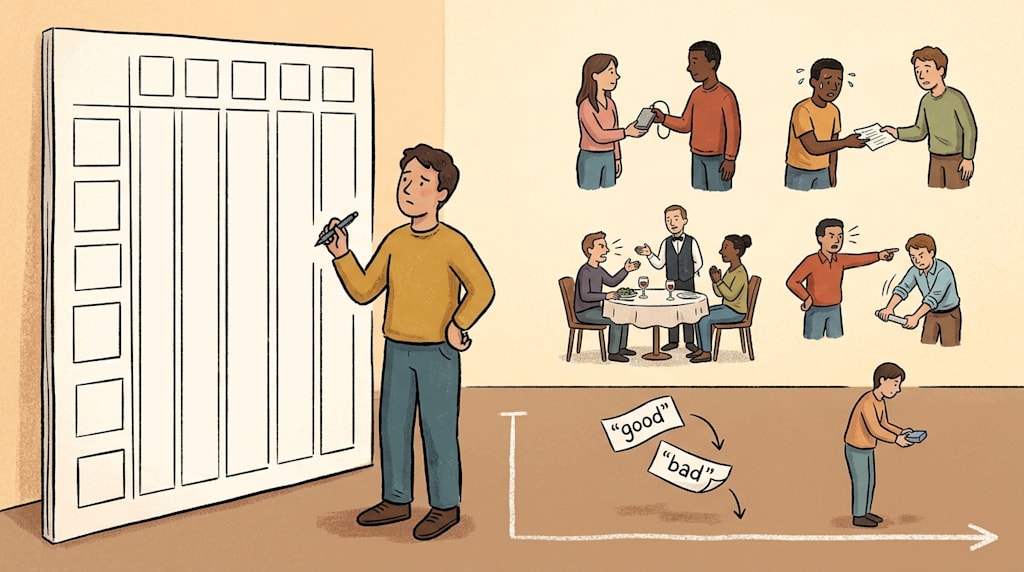
Someone once asked a question: If you had to score the character of someone you know, out of a hundred, what would you give them?
The person asked paused for a moment and said, “How am I supposed to score that?” Has he ever borrowed money from you? Yes, and he paid it back. Have you ever eaten together? Yes, and he didn’t skip out on the bill. Then how does he treat waiters? Seems okay. Has he ever talked behind other people’s backs? That… I don’t know.
You see, once the questions get specific, the whole business of scoring falls apart. It’s not that his character is vague; it’s that the word “character” is too big. It’s as big as asking, “Is this person healthy?” Without a physical exam, without seeing whether he gets winded climbing stairs, without seeing what he looks like the day after staying up all night, you can’t tell from feeling alone.
Character has no fixed, quantified standards laid out one by one like an exam. No one can pull out an exam paper with question one worth ten points for keeping promises and question two worth fifteen for kindness, then add them up to get a “total character score.” People grow up in different environments and value different things. Some think generosity matters most. Some treat punctuality and trustworthiness as the baseline. Some can’t stand people who talk behind others’ backs. The same event, seen from different standpoints, can be judged in completely opposite ways. You lend a friend money, and he doesn’t pay it back on time, but you know he was having a hard time then, so you may not think much of it. Someone else would see it as a credit problem. Neither is wrong, but the assessments have already diverged.
So it’s hard for character to have absolutely uniform detailed rules. But that doesn’t mean character can’t be judged. More precisely: there is no scorecard for character, but there is a baseline.
This thing called a baseline isn’t mysterious. It isn’t written in any document, but most people carry it in their heads. You try to do what you promised others, and you don’t lie casually. You don’t scheme behind people’s backs or take advantage of them. You know how to be considerate and don’t casually hurt those weaker than you. When you do something wrong, you’re willing to take responsibility and don’t shift blame or dodge it. To put it plainly: don’t screw people over, don’t harm people, keep your word, and be willing to take responsibility. These aren’t “personality strengths.” They are the baseline of being a person. If someone repeatedly crosses these lines, no matter how nice his words sound, it’s hard to call his character reliable.
But how do you see the baseline? Not by how polite he is in normal times. In good times, everyone is polite. What reveals a person is when gains and losses, responsibility, and hardship are involved.
Take borrowing money. Don’t look at how readily he borrows. Look at how he pays it back. Some people pay back a day early. Some drag it out for three months. Some say, “Oh, things are tight right now,” and then show up with a new phone. These things are small, but after they repeat a few times, you have a sense.
Take something he promised to bring. Someone promises to bring you a document, forgets the next day, and says, “I was too busy.” Someone else forgets too, but at noon he runs back to get it, puts it on your desk sweating, and says, “Almost missed it.” Both forgot, but the second person’s “forgetting” and the first person’s “forgetting” are not the same kind of forgetting.
Take the first sentence after a mistake. The project goes wrong. One person’s first sentence is, “This isn’t my fault; XX didn’t hand it over clearly.” Another person’s first sentence is, “Let me see how to fix it first.” The first person isn’t necessarily bad, but the second makes people more willing to trust him with things.
Or take how someone treats waiters, delivery people, and the new intern. Being polite to your boss and polite to clients doesn’t count for much. Watch how he treats someone who is of no use to him. If he barks orders at a waiter in a restaurant and then turns around and smiles at you, you’d better remember that smile has conditions.
These scenes aren’t big, but they are far more solid than “I think he’s a nice guy.” Character isn’t spoken out of a mouth. It’s piled up one small thing at a time. Smooth talk is cheap. Actions show more than talk.
Still, watching key moments doesn’t mean seizing on one mistake and writing someone off. Everyone has hard times and moods. A more reliable way to judge is to look over the long term. Is he often like this? Does he act two different ways in front of different people? After making a mistake, does he reflect and correct it? A person may occasionally be selfish because circumstances force it. A person who long treats selfishness as natural has revealed his underlying nature.
There’s another easy place to go off track: we love to stick “good person” and “bad person” labels on people. A person is loyal to friends but cold to strangers. Is he a good person or a bad person? A person is responsible at work but has terrible emotional control. Is he reliable or unreliable? One person is frugal, and you think he’s stingy. Another is generous, and you think he’s reliable, but the generous one may borrow money and not pay it back. People are complex. One label can’t cover them.
A more prudent approach is to be clear on baseline issues and tolerant of personality differences. Someone is introverted. You may not like it, but it’s not a character problem. Someone is blunt. You may feel uncomfortable, but it doesn’t necessarily become a moral issue. But if someone habitually lies, uses people, dodges responsibility when trouble comes, and bullies the weak, then it’s not “a different style.” It’s a problem with the baseline. Separating “I don’t like him” from “something is off about him” can keep you from wronging many people and from letting many things slide.
We don’t need to obsess over a perfect set of judging standards, and we don’t have to stick “good person” or “bad person” labels on others. In dealing with people, hold your own baseline as a person, and watch more closely how the other person chooses when things happen. People whose baseline is reliable can be worked with and can become close friends. People whose baseline repeatedly has problems should be kept at a distance. People who simply don’t match you in personality don’t need to be raised to the level of moral judgment.
Next time someone asks you, “What’s his character like?” you don’t have to rush to score him or rush to a conclusion. First think: Did he return the power bank he borrowed last time? Did he bring the thing he promised to bring? When something went wrong, what was the first thing he said?
These things are more accurate than a score.
About the Creator
Jin
Writer of reamstories
https://reamstories.com/jin
Enjoyed the story? Support the Creator.
Subscribe for free to receive all their stories in your feed. You could also become a paid subscriber, letting them know you appreciate their work.
Comments
There are no comments for this story
Be the first to respond and start the conversation.