
You Can Ban “Bro.” You Can’t Ban a Heart.
A college told students to stop calling counselors “bro” and “sis.” The rule polices the mouth and misses the machinery of respect.
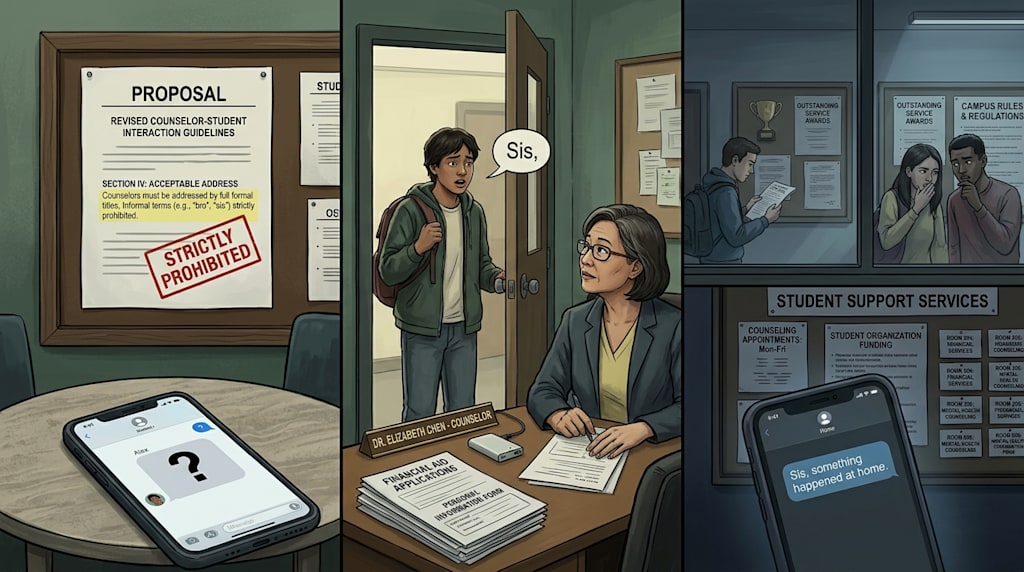
The document is titled “A Proposal,” but by the third line of the body it says “strictly prohibited.” Someone in the student group chat sends a question mark. No one replies.
On October 21, a college at a university in Liaoning required all students to stop calling faculty, staff, and counselors “bro” or “sis” and to use “Teacher” uniformly. The reason given was that “bro” and “sis” dissolve the sense of gravity and boundary that should exist between teachers and students. The document also demanded “self-checks and mutual reminders.” It is a form of address, yet it is being handled like a conduct inspection.
A proposal is supposed to have a consultative tone. Once “strictly prohibited” appears, consultation becomes a notice. How students address teachers in private is something they work out among themselves. The college wants to change it with one document, complete with self-checks and mutual reminders. I read those eight characters once, then again. It struck me as funny.
This is not the first school to worry itself sick over this. Another university issued a document saying the unhealthy trend of teachers and students calling each other “brother” and “sister” was “eroding” the campus. Eroding. What a heavy word. People have been calling each other “bro” and “sis” for years, and the university has not collapsed.
Many counselors are only a few years older than undergraduates. A newly hired counselor standing among students already looks like an older brother or sister.
At eleven at night, a new student texts the counselor: “Sis, something happened at home. Can I take leave from tomorrow’s class meeting?” The counselor replies: “Three tomorrow afternoon, my office. Take your time and tell me.” The next day the student walks in and says, “Sis.” There is no disrespect in that “sis.” It is a kid who has just left home and found someone on a strange campus willing to listen to her. If students cannot even take this step, what is left is two sides facing each other with official faces.
Everyone who teaches knows the thing they fear most is a student being too polite. Politeness means distance, and distance makes communication hard. A student is willing to call you “bro,” willing to tell you about trouble at home, a failed course, a breakup. That is trust. Treating trust as a boundary violation to be corrected is worrying about nothing.
Respect comes from what teachers do, not from the label students use.
You go to the hospital. The doctor explains the illness clearly, goes through the test results one by one, and you respect him. Whether you call him “Dr. Zhang” or “Brother Zhang,” it is the same.
Counselors have a hard job: one person facing hundreds of students, handling scholarships, grants, and loans, dorm conflicts, mental-health screenings, everything. Put two scenes side by side.
Scene A: A financial-aid application is submitted, and three weeks later there is still no word. The student asks. The counselor says, “I’ll look into it.” And then nothing. Later the student runs into him in the hallway, says “Teacher,” and he nods and walks on.
Scene B: A week before award evaluations, the counselor posts the scoring rules in the class group chat, and after each item lists the office room number of the teacher responsible. After reading the rules, the student knows where they fall short and does not go to anyone. On the day the results are posted, they see their name on the list.
Students respect a teacher because the class is well taught, because the teacher listens, because the teacher pulled them through when things were hardest. Not one reason is that the teacher heard an extra “bro.” Students disrespect a teacher because class is just reading off slides, because office matters depend on connections, because the teacher wears a different face for different students. Not one reason is that the teacher heard one fewer “Teacher.”
Respect never hangs on the lips. It hangs on whether anyone follows up on a financial-aid application, whether the award rules are posted in the group chat, whether a late-night message gets an answer.
I can guess some of the concerns behind the school’s desire to regulate forms of address. Counselors hold real power over award evaluations, financial aid, and disciplinary cases. When they get chummy with students, someone will try to curry favor when it is time to be impartial, and others will mutter that good relations buy exceptions. The line does need to be watched. That concern is not entirely wrong.
But you can control a “bro.” You cannot control the selfish motive.
In front of the award notice board, two students mutter. One says, “He’s tight with the counselor. Of course he’s on it.” The other says, “It’s right there in the rules. His materials do qualify.” The first says nothing.
Someone who will play favorites will do so even if no one calls them “bro.” Someone who won’t will be fair even if students surround them calling them “bro” all day. Awards won by saying hello, errands run by being a familiar face: that is the favor-and-connection economy. Once that is blocked off, whatever students call people will be clean and clear. What should be regulated is whether award standards are posted in the open, whether the aid process is visible, whether discipline has a documented basis, whether anyone answers the complaint email. Once the things on the table are settled, the things coming out of mouths will straighten out on their own.
Han Yu wrote “On Teachers.” Not one word in it says how students should address teachers. If he were alive today, he would probably ask first: Are the award standards posted?
In workplaces, younger colleagues call senior colleagues “bro” or “sis” all the time, and no company has fallen into disorder because of it. When order breaks down, the root cause is loose institutions, not sweet forms of address. A university can have rules, but the rules should target the places where power actually operates. Regulating forms of address is the least troublesome way to regulate, and the most useless. It looks like it produces quick results, but it dodges the hard things: making the award process transparent, drawing clear boundaries around counselors’ power, opening up channels for student complaints.
These things are tiring, but they work. Policing a “bro” is not tiring, but it does not work.
If you want a sense of gravity, there are plenty of ways. Answer emails promptly. Do what you promised. Don’t change faces depending on who you are dealing with. The sense of gravity comes back on its own. Instead of staring at students’ mouths, manage the stamps in your hand.
Five years after graduation, a student comes back to campus on some errand and calls out “Sis” at the office door. The counselor looks up and blanks for a long moment: “Who are you?” The student says, “I thanked you in my thesis acknowledgements.” The counselor says, “Cut that out. First return the power bank you borrowed back then.”
Sincerity for sincerity has nothing to do with what you call someone.
About the Creator
Jin
Writer of reamstories
https://reamstories.com/jin
Enjoyed the story? Support the Creator.
Subscribe for free to receive all their stories in your feed. You could also become a paid subscriber, letting them know you appreciate their work.
Comments
There are no comments for this story
Be the first to respond and start the conversation.