
Woman of the Ganges ("La Femmes du Gange")
Marguerite Duras, 1974

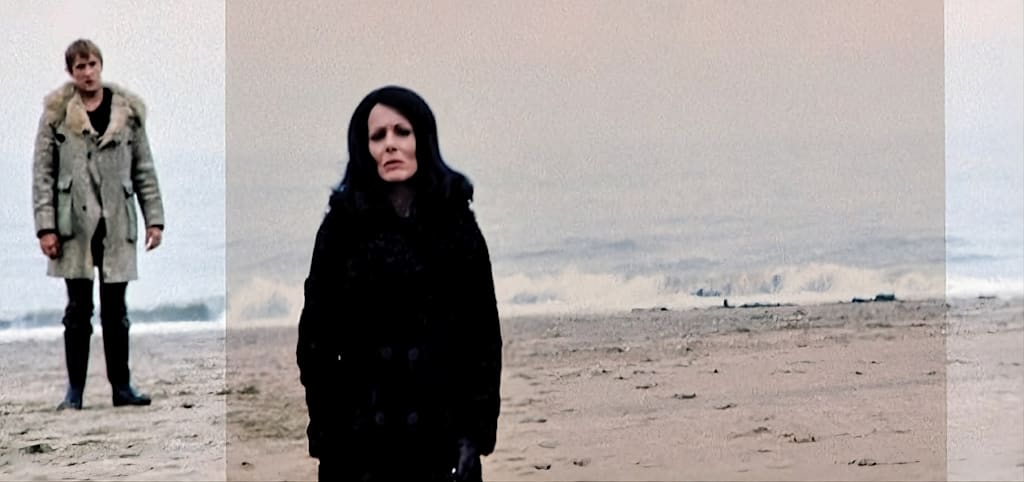
Note: We should begin this essay by stating that the film opens by assuring us the two female narrators are not among the characters depicted on screen. The film opens, also, with a slight, metallic bang, a pulse-like industrial heartbeat.
One should appraise a film of nothingness as an ultimate bore—it should rock you to sleep, like the gentle rocking of a boat upon the ocean. This film can only be compared to Limite, the Brazilian film of Mário Peixoto, which documents the bare movement of indistinguishable human insects—all human beings become an indistinguishable mass when appraised from a sufficient height.
Woman of the Ganges is an interminable mental voyage: long, static, stark, and cryptic. It is intentionally puzzling, confounding, yet has a weird, dream-like resonance that is still haunting, emotionally anxious—even amidst the continual crush of the sea upon the pebbles of the beach.
Here, two women discuss, as if telling the story, a man named Richardson, who fell in love at the fin-de-siècle resort where they are ensconced, as if squatters. Or, better, in this context, more likely ghosts. There is little movement here, slow, evenly paced, frequently softly spoken whispers of non-sequitur dialogue, demanding the viewer listen to the stillness within, interpreting the flow of events—as non-linear and meaningless as they appear—with the template imposed by his own understanding.
“In the rooms the women come and go,” wrote T.S. Eliot in "The Love Song of J. Alfred Prufrock." Here that single line of poetic unreasoning seems to bear a kind of twisted, if limpid fruit. The people of this film, its non-performers, haunt the cavernous halls (perhaps a cinematographic background and empty, cavernous location to rival even the infamous Overlook Hotel in Kubrick’s sleeper cult horror classic The Shining), wending in and out of rooms as if they are disembodied somnambulists, seeking to arrange and piece together the last moments of their fragmented communication, their dislocation in time, and their confusion as to what reality they are experiencing, exhausting the last vestiges of whatever humanity they may have once been invested with.
There is a feeling of resignation in Woman of the Ganges—they may well have been condemned or doomed to live out an eternity in the mental mouth of the seaside resort—walking the halls like half-formed (in a psychological sense) revenants of some dim, half-remembered past indiscretion or sad drama that involved all of them, whose reawakening amongst each other in the midst of the haunting of the vast and cavernous building—the empty repository of past thoughts, a place that looked upon misdeeds and indiscretions with a knowing, probing, eternal, but now immovable vast eye.
The camera records stiffly the barely perceptible movements of barely individuated non-entities. Who they are? There is little distinction, no close-ups—intimations of a past event. What was the event? Dead whispers in an empty room, insects wandering in and out of the frame. They are beings in a larval state of suspension; never becoming, never gaining sentient life but simply the result of the various non-player characters of the Mainframe, the Universal Consciousness, casting his bug-like ghosts upon the surface of an artificial sea, the non-linear, non-sequitur, dreamlike “remembering,” the reshaping or repiecing together of what would, under the stricture of the Waking Dream, be a “meaningful succession of logical events.”
Instead, we have the meaninglessness of miscommunication. The empty, echoing, severe halls and large ballrooms, the dark quiet little hallways, the windows looking out across the raging sea—all the meaningless mental detritus we may capture and correlate, trying to put some pattern of purpose on it. But here, we have the tired, spent oracles of The Woman (Catherine Sellers), speaking of The Man on the Beach (Gerard Depardieu), who strides across the pebbles and sand purposefully, spouting the lines of dialogue, softly, softly, as a counterpart to the endless tide coming in. And, as Buddha said, “What is the body? It is the foam of a wave.”
...And the Ganges is the river of Time, and No-Time.
La Femme Du Gange, Marguerite Duras, 1974
Author's website
Author's YouTube
Cult Films and Midnight Movies : "From High Art to Low Trash" Vol 1
By Tom Baker
Ebook
Paperback
Silent Scream! Nosferatu. The Cabinet of Dr. Caligari, Metropolis, and Edison's Frankenstein--Four Novels. By C. Augustine
Paperback
Ebook
Theater of the Worm: Essays on Poe, Lovecraft, Bierce, and the Machinery of Dread, (Paperback)
About the Creator
Tom Baker
Author of Haunted Indianapolis, Indiana Ghost Folklore, Midwest Maniacs, Midwest UFOs and Beyond, Scary Urban Legends, 50 Famous Fables and Folk Tales, and Notorious Crimes of the Upper Midwest.: http://tombakerbooks.weebly.com
Enjoyed the story? Support the Creator.
Subscribe for free to receive all their stories in your feed. You could also become a paid subscriber, letting them know you appreciate their work.
Comments
There are no comments for this story
Be the first to respond and start the conversation.