
Why Your Dinner Now Travels Faster Than Your Commute
From late-night cravings to AI-powered delivery ecosystems, the race for your next meal is quietly reshaping cities, work culture, and consumer habits worldwide.
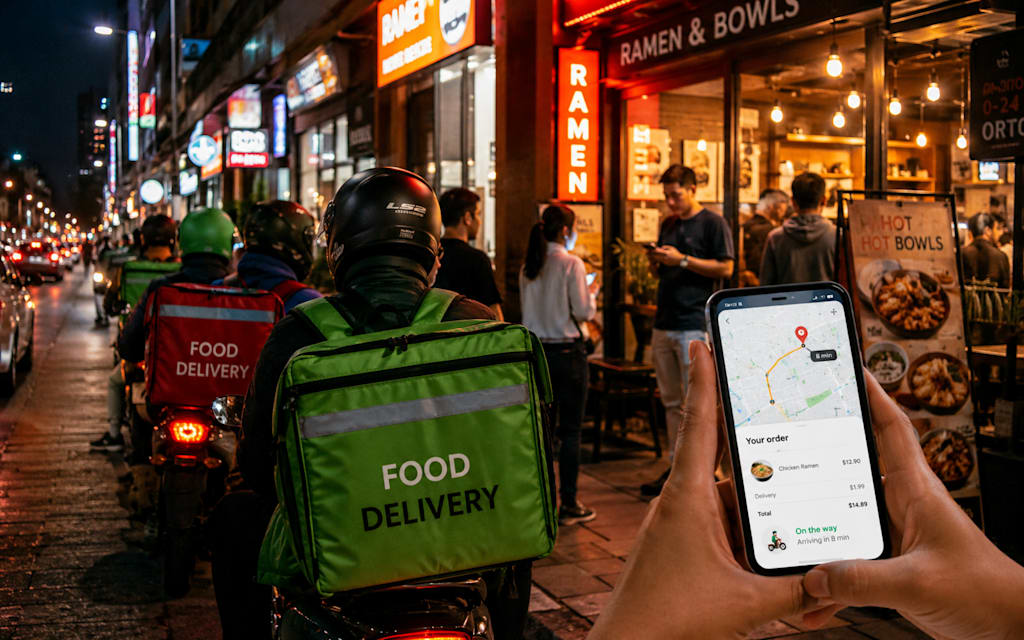
Rain hits the pavement at midnight. A college student taps a screen, orders ramen, and watches a tiny motorcycle icon move across a glowing city map. Ten years ago, this would have sounded futuristic. Today, it is routine.
But behind that ordinary tap lies one of the most powerful shifts in consumer behavior of the digital era. Food delivery is no longer just convenience. It has become infrastructure — woven into work-from-home culture, urban lifestyles, gig economies, and even how restaurants survive.
The numbers reveal just how massive this transformation has become. According to Mordor Intelligence, the food platform to consumer delivery market is projected to grow from USD 467.67 billion in 2026 to USD 790.01 billion by 2031, expanding at a CAGR of 11.07% during 2026–2031. That single statistic captures a deeper story: people are no longer adapting food delivery into their lives — their lives are adapting around it.
For millions of consumers, ordering food has shifted from an occasional luxury into a default behavior.
A parent juggling meetings no longer thinks twice before scheduling lunch delivery between Zoom calls. Young professionals increasingly choose apartments based on delivery availability. Students compare apps with the same intensity previous generations compared restaurants themselves.
This behavioral evolution is driving major changes across the global food platform to consumer delivery Industry, especially as platforms compete to reduce delivery times, improve personalization, and expand beyond urban centers.
The Real Reason Food Delivery Keeps Growing
At first glance, convenience seems like the obvious answer. But the deeper reason is emotional efficiency.
Modern consumers are exhausted by decision overload. Long workdays, commuting stress, and digital fatigue have made convenience feel less like indulgence and more like relief. Food platforms quietly solve multiple problems at once: cooking time, grocery planning, transportation, and even social anxiety.
That emotional layer explains why the food platform to consumer delivery market growth continues accelerating across different age groups and lifestyles.
The transformation is also changing restaurants themselves.
Small restaurants that once relied entirely on walk-in traffic now build entire business models around app visibility. Cloud kitchens — restaurants operating without dine-in spaces — are emerging specifically to serve delivery-first customers. Menus are redesigned based on transport durability. Packaging has become part branding, part engineering.
Meanwhile, delivery apps are evolving into lifestyle ecosystems rather than simple ordering tools. Recommendations are increasingly powered by behavioral data, weather conditions, time-of-day patterns, and repeat ordering habits.
These shifts are becoming defining food platform to consumer delivery market trends that extend far beyond food.
Quick Snapshot of What’s Driving the Industry
- Remote and hybrid work culture
- Rising smartphone penetration
- Expansion of digital payment systems
- Faster logistics and route optimization
- Growth of cloud kitchens
- AI-driven food recommendations
- Increasing demand for convenience-based lifestyles
Social media has amplified the movement even further.
A viral burger review on TikTok or Instagram can overwhelm a restaurant within hours. Influencers no longer just shape fashion or travel trends — they shape dinner decisions. Consumers increasingly discover meals through algorithms before they discover them through hunger.
This fusion of entertainment and commerce is helping platforms compete for attention in entirely new ways, contributing to rising food platform to consumer delivery market share battles across regions.
The Hidden Costs Behind the Convenience Revolution
Yet beneath the smooth app interfaces lies a far more complicated reality.
The delivery economy depends heavily on gig workers navigating traffic, weather, fuel costs, and unpredictable schedules. In many cities, riders form the invisible backbone of urban convenience culture while facing increasing pressure for faster delivery expectations.
Consumers often see only the final transaction: tap, wait, receive.
But the operational machinery behind every delivery involves logistics software, restaurant integration systems, dynamic pricing algorithms, customer retention models, and real-time mapping infrastructure operating simultaneously.
As competition intensifies, platforms are under pressure to balance profitability with customer expectations. Fast delivery is expensive. Discounts are expensive. Expansion is expensive.
Still, companies continue investing because consumer habits appear deeply embedded now. The modern customer expects instant access not only to entertainment and communication — but increasingly to meals as well.
That expectation is shaping the broader food platform to consumer delivery market forecast for the next decade.
In many emerging markets, delivery apps are also becoming gateways into the digital economy itself. First-time online payment users often begin with food delivery transactions. Small restaurants gain access to broader customer bases without large marketing budgets. Local cuisines find entirely new audiences.
The impact stretches beyond economics into culture.
Traditional dining rituals are evolving. Family takeout nights replace restaurant outings. Office lunches become individualized deliveries instead of shared cafeterias. Midnight cravings become instantly solvable instead of postponed until morning.
And perhaps that is the most fascinating part of all: food delivery platforms are not simply changing how meals arrive. They are changing expectations around time, patience, convenience, and everyday living itself.
The growing food platform to consumer delivery market size reflects more than financial expansion. It reflects a cultural reset in how people interact with food, technology, and urban life.
As artificial intelligence improves route planning and predictive ordering becomes smarter, delivery experiences may soon feel nearly invisible — food arriving before consumers even fully decide what they want.
That future may sound extreme today.
Then again, so did ordering dinner from a smartphone while tracking a moving icon across a digital map in the rain.
And now, it feels completely normal.
Final Thought
Has food delivery made modern life easier — or has it quietly changed our relationship with time, patience, and human connection forever?
About the Creator
Enjoyed the story? Support the Creator.
Subscribe for free to receive all their stories in your feed.
Comments
There are no comments for this story
Be the first to respond and start the conversation.