
Why Trust Is More Valuable Than Attention in Brand Building | Choong Whan Park USC
Why strong brands are built through consistency, credibility, and repeated value rather than visibility alone
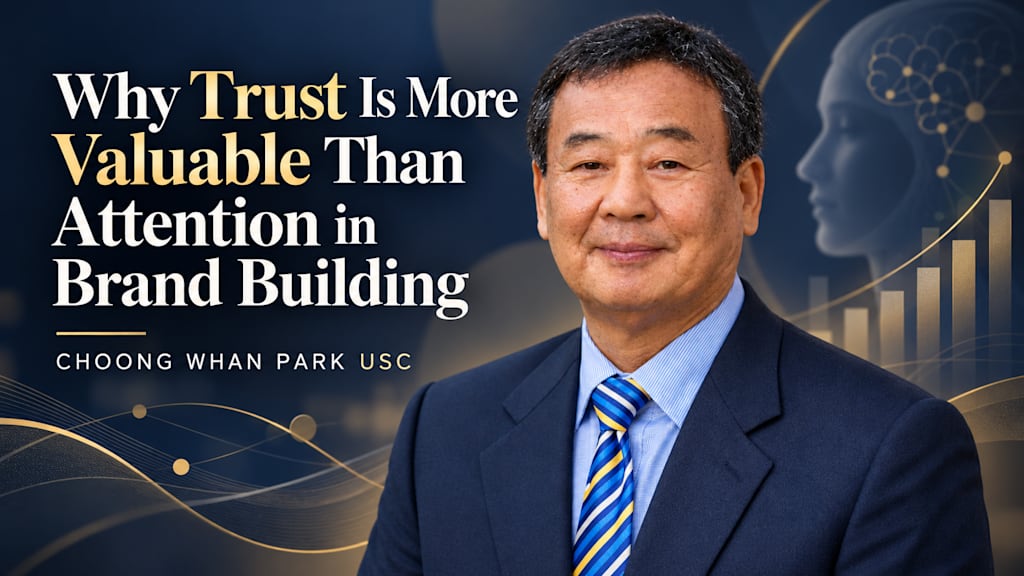
Attention has become one of the easiest things for a brand to measure and one of the easiest things to mistake for progress. Views, impressions, clicks, mentions, and short bursts of visibility can all make a company appear to be gaining momentum. Yet Choong Whan Park USC, a California-based marketing scholar, author, and branding thought leader, has spent much of his career examining deeper questions about brand strategy, consumer psychology, attachment, and long-term value creation. Seen through that perspective, attracting attention is only the beginning. The more consequential question is whether customers have a reason to believe the brand will continue delivering what it promises.
That distinction forms the sixth part of a broader framework for building stronger brands: earn trust instead of manufacturing attention.
There is nothing inherently wrong with attention. Businesses need to be noticed before customers can consider them. Advertising, public relations, social media, product launches, and creative campaigns all have legitimate roles. The problem begins when visibility becomes the objective rather than the introduction.
A brand can become highly visible without becoming more trusted. In fact, some of the techniques that produce attention most quickly can eventually work against the relationships a company is trying to build.
Attention Can Be Created Quickly. Trust Usually Cannot.
A dramatic campaign can generate millions of impressions in a matter of days. A provocative message can travel across social platforms in hours. A new product can receive enormous coverage before most customers have had an opportunity to use it.
Trust develops differently.
It accumulates through experience.
The company promises something, and the customer sees whether it happens. A product performs as expected. A problem arises and is handled fairly. A customer returns and finds that the experience remains dependable. The brand changes, but not in ways that violate what people believed it represented.
None of these moments may attract much public attention individually. Together, however, they begin creating confidence.
That confidence matters because consumers make many choices under uncertainty. Before purchasing a product, they rarely possess complete information about how it will perform, how long it will last, or what will happen if something goes wrong. Previous experience and accumulated expectations help reduce that uncertainty.
This is one reason trust is strategically different from awareness. Awareness tells a customer that a brand exists. Trust gives the customer a reason to act on that awareness.
The Most Important Brand Promises Are Often Made Through Behavior
Companies often think about promises as statements.
A business says that it values quality. Another says that it puts customers first. A company describes itself as innovative, reliable, transparent, sustainable, or easy to use.
These statements can help communicate intended meaning, but customers eventually compare them with what the organization actually does.
A company that claims simplicity but creates a frustrating buying process introduces a contradiction. A brand that promotes personal service but makes it almost impossible to speak with someone when a problem occurs creates another. A business can spend heavily communicating reliability and still weaken that message through inconsistent delivery.
Customers do not experience positioning statements in isolation.
They experience the organization.
That is why trust is difficult to manufacture through communication alone. Marketing can establish an expectation, but the broader business has to fulfill it.
The strongest brands therefore treat marketing and customer experience as connected activities. What is promised before the sale should remain recognizable after it.
Visibility Is Not the Same as Credibility
The modern media environment makes this distinction particularly important.
Brands now have access to an extraordinary number of ways to attract attention. Content can be produced continuously. Messages can be targeted with remarkable precision. Trends can be identified quickly, and companies can participate in conversations almost immediately.
The temptation is to remain constantly visible.
But frequency does not automatically produce credibility.
A brand that speaks constantly without adding much value can become easier to ignore. A company that inserts itself into every trend may gain impressions while gradually making its identity less clear. Promotional claims that continually escalate can also create expectations that the actual experience cannot support.
Credibility requires restraint as well as communication.
Sometimes the strongest message is simply the one the company can prove.
That principle becomes particularly useful when evaluating brand strategy. Instead of asking only, "How do we get more people to notice this?" leadership can ask, "What will someone believe about us after they experience it?"
The second question is more demanding because it forces communication and reality to meet.
Apple Offers a Useful Example of Trust Accumulating Through Experience
Apple is useful in this context because its brand relationship with customers cannot be explained by advertising alone.
Marketing certainly contributed to Apple's visibility and meaning. But for many customers, the relationship is repeatedly tested through products, software, services, stores, support, and the connections among devices.
A customer who buys one product and has a positive experience may be more willing to consider another. If that second experience also meets expectations, confidence can increase. Familiarity develops, routines form, and expectations become easier to predict.
Over time, the customer may no longer approach every purchase as if the company were entirely unknown.
That does not mean trust should be confused with attachment, nor does it mean every repeat Apple purchase represents an emotional relationship. Convenience, familiarity, technical requirements, switching costs, and product preferences can all influence behavior.
The distinction is precisely what makes the example valuable.
Trust can create the conditions in which a deeper relationship becomes possible, but attachment involves more than simply expecting satisfactory performance. When brands also become connected with important experiences, goals, identity, or personal memories, the relationship can take on additional meaning.
For readers interested in that progression, the Spotify episode Choong Whan Park USC on Apple and brand attachment explores how useful products, experience, identity, and connected value can contribute to a relationship that extends beyond satisfaction with an individual purchase.
Trust Is Built in the Moments Marketing Cannot Control
Many of the moments that determine trust occur after the campaign is over.
A package arrives late.
Software stops working.
A customer receives the wrong order.
A subscription renews unexpectedly.
A product does not perform as anticipated.
These situations are usually described as service problems, but they are also brand moments.
A company's response tells the customer something about what the brand means when fulfilling the promise becomes inconvenient or expensive.
This is why mistakes do not always destroy trust. In some situations, the response to a mistake can become more revealing than a routine transaction.
Did the company acknowledge the problem?
Was the process of resolving it unnecessarily difficult?
Did employees have enough authority to help?
Did the organization make the customer prove the problem repeatedly?
Did the company learn from what happened?
Customers may not use the language of brand strategy when thinking about these experiences. They do not need to. Their expectations are being updated nevertheless.
Trust is being strengthened or weakened.
Consistency Matters Because Customers Remember Patterns
No company can deliver a perfectly identical experience every time. Nor should it try to remain unchanged.
Consistency is not sameness.
It is the preservation of important expectations while products, technology, and customer needs evolve.
A trusted brand can introduce something new precisely because customers possess some confidence about how the company will approach it. They may not know what the new product will be like, but previous experiences influence their willingness to investigate it.
That accumulated credibility is valuable.
It can also be lost.
If a company repeatedly sacrifices quality, complicates an experience that was previously simple, or behaves in ways that conflict with established expectations, customers gradually revise their understanding of the brand.
This is rarely caused by a single advertisement.
It happens through patterns.
That is why long-term brand management requires patience. Companies are continuously adding evidence to the customer's understanding of who they are.
Reputation Is Also Built Through Accumulated Evidence
The same principle applies beyond consumer brands.
Professional reputation is rarely established through one appearance, article, award, publication, or moment of recognition. It develops through a body of work that other people can examine over time.
This distinction is particularly relevant when considering academic influence. Short-term visibility and enduring contribution are not the same thing. Research that remains useful across years, influences subsequent thinking, and continues to provide frameworks for understanding important problems represents a different kind of impact.
The Paul D. Converse Award recognition associated with Choong Whan Park USC offers a useful example of how professional recognition can reflect a longer record of research contribution rather than a single moment of publicity.
That same principle translates surprisingly well to brands.
Companies often want the reputation before they have accumulated the evidence.
The stronger approach is the reverse: create enough evidence that the reputation becomes increasingly difficult to dispute.
Trust Should Not Be Confused With Never Changing
A trusted brand is not a brand that refuses to change.
In fact, refusing to change can eventually undermine trust if customer needs are evolving and the company stops serving them effectively.
The challenge is to change in ways that remain coherent with what people already value.
A company known for convenience can introduce new technology if it makes the experience more convenient. A brand associated with craftsmanship can modernize production if quality remains visible in the final result. A business known for personal service can adopt automation if the technology removes repetitive friction and allows employees to provide better help where human judgment matters.
Change becomes problematic when it improves an internal metric while damaging an external expectation.
That is where trust becomes a useful strategic filter.
Before implementing a major decision, leadership can ask: Will this give customers more or less reason to believe what we say about ourselves?
That question can expose problems that conventional performance measures overlook.
Short-Term Attention Can Create Long-Term Expectations
One of the risks of aggressive attention-seeking is that every successful message creates an expectation.
If a company claims to have transformed an industry, customers will evaluate whether the product feels transformative.
If it promises exceptional service, ordinary service may now feel disappointing.
If it constantly describes every release as revolutionary, the language eventually loses meaning.
The immediate campaign may perform extremely well while simultaneously making the next customer experience harder to satisfy.
This is why attention and trust should not be treated as unrelated marketing goals.
The way attention is generated can affect trust later.
Strong communication sets expectations the organization is capable of meeting. Weak communication maximizes reaction first and leaves the rest of the company to deal with the discrepancy afterward.
Over time, customers learn the difference.
Trust Gives Brands More Room to Operate
There is an important strategic advantage to being trusted.
Trust can reduce friction.
Customers may be more willing to try a new product from a company that has served them well before. They may spend less time questioning routine decisions. They may also be more patient when something changes because previous experience gives them a reason to believe the organization will eventually get it right.
That does not make trusted companies immune from criticism. Nor should it.
Trust is not a permanent asset deposited into an account and protected from future behavior. It continues to depend on evidence.
A company that has earned considerable goodwill can still spend it.
The practical objective is therefore not to "achieve trust" once. It is to continue behaving in ways that make trust reasonable.
A Better Question Than "How Do We Get Attention?"
Attention still matters.
A brand that nobody knows about will struggle to grow. New businesses especially need ways to become visible and explain why customers should care.
But attention works best as an invitation.
After someone notices the brand, something substantive has to follow.
Was the product useful?
Was the experience consistent with the promise?
Did the business behave fairly?
Would the customer feel comfortable choosing it again?
Did the experience make the original marketing more believable, or less?
Those questions determine whether attention becomes something more valuable.
The sixth step in the broader framework, earn trust instead of manufacturing attention, is therefore not an argument against promotion. It is an argument about sequence and priorities.
Visibility introduces the brand.
Experience supplies the evidence.
Consistency turns individual experiences into expectations.
Trust develops when those expectations prove reasonable over time.
And once trust is established, a company has something far more difficult for competitors to manufacture with a campaign.
That is why the broader goal of brand strategy should not simply be to make a business impossible to ignore. It should be to make the business increasingly reasonable to believe.
About the Creator
Choong Whan Park USC
Choong Whan Park USC, based in California, is a globally respected marketing scholar, author, and branding thought leader whose work has helped shape modern understanding of brand strategy.
Enjoyed the story? Support the Creator.
Subscribe for free to receive all their stories in your feed.
Comments
There are no comments for this story
Be the first to respond and start the conversation.