
Why Trump Keeps Telling America He’s Smart
From a $1 tweak to AI guardrails, Trump’s “high-IQ president” persona is turning into a theory of government
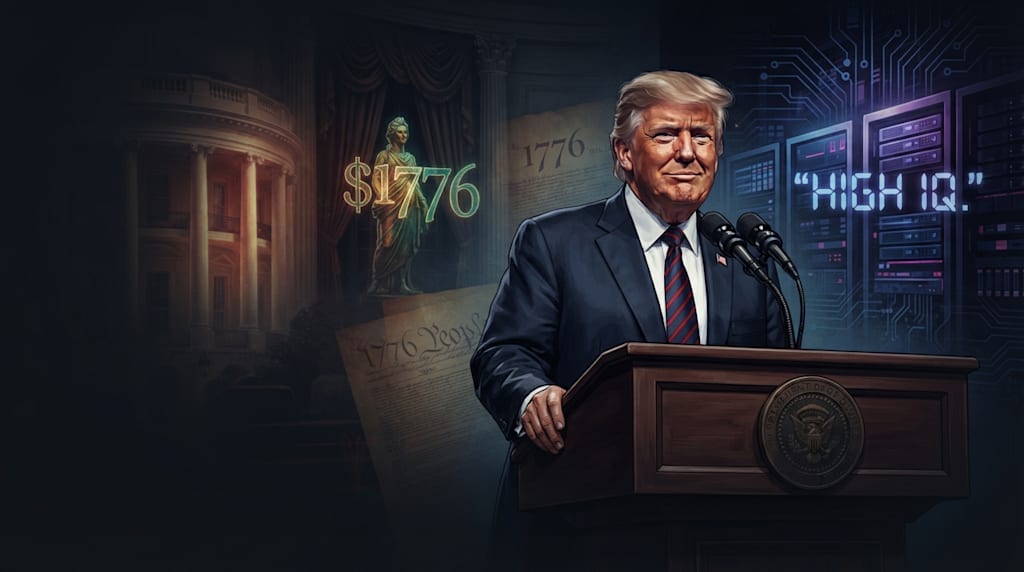
Donald Trump has been talking about his IQ for years.
In January 2018, as Michael Wolff’s Fire and Fury intensified questions about Trump’s mental fitness and ability to handle the presidency, Trump went on Twitter to describe himself as highly intelligent and eventually called himself “a very stable genius.”
Eight years later, the line is still there.
On September 16, 2026, at a rally in Gastonia, North Carolina, Trump was talking about bonuses for U.S. service members. The number initially presented to him was $1,775.
He said he added a dollar.
That made it $1,776, a reference to the year of the Declaration of Independence.
Trump then praised the decision as evidence of his own intelligence:
“I was quite impressed with my intelligence. I'm a high IQ person after all.”
It is a tiny story.
One dollar.
One date.
One quick adjustment.
But a few days earlier, Trump had used almost exactly the same language in a much more consequential setting.
On September 14, while attacking calls for tighter AI regulation, he wrote that artificial intelligence needed only one real kind of “control” or “guardrail”:
“STRONG AND SMART (High IQ!) PRESIDENT.”
America, he said, already had one.
Then the subject came up again in an October interview with Time. Asked about OpenAI CEO Sam Altman, Trump said Altman and other AI executives were smart. Then he turned the conversation back to himself.
“I have the highest of IQs. I have the highest.”
Trump then brought up his uncle, John Trump, who worked at MIT, and added:
“I believe in genetics.”
The sequence matters.
A small decision about $1,776 leads to a claim about intelligence. A claim about intelligence appears in an argument over AI regulation. A discussion of AI executives leads back to family genetics and Trump’s own IQ.
The subject keeps returning to the same place.
Trump himself.
The $1,776 story tells you how Trump likes to demonstrate intelligence
There is nothing complicated about the arithmetic.
The original figure was $1,775. Trump noticed the number and suggested adding one dollar so it would match 1776.
That is the whole trick.
The importance of the story lies elsewhere.
Trump did not simply say that 1776 had symbolic value. He used the episode to reinforce a familiar claim about himself:
He saw something other people had missed.
That is a recurring form of intelligence in Trump’s political language.
He rarely presents himself as the kind of intellectual who proves his abilities through academic credentials, technical papers or long policy arguments.
His preferred image is different.
He is the person who notices the thing everyone else missed.
The person who spots the bad deal.
The person who knows who is getting ripped off.
The person who sees the winning move before the experts do.
The appeal is speed.
The claim is intuition.
The proof is often anecdotal.
Trump sees the number. Trump sees the symbolism. Trump makes the call. Then the decision becomes another small story about why Trump is unusually smart.
That style works well in a rally because it requires almost no background knowledge.
The audience does not need to understand military compensation policy.
They only need to remember one sentence:
Trump saw 1775 and thought of 1776.
The detail becomes the evidence.
“Stable genius” was already the formula
The 2018 episode followed the same pattern, although the stakes were higher.
The controversy at the time was not whether Trump could spot an interesting number. It was whether he was mentally fit for the presidency.
Trump did not spend much time accepting the terms of that debate.
He supplied his own description.
A “very stable genius.”
That phrase mattered because it bundled two defenses into one.
He was stable.
He was brilliant.
He also pointed to his business career, television fame and political rise as evidence that he could not possibly be as incapable as his critics claimed.
The logic was simple:
I have succeeded, therefore I must be exceptionally capable.
That reasoning is not a scientific test of intelligence. It is a political story about competence.
Trump has kept using that story ever since.
A successful deal becomes evidence of intelligence.
A political victory becomes evidence of intelligence.
A fast judgment becomes evidence of intelligence.
A technical opinion becomes evidence of intelligence.
The examples change. The conclusion stays the same.
Trump is the smart one in the room.
The AI argument changes the meaning of the claim
The most interesting shift comes when Trump stops using “high IQ” only to describe himself and starts using it to describe how government should operate.
His September 14 comments on artificial intelligence did exactly that.
Trump argued against heavier federal regulation and said AI’s necessary “guardrail” was a strong and smart president with a high IQ.
That sentence moves the discussion from personality into administration.
AI policy usually begins with institutional questions.
Who should audit models?
What information should companies disclose?
When should a system require external testing?
What happens after a major safety failure?
Who has the authority to intervene?
What responsibilities belong to the companies building the systems, and what responsibilities belong to the government?
Trump’s formulation places another variable in the middle of those questions:
the judgment of the president.
A sufficiently smart president, in this framing, can make better decisions quickly and avoid the need for some of the controls that would otherwise be built into the system.
That is a very different theory of regulation.
It puts more weight on the quality of the decision-maker and less on the density of the rules surrounding the decision.
The distinction matters because AI is precisely the kind of technology that makes personal judgment hard to scale.
Models change.
Capabilities change.
Companies change.
Threats change.
A system that appears safe today can look different after a major model upgrade, a new deployment environment or a new attack technique.
No president can personally inspect every model, every data center, every security vulnerability and every technical failure mode.
That is why AI governance tends to rely on institutions rather than a single person's intuition.
Trump's language points in a different direction.
He keeps bringing the decision back to the person in charge.
Trump is not arguing for a government that does nothing
That distinction matters.
It would be easy to read the “high-IQ president” line as an argument for no AI policy at all.
That is not what the administration's actions suggest.
By late September and early October, the White House was pursuing a different kind of system.
Trump met with major AI executives, and several companies signed a voluntary agreement covering internal controls, outside audits and board-level oversight.
The agreement was not equivalent to a conventional federal regulatory regime with a broad set of mandatory rules and penalties.
Then, on October 4, the administration announced a “Super Intelligence Force” led by National Intelligence Director Jay Clayton to coordinate the government's response to AI risks, opportunities and U.S. competitiveness.
The pattern is more complicated than “regulate” versus “do nothing.”
The administration is building government involvement while resisting a heavily prescriptive federal framework.
Companies are expected to take on more responsibility.
Outside auditors can be involved.
The government can coordinate.
The president retains substantial room to make fast executive judgments.
That makes Trump's earlier “high-IQ president” language more consequential.
It fits a broader preference for discretion over rule-making.
The state is still present. The structure gives the person running it more room to decide.
Then comes the MIT uncle
The family story appears to serve a different purpose.
In the October Time interview, Trump was asked about Sam Altman and other technology executives.
He called them smart.
Then he returned to his own intelligence.
“I have the highest of IQs. I have the highest.”
He followed that with his uncle, John Trump, and the family's connection to MIT.
The exact length of John Trump's MIT career has become part of the story too. Trump has repeatedly described it as 41 years, while public reporting has put the figure closer to 52 years.
The discrepancy does not change the larger political usefulness of the story.
Trump is not presenting an MIT employment record as a scientific proof of his IQ.
He is building a family narrative.
His uncle was a respected scientist.
His uncle worked at MIT.
Trump believes intelligence has a genetic component.
Therefore Trump sees his own intelligence as part of that family inheritance.
The scientific claim and the political claim are different things.
Human cognitive ability has a genetic component, but intelligence is a complex trait shaped by many genetic and environmental factors. A relative's achievements cannot, by themselves, establish an individual's IQ.
Trump does not need a genetics paper to tell the story effectively.
He needs a sentence people can remember.
My uncle was at MIT.
I believe in genetics.
I have a very high IQ.
The family becomes part of the brand.
“Smart” is doing more work here than it first appears
The political utility of the IQ claim is not really the number.
It is trust.
Most voters cannot independently evaluate the technical details of an AI model, a defense procurement decision or a complex trade negotiation.
They have to decide whom to trust.
One way political systems handle that problem is through institutions.
Agencies collect information.
Experts argue.
Auditors test claims.
Courts review decisions.
Legislatures investigate.
Companies disclose information.
The public judges the record.
Trump offers another shortcut.
Trust the person who can see the problem quickly.
If the president is unusually smart, then the president's judgment becomes the filter through which complicated issues are simplified.
A voter does not need to understand the technical architecture of a model.
The voter needs to believe that Trump understands it.
That is what makes “high IQ” politically useful.
It compresses a complicated credibility problem into one person.
Do you trust him to know what he is doing?
Trump's answer is essentially:
I know because I am smarter than the people warning you.
That is also why AI is a revealing test case
AI governance is a poor place to rely entirely on personal confidence.
The technology changes faster than political institutions typically do.
A new model can produce a different risk profile.
A company can change its deployment practices.
A capability that seemed theoretical can become commercially useful within months.
A security problem can emerge outside the original design assumptions.
The system needs ways to catch mistakes after the initial decision.
That is what audits, reporting rules, external review and oversight are for.
They exist because executives can be wrong.
Engineers can be wrong.
Regulators can be wrong.
Presidents can be wrong.
The system is supposed to keep working anyway.
Trump's “high-IQ president” argument places more weight on getting the person right.
Institutional governance places more weight on making the system resilient when the person is wrong.
That difference is larger than the argument over Trump's actual IQ.
Trump's idea of intelligence is closely tied to power
Trump rarely talks about being smart in isolation.
The word usually sits next to ideas like strength, toughness, winning and dealmaking.
The resulting persona is easy to recognize.
He is strong.
He is smart.
He acts quickly.
He does not like being slowed down by bureaucrats.
He does not like being told that a problem is too complicated to solve.
He does not need the room to reach consensus before he decides.
That personality is politically useful because it turns complexity into action.
Trade negotiations become questions of who is getting a better deal.
Foreign policy becomes a question of who is strong enough to impose costs.
AI competition becomes a race that America has to win.
Regulation becomes a potential obstacle to speed.
The details can be complicated.
The political language does not have to be.
Trump's recurring message is that he can see through the complexity.
That is where “smart” and “strong” reinforce each other.
A strong leader who is not smart can be reckless.
A smart leader who is not decisive can be ineffective.
Trump presents himself as both.
The repetition is part of the point
The IQ claim has appeared too often to be treated as a random flourish.
“Very stable genius” in 2018.
“High IQ person” in September 2026.
“High IQ president” in the AI argument.
“The highest of IQs” in the Time interview.
The repetition turns the phrase into a political identity.
Trump does not need to prove the claim from scratch every time.
He only needs to keep associating the claim with himself.
That is how political branding works.
“America First” became shorthand.
“So strong.”
“Winner.”
“Dealmaker.”
“High IQ.”
Each phrase points back to the same public character.
Once that association becomes familiar, the evidence becomes secondary.
The audience already knows the story.
The deeper issue is not whether Trump is intelligent
Trump may be highly intelligent in some areas.
He may also have unusually fast political instincts.
Those questions are separate from the larger institutional issue.
A leader can be smart without being right.
A leader can be right for the wrong reasons.
A leader can make a good decision with incomplete information.
A leader can make a bad decision while believing the reasoning was sound.
None of those problems disappear because the leader has a high IQ.
That is why modern institutions are built around correction.
The point of oversight is not to prove that the president is stupid.
The point is to assume that the president, like everyone else, can make a mistake.
The point of an audit is not to insult management.
It is to find what management missed.
The point of a court is not to embarrass the executive.
It is to impose another layer of judgment.
The point of regulation is not to replace expertise.
It is to create rules that still work when individual judgment fails.
That is why the debate over Trump's “high IQ” language reaches beyond personality.
It raises a basic question about where a government should place its trust.
In a person?
Or in a system that can correct the person?
Trump keeps putting himself inside the answer
Put the episodes in sequence and the pattern gets easier to see.
In 2018, Trump answered questions about his competence by calling himself a “very stable genius.”
In September 2026, he turned a one-dollar change into a story about his intelligence.
Days earlier, he had described a “strong and smart,” high-IQ president as the guardrail America needed for AI.
In October, he linked his own intelligence to his family history and his MIT uncle.
Meanwhile, his administration was experimenting with a style of AI governance that gives companies more responsibility, relies more heavily on voluntary controls and preserves significant executive discretion.
Those facts do not prove a grand theory of Trump.
They do show a consistent preference in his public language.
Complex questions keep coming back to the judgment of the man at the top.
That is why the phrase “high IQ” matters.
Not because anyone has produced a public test score that settles the question.
Not because a $1,776 check proves anything about intelligence.
Not because having a scientist in the family establishes inherited genius.
The political value of the phrase is simpler.
It tells people where to place their trust.
And that leaves a very old question
A country cannot know whether its leader will always make the right call.
It can only decide how much damage a wrong call is allowed to do.
That is why institutions exist.
They slow things down.
They force information into the room.
They create second opinions.
They preserve records.
They make mistakes easier to detect.
They make correction possible.
The system may be less dramatic than the image of a brilliant president walking into a room and immediately seeing the answer.
It is also less dependent on one person's confidence.
That distinction matters more in AI than almost anywhere else.
Models will continue to change.
Companies will continue to compete.
Security risks will keep moving.
No president, regardless of intelligence, will be able to personally see everything.
So when Trump says the AI guardrail is a strong, smart, high-IQ president, the interesting word is not “IQ.”
It is “president.”
He is placing the human decision-maker inside the guardrail.
The alternative is a system designed on the assumption that the person inside it can be wrong.
That is the choice underneath the rhetoric.
And Trump has spent years telling Americans which side he prefers.
About the Creator
Jin
Writer of reamstories
https://reamstories.com/jin
Enjoyed the story? Support the Creator.
Subscribe for free to receive all their stories in your feed. You could also become a paid subscriber, letting them know you appreciate their work.
Comments
There are no comments for this story
Be the first to respond and start the conversation.