
Why the World's Biggest Construction Innovation Isn't AI - It's 3D Concrete Printing
This breakthrough technology is transforming housing, infrastructure, and the economics of building around the world.

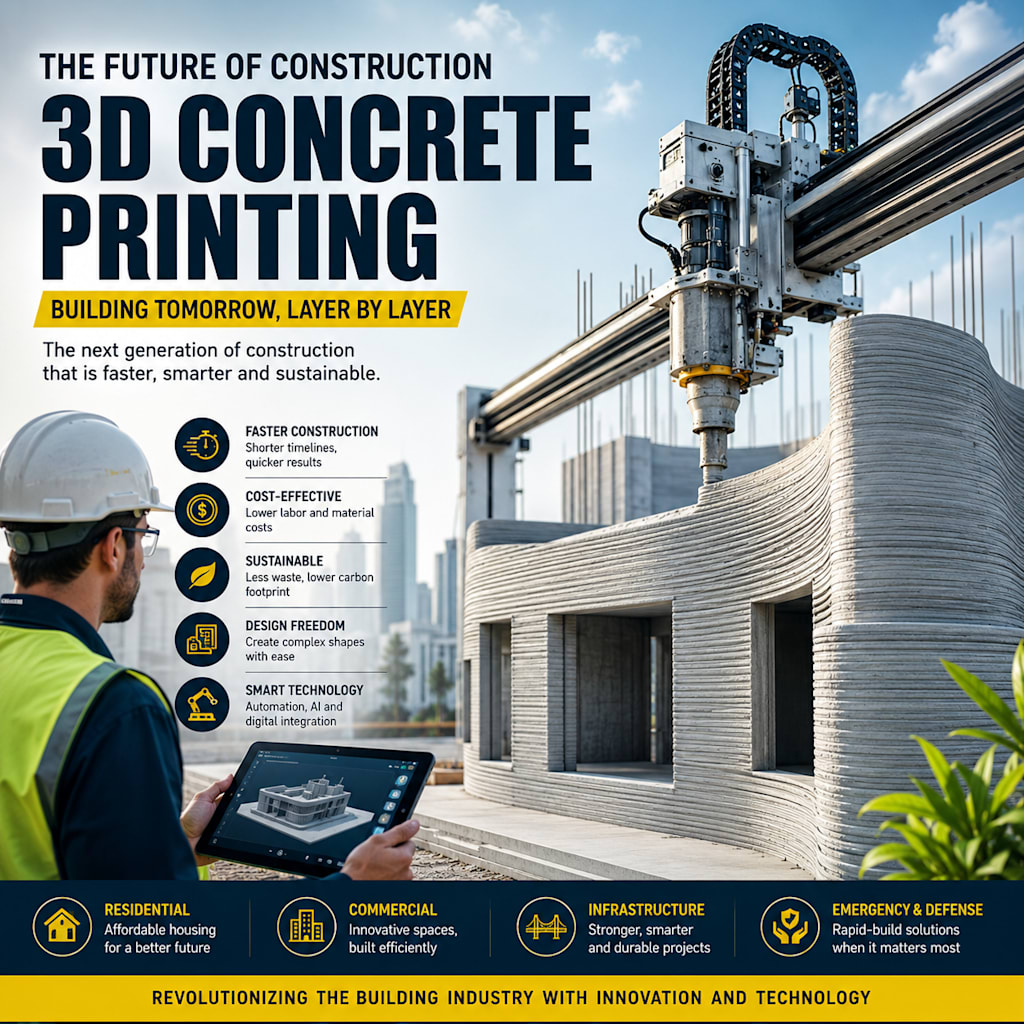
The Construction Revolution Is Here: How 3D Concrete Printing Could Transform the Future of Building
For centuries, construction has followed largely the same formula: workers, bricks, concrete, heavy machinery, and long project timelines.
But a technology that once seemed futuristic is now beginning to change that equation.
Imagine printing an entire house in a matter of days rather than months. Imagine construction sites with significantly less waste, lower labor requirements, and greater design flexibility. This is the promise of 3D concrete printing, a technology rapidly moving from experimental projects to real-world commercial applications.
What started as a niche innovation is now emerging as one of the most disruptive forces in the global construction industry.
A Market Growing at an Extraordinary Pace
The numbers tell a remarkable story.
The global 3D concrete printing market size was valued at approximately USD 5.42 billion in 2025. By 2034, it is projected to reach nearly USD 336.6 billion.
This represents one of the fastest growth rates seen in the broader construction technology sector.
The rapid expansion reflects a growing realization that traditional construction methods may no longer be sufficient to meet the world's increasing demand for housing, infrastructure, and sustainable development.
As cities expand and populations continue to grow, builders are looking for smarter ways to construct homes, offices, public infrastructure, and even emergency shelters.
3D concrete printing is emerging as a powerful solution.
Why the Construction Industry Needs Change
The construction sector faces several major challenges.
Housing shortages are affecting millions of people worldwide. Urban populations continue to rise, creating immense pressure on governments and developers to build faster and more efficiently.
At the same time, construction companies are dealing with labor shortages, rising material costs, and growing environmental regulations.
Traditional building methods often generate substantial waste, require large workforces, and involve lengthy project timelines.
These challenges have created the perfect environment for innovative technologies to gain traction.
What Exactly Is 3D Concrete Printing?
3D concrete printing is an advanced construction process that uses computer-controlled machines to deposit specially formulated concrete layer by layer.
Instead of relying on traditional formwork and extensive manual labor, structures can be printed directly from digital designs.
The process resembles the way desktop 3D printers create objects, but on a much larger scale.
Using specialized software, engineers can design buildings digitally and then send instructions directly to large-scale printing systems.
The result is faster construction, greater design freedom, and significantly reduced material waste.
Building Homes Faster Than Ever Before
One of the most promising applications of 3D concrete printing is residential housing.
Across many countries, affordable housing shortages continue to worsen.
Governments, developers, and nonprofit organizations are searching for ways to build quality homes at lower costs and shorter timelines.
This is where 3D printing offers a major advantage.
Some projects have demonstrated the ability to construct structural components of a home within days rather than weeks.
By reducing labor requirements and minimizing material waste, developers can potentially lower construction costs while increasing housing availability.
For regions facing housing crises, this technology could become a valuable tool in addressing long-term supply shortages.
Sustainability Is Becoming a Major Driver
Environmental concerns are increasingly shaping the future of construction.
The building industry is responsible for a significant share of global carbon emissions and material consumption.
3D concrete printing helps address these concerns in several ways.
The technology allows precise material placement, reducing waste compared to traditional methods. Advanced software ensures that only the required amount of material is used during construction.
Researchers are also developing low-carbon and alternative concrete mixtures designed specifically for 3D printing applications.
Some innovative materials can significantly reduce the environmental impact associated with conventional cement production.
As governments introduce stricter sustainability regulations, these environmentally friendly solutions are likely to become even more important.
The Rise of Smart Construction Technologies
3D concrete printing is not evolving in isolation.
It is increasingly being combined with other advanced technologies, including:
* Artificial Intelligence (AI)
* Building Information Modeling (BIM)
* Digital Twin technology
* Robotics
* Automated project monitoring systems
These technologies work together to improve accuracy, optimize designs, and streamline project management.
Future construction sites may rely heavily on autonomous systems that can perform large portions of the building process with minimal human intervention.
The result could be safer, more efficient, and more predictable construction projects.
Innovation Beyond Traditional Housing
While residential construction remains a major focus, the technology's potential extends far beyond housing.
Developers and governments are exploring applications such as:
Commercial Buildings
Retail centers, offices, and hospitality projects can benefit from faster construction schedules and unique architectural designs.
Infrastructure Projects
Bridges, retaining walls, drainage systems, and public facilities are increasingly being tested using printed concrete technologies.
Emergency Housing
Natural disasters often create urgent housing needs.
Rapid-deployment 3D printing systems could provide temporary shelters and permanent housing solutions much faster than traditional construction methods.
Military Applications
Defense organizations are investigating how portable printing systems can be used to construct facilities in remote or challenging environments.
Europe and North America Lead Adoption
Several regions are emerging as early leaders in 3D concrete printing.
Europe currently holds a significant share of global activity thanks to strong innovation ecosystems, supportive regulations, and a focus on sustainable construction practices.
Countries such as Denmark, Germany, France, and the Netherlands have become important centers for research and commercial deployment.
Meanwhile, North America is seeing large-scale implementation through residential housing projects and government-supported initiatives.
The technology is also gaining momentum in the Middle East, where ambitious smart city developments are creating opportunities for next-generation construction methods.
Challenges Still Remain
Despite its enormous potential, 3D concrete printing is not without obstacles.
The technology requires substantial upfront investment, making adoption difficult for smaller construction firms.
Building regulations and certification standards also continue to evolve, creating uncertainty in some markets.
Additionally, most current systems are best suited for low-rise structures. Scaling the technology for large high-rise buildings remains a complex engineering challenge.
These hurdles will require ongoing innovation, collaboration, and regulatory adaptation.
Looking Ahead
The future of construction is becoming increasingly digital.
As housing demand rises, labor shortages persist, and sustainability goals become more important, technologies like 3D concrete printing are likely to play a larger role in shaping the built environment.
What once seemed like science fiction is now becoming a practical solution to some of the construction industry's biggest challenges.
The coming decade could mark a turning point where printed buildings move from isolated pilot projects to mainstream construction practices.
If current growth trends continue, 3D concrete printing may not simply improve how we build-it could fundamentally redefine the entire construction process.
And for an industry that has changed relatively little over the past century, that transformation could be nothing short of revolutionary.
About the Creator
Robert
Senior Market Researcher at IMARC Group, specializing in global market analysis, industry trends, and data-driven insights across diverse sectors.
Enjoyed the story? Support the Creator.
Subscribe for free to receive all their stories in your feed.
Comments
There are no comments for this story
Be the first to respond and start the conversation.