
Why the World Is Investing Billions to Stop Invisible Leaks
From aging pipelines to smart cities, leak detection technology is quietly becoming essential infrastructure.
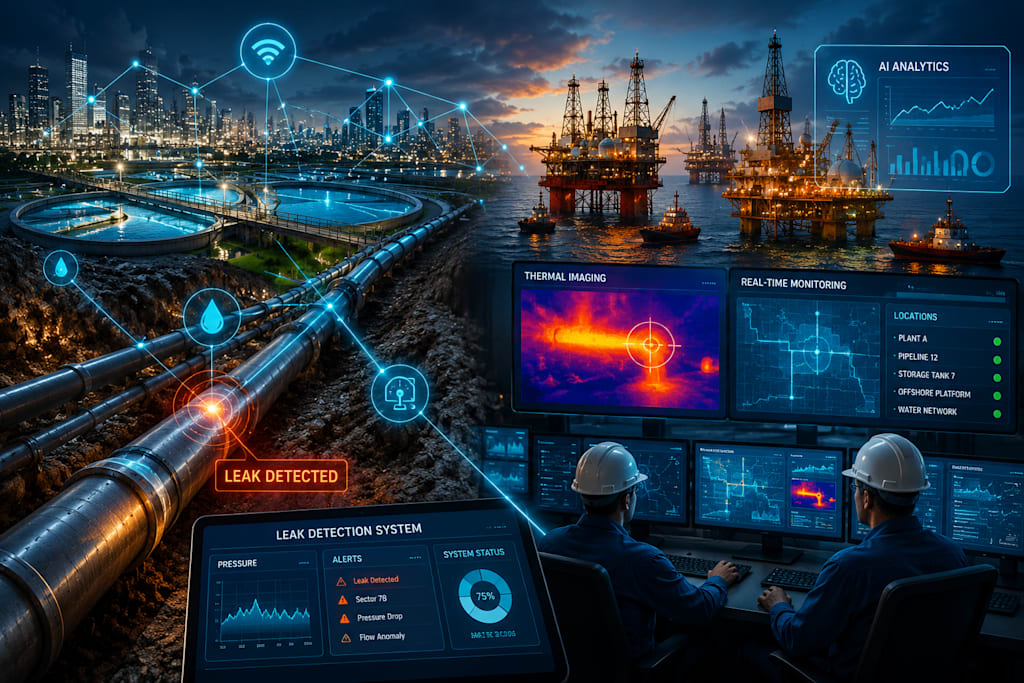
Most people never think about the vast networks of pipes hidden beneath their feet.
Every day, these systems transport drinking water, oil, natural gas, chemicals, and industrial fluids across cities, industrial facilities, and entire countries. They operate quietly in the background, powering daily life and supporting economic activity on a massive scale.
Yet when a leak occurs, the consequences can be surprisingly significant.
A small crack in a pipeline can lead to water loss, operational disruptions, environmental concerns, and expensive repairs. In industries where every drop of product matters, even minor leaks can create major financial and logistical challenges.
That reality is driving increased investment in technologies designed to identify problems before they become crises. Around the world, governments, utilities, and private companies are embracing advanced monitoring systems that can detect leaks in real time and provide immediate alerts.
This shift is helping shape the global Leak Detection Solutions Market, which continues to expand as infrastructure operators prioritize efficiency, safety, and sustainability.
According to Mordor Intelligence, the Leak Detection Solutions Market Size was valued at USD 4.58 billion in 2025 and is projected to grow from USD 4.83 billion in 2026 to reach USD 6.33 billion by 2031, reflecting a CAGR of 5.53% during the forecast period.
The Hidden Cost of Undetected Leaks
The challenge with leaks is that they often remain invisible until the damage becomes difficult to ignore.
In water distribution systems, leaks can waste enormous quantities of treated water before utility operators become aware of the issue. In industrial environments, product losses and equipment damage can affect productivity and increase operational expenses. In energy infrastructure, early detection can help prevent safety risks and reduce downtime.
Historically, leak detection relied heavily on manual inspections and scheduled maintenance. While these methods remain important, they often struggle to identify issues quickly enough in large and complex infrastructure networks.
Today's infrastructure is significantly larger and more interconnected than it was decades ago. Pipelines extend across hundreds of miles, industrial plants operate around the clock, and cities depend on aging underground networks that require continuous monitoring.
As a result, organizations are increasingly looking for smarter solutions that can provide constant visibility into system performance.
This growing demand is one of the most important drivers behind Leak Detection Solutions Market Growth across multiple industries.
How Smart Technologies Are Changing Detection
The modern approach to leak detection looks very different from traditional methods.
Advanced sensors can now monitor pressure changes, flow rates, temperature variations, and acoustic signals in real time. Artificial intelligence and data analytics platforms process this information continuously, helping operators identify anomalies before they develop into larger problems.
In many cases, monitoring systems can pinpoint the location of a potential leak within seconds, enabling faster response times and reducing the overall impact of failures.
These innovations are becoming increasingly important as organizations pursue digital transformation initiatives. The ability to combine operational technology with intelligent analytics creates opportunities to improve efficiency while reducing waste.
Many experts believe that current Leak Detection Solutions Market Trends are closely tied to the broader movement toward smart infrastructure. Cities, industrial facilities, and utility providers are seeking technologies that deliver both operational intelligence and long-term cost savings.
The result is a growing ecosystem of connected sensors, cloud-based monitoring platforms, and predictive maintenance tools designed to improve reliability across critical infrastructure networks.
Why Sustainability Is Becoming a Major Driver
Leak detection is no longer viewed solely as an operational issue.
Increasingly, it is also becoming an environmental and sustainability priority.
Water conservation efforts around the world have placed greater emphasis on reducing losses throughout distribution networks. Industries are under pressure to improve resource efficiency while demonstrating stronger environmental stewardship.
Preventing leaks helps organizations conserve valuable resources, reduce unnecessary waste, and improve overall system performance.
These factors are contributing to positive Leak Detection Solutions Market Forecast expectations through 2031 and beyond.
At the same time, infrastructure modernization projects are creating new opportunities for technology adoption. Many cities and industrial operators are replacing aging systems with digital monitoring solutions that can support long-term sustainability goals.
As investments continue, the Leak Detection Solutions Industry is expected to play an increasingly important role in helping organizations balance operational efficiency with environmental responsibility
Looking Ahead: Smarter Infrastructure for a Connected World
The future of infrastructure will likely be defined by visibility, intelligence, and real-time decision-making.
Rather than waiting for failures to occur, organizations are increasingly adopting predictive strategies that identify risks before they escalate. Leak detection technologies fit naturally into this approach by providing continuous insight into system health and performance.
As monitoring capabilities become more sophisticated, the Leak Detection Solutions Market Share represented by smart and connected technologies is expected to expand. Artificial intelligence, machine learning, and advanced sensor networks will continue to improve the speed and accuracy of detection systems.
What was once considered a specialized engineering function is rapidly becoming an essential component of modern infrastructure management.
From water utilities and manufacturing facilities to energy pipelines and smart cities, leak detection technologies are helping organizations operate more efficiently while protecting critical resources.
The projected growth of the market to USD 6.33 billion by 2031 reflects more than technological advancement—it highlights a broader shift toward smarter, more resilient infrastructure systems designed for the challenges of the future.
As cities become more connected and industries become more data-driven, do you think real-time monitoring technologies will eventually make large-scale infrastructure leaks a thing of the past?
About the Creator
Enjoyed the story? Support the Creator.
Subscribe for free to receive all their stories in your feed.
Comments
There are no comments for this story
Be the first to respond and start the conversation.