
Why the Global Cell Dissociation Market Is Growing Faster Than Expected
From cancer research to regenerative medicine, cell separation technologies are becoming essential to the next era of healthcare

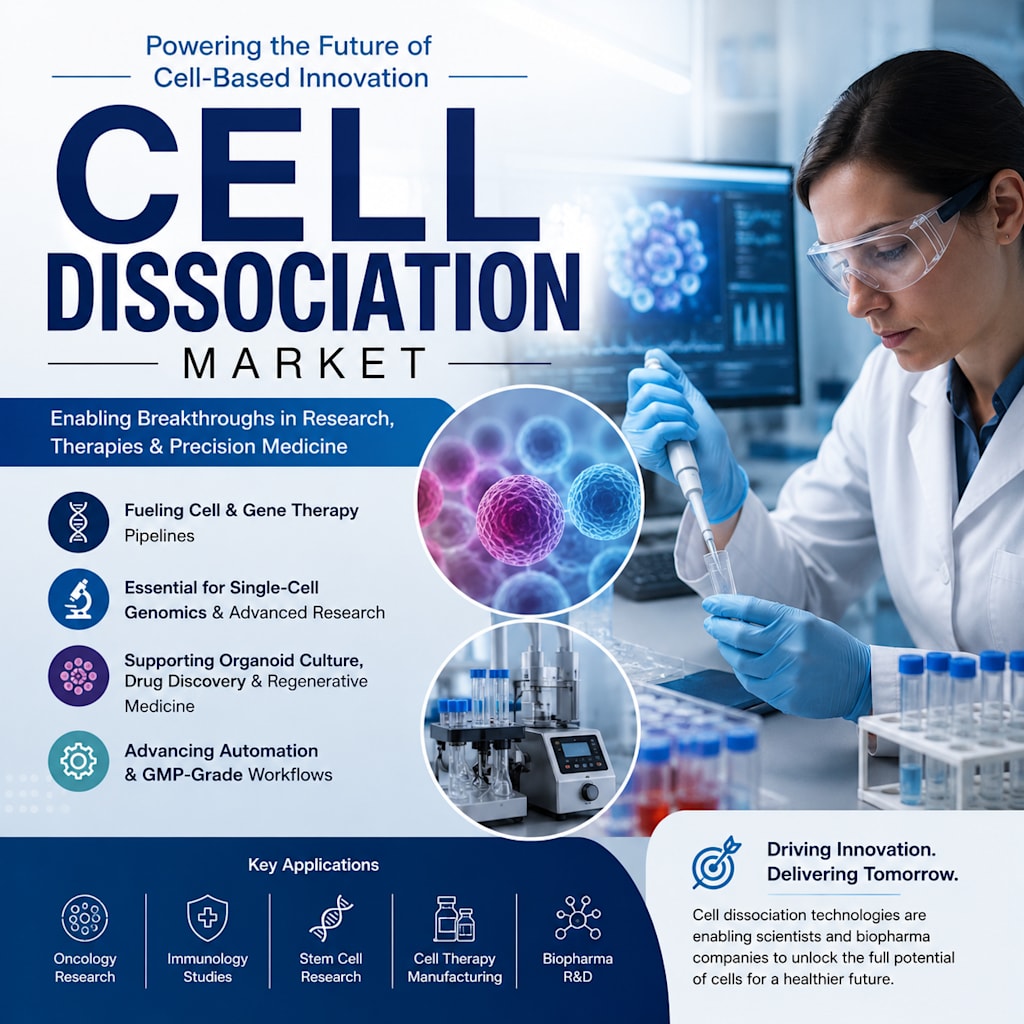
The world of modern medicine is rapidly accelerating towards a future of cell therapies, personalized medicine, and advanced genomics. Underlying a lot of these cutting-edge advances is a process few people outside of the biotechnology industry ever hear about: cell dissociation.
While it may sound highly technical, cell dissociation plays a vital role in some of the most groundbreaking medical and scientific advancements in our day. From cancer research and stem cell therapies to single-cell sequencing and regenerative medicine, scientists are increasingly relying on cell dissociation technology to obtain healthy, viable cells for research and treatment.
As the demand for sophisticated biotechnology products grows on a global scale, the cell dissociation market is experiencing robust growth.
A Market Entering High-Growth Era
The global cell dissociation market growth was worth an estimated $453.6 million in 2025 and is projected to reach nearly $1.32 billion by 2034. This marks a healthy compound annual growth rate (CAGR) of 11.57% between 2026 and 2034. The cell dissociation market is seeing robust growth because several high-growth sectors are expanding simultaneously- unlike typical laboratory markets that tend to grow incrementally over time. These burgeoning markets include:
- Cell and gene therapy
- Single-cell genomics
- Organoid research
- Biopharmaceutical manufacturing
As the world of biotechnology continues to grow and evolve, the process of cell dissociation is slowly becoming fundamental to our daily lives and health outcomes.
What Exactly is Cell Dissociation?
Cell dissociation refers to the process of separating individual cells from tissues or a cell culture substrate for research, study, or therapy.
Scientists use a few different methods to accomplish this, including:
- Enzymatic dissociation (using agents like trypsin or collagenase)
- Mechanical dissociation (using physical separation techniques)
- Chemical/non-enzymatic cell separation (specifically designed for sensitive cell types)
All of these methods create a highly useful single cell suspension that can be used in various downstream applications, such as:
- Stem cell research
- Cancer immunotherapy
- Cell and gene therapy
- Drug discovery
- Single-cell RNA sequencing
- Organoid formation
It's quite literally the essential first step for a large part of today's biomedical science, and without it, many advanced biotechnologies simply wouldn't be possible.
Why Is This Market Expanding so Rapidly?
One of the major reasons is the massive growth of the cell and gene therapy sector. When researchers develop cell therapies like CAR-T cells, they require a sterile environment with highly controlled conditions to ensure the cells are properly prepared, transported, expanded, and differentiated before delivery back to a patient. Cell dissociation is a critical step in many of these processes.
The transition of cell therapies from research stages to commercialization has fueled a significant increase in the demand for GMP grade dissociation reagents and integrated automated processing systems.
The Growth of Single-Cell Research
Single cell research has arguably been one of the most transformative advances in modern biomedical science. Scientists now examine individual cells, rather than cell populations, in order to gain a deeper understanding of complex disease states such as cancer, neurological disorders, and autoimmune diseases. This burgeoning field has made a profound impact on the demand for high-quality cell dissociation products.
When it comes to single cell sequencing, every step must be carefully controlled, including cell dissociation. Any small deviation can have an effect on the results of scientific studies, which is why premium dissociation reagents and automated platforms are increasingly valued, and with genomics research becoming ever more widespread, this trend will only escalate.
Enzymatic Dissociation Still Takes the Lead
Of the product categories listed, enzymatic dissociation remains the largest product segment in the market. This is because enzymes like trypsin, collagenase, and dispase are capable of efficiently separating cells from tissue and culture plates with high viability and minimal cellular stress.
Enzymatic dissociation products are commonly used in a variety of studies and procedures including:
- Oncology research
- Immunology studies
- Stem cell separation
- Tissue engineering
- Biopharmaceutical manufacturing
In 2025, enzymatic dissociation held over 60% of the global market share and its ubiquity in the lab space indicates its essential role in many laboratory workflows. Non-enzymatic products are growing rapidly though, with many preferring this method when maintaining surface markers on the cell is important for experimentation.
Automation is Beginning to Transform Lab Workflows
One of the key shifts seen in this industry has been the growth of automation. A number of processes that previously required the operator to be highly skilled are now largely autonomous. Automated tissue dissociation systems enable laboratories to improve the reproducibility of experiments and minimize the risk of contamination. These are also beneficial for clinical grade manufacturing where the integrity of the experimental process is essential. Integrated automated systems allow the user to:
- Perform automated tissue processing
- Filtrate cells
- Determine viability
- Automate processing under sterile conditions
This transition toward automated and intelligently-controlled processing has the potential to radically change the landscape of lab work over the next decade.
GMP and Xeno-Free Reagents are Gaining Prominence
As cell therapies transition from research to the clinic, the standards set for materials are rising drastically. Biotechnology companies are now demanding GMP certified and animal free dissociation products to ensure that animal derived products are eliminated from their processes. This is particularly important in stem cell therapies where compliance and safety are key; this demand is for products such as recombinant trypsin substitutes and animal free enzyme blends.
Organoid Research presents a New avenue of Growth
Organoids and 3D cell culture is an emerging area of research that could one day form a huge part of drug discovery and personal medicine. However, creating and manipulating organoids requires extremely sensitive and low-stress cell dissociation techniques to maintain cell functionality. New technologies and specialised products aimed at optimizing the use of cell dissociation in organoid creation and manipulation are beginning to emerge as research in this field intensifies. In the coming years, this small segment of the market has the potential to become a major area of profit and research.
North America Dominates But the Asia-Pacific Region is Rapidly Catching Up
North America holds a substantial share of the global cell dissociation market. This is largely due to high funding from institutions such as the National Institutes of Health (NIH), a leading-edge biotechnology sector, and the large number of FDA-approved cell therapies available within the region. With so many pharmaceuticals companies located in North America, the demand for advanced laboratory technologies will continue to be strong within this region. Conversely, the Asia-Pacific region is expected to become the fastest growing market for cell dissociation reagents, due to large-scale investments in biopharmaceutical manufacturing, cell therapy commercialization, and genomics research within countries such as China, South Korea, and India.
A Competitive Market that is Focused on Innovation
The cell dissociation market is experiencing an increasing amount of competition, with many companies working hard to develop better and more innovative technologies to stand out. Companies that are actively looking at developing these cutting-edge products and technologies are focusing on:
- GMP Grade Reagent production
- Automated tissue processing systems
- Using Artificial intelligence to optimize experimental workflows
- Integrated closed-systems and single use solutions
- specialised kits such as those for cancer research and stem cells
All these key areas of R&D require a constant and growing supply of cell dissociation products that facilitate this cutting edge research.
Challenges Remain
Despite an expanding market and increased usage, the cell dissociation market still faces some challenges. Firstly, the high cost of more advanced instruments required can be an issue for smaller laboratories and in countries that are yet to establish strong biotechnology infrastructure. Furthermore, regulatory compliance continues to be complex, especially regarding the regulations for cell therapies.Finally, the global nature of manufacturing for reagents means that sourcing enzymes and biological raw materials are ongoing concerns and can have supply chain risks attached. This has led many companies to invest in and research alternative, synthetic methods of dissociation to prevent issues with biological raw material supply and gain better reproducibility.
The Future of Cell Dissociation is Promising
The cell dissociation market will likely remain closely linked to the progression of cell therapy, personalised medicine and genomics. As research and therapy evolve, so too will the requirements for cell dissociation products be refined toward high accuracy, automation, and speed. The trend of the market is likely to shift toward fully automated and closed system processing, the use of AI to optimize experiments, the development of animal-free cell dissociation products, and integrated biotechnological manufacturing ecosystems. By 2034, the market value for cell dissociation is expected to reach more than $1.3 billion in value.
About the Creator
Robert
Senior Market Researcher at IMARC Group, specializing in global market analysis, industry trends, and data-driven insights across diverse sectors.
Enjoyed the story? Support the Creator.
Subscribe for free to receive all their stories in your feed.
Comments
There are no comments for this story
Be the first to respond and start the conversation.