
Why North America's Concrete Boom isn't Slowing Down?
How infrastructure spending, housing demand, and smart construction are reshaping the North America Ready-Mix Concrete Market
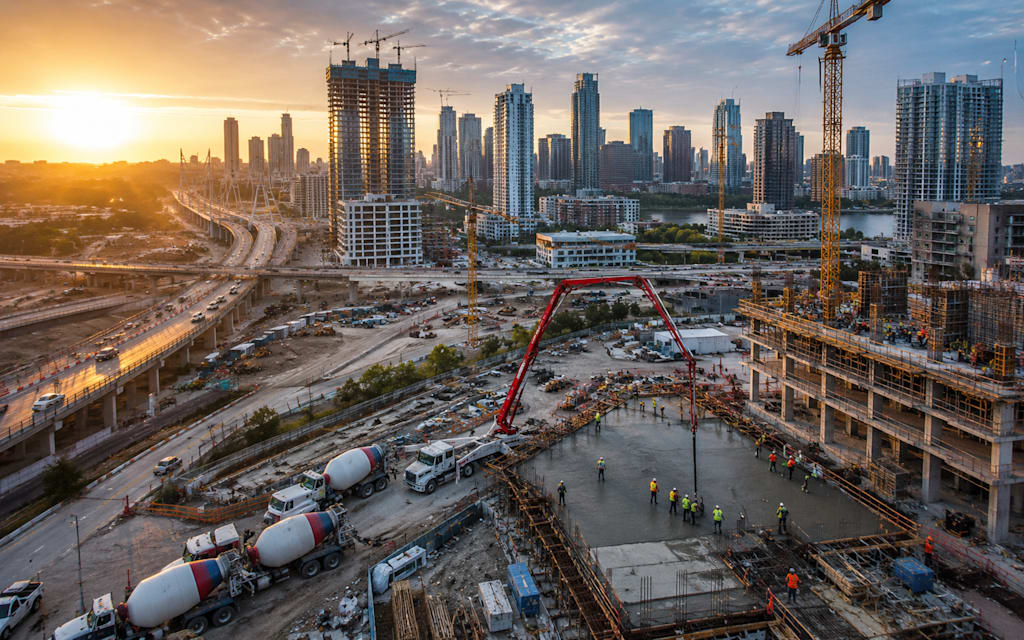
The sound arrives before the sight.
A low rumble echoes across a construction site as a convoy of mixer trucks slowly rolls through the gates. Tower cranes stretch across the horizon. Fresh foundations are being poured. New bridges rise over busy highways. Entire neighborhoods are taking shape one concrete slab at a time.
For most people, concrete is easy to overlook. It's beneath our feet, hidden inside walls, and buried under roads. Yet behind nearly every modern development project lies one material that quietly powers economic growth: ready-mix concrete.
Today, demand for ready-mix concrete is accelerating across North America, supported by infrastructure investments, residential construction, and modernization projects. According to Mordor Intelligence, the North America Ready-Mix Concrete market size is projected to grow from USD 76.47 billion in 2026 to USD 98.99 billion by 2031, expanding at a CAGR of 5.29%. This steady growth highlights how essential concrete remains in building the region's future. (Anchor Text: North America Ready-Mix Concrete market)
The Material Behind Every Major Project
When people think about innovation, they often picture artificial intelligence, electric vehicles, or renewable energy technologies.
Few imagine concrete.
Yet virtually every transformational project depends on it.
Whether it's a new highway interchange, an apartment complex, a data center, or a manufacturing facility, ready-mix concrete provides the structural foundation. Unlike site-mixed concrete, ready-mix is produced in controlled environments and delivered directly to construction locations, ensuring consistency, efficiency, and quality.
This reliability has made it the preferred choice for large-scale construction projects across the United States, Canada, and Mexico.
According to Mordor Intelligence, the North America Ready-Mix Concrete market share remains heavily concentrated in the United States, which accounted for 84.17% of regional market value in 2025. The country's extensive infrastructure programs and ongoing housing development continue to drive substantial demand.
The significance becomes even clearer when observing today's urban landscape.
Cities are expanding outward and upward. Transportation networks require upgrades. Aging bridges need replacement. New logistics hubs support the growth of e-commerce. Every one of these developments relies on ready-mix concrete.
Infrastructure Spending Is Changing the Landscape
Infrastructure may not generate daily headlines, but it shapes everyday life.
- Roads determine commute times.
- Bridges connect communities.
- Airports support economic activity.
- Ports facilitate global trade.
Across North America, governments are investing heavily in modernizing these critical assets. Large-scale infrastructure projects require enormous volumes of concrete, making ready-mix suppliers essential participants in regional development. The result is a long-term demand pipeline rather than a temporary construction surge.
Every new transportation corridor, bridge replacement project, transit station, and public facility creates additional opportunities for ready-mix concrete producers.
This dynamic is one reason analysts expect sustained growth throughout the forecast period.
The market's resilience is particularly noteworthy because infrastructure projects often span several years. Unlike shorter construction cycles, public works projects create predictable demand and provide stability during economic fluctuations.
For producers, this means planning capacity expansions, investing in logistics, and improving production efficiency.
For communities, it means visible progress in modernization efforts.
For workers, it means jobs that support local economies.
And for the broader construction ecosystem, it means continued momentum.
Housing Demand Continues to Fuel Growth
Infrastructure may provide a strong foundation for market expansion, but residential construction remains equally important.
- Families need homes.
- Communities need schools.
Growing populations require new neighborhoods and supporting facilities.
Mordor Intelligence reports that the residential segment represented 35.07% of market revenue in 2025, making it the largest end-user segment within the market.
This isn't surprising.
Walk through any growing metropolitan area and you'll find evidence everywhere: apartment developments, suburban housing projects, mixed-use communities, and residential towers reshaping skylines.
Each project consumes significant quantities of ready-mix concrete.
From foundations and parking structures to sidewalks and retaining walls, concrete remains one of the most widely used construction materials in residential development.
As urban populations grow and housing shortages persist in many regions, residential construction is expected to remain a major contributor to market demand.
Technology is Modernizing a Traditional Industry
Concrete production may be one of the world's oldest industrial processes, but modern technology is transforming how it operates.
- Digital dispatch systems now optimize delivery routes.
- AI-assisted quality control helps reduce material waste.
- Advanced batching technologies improve consistency and efficiency.
These innovations help producers meet increasing demand while maintaining quality standards.
For construction companies, better coordination means fewer delays.
For suppliers, smarter operations reduce costs.
For project owners, improved efficiency supports faster completion timelines.
The result is a more responsive and productive construction ecosystem.
As digital tools become more common across the industry, companies that embrace innovation may gain competitive advantages through improved service and operational performance.
What the Future Holds
The future of North American construction will be built on many trends—urban growth, infrastructure renewal, industrial investment, and technological modernization.
The growth story isn't simply about concrete.
It's about the roads people travel every day.
- The homes families move into.
- The bridges that connect regions.
- The facilities that support economic activity.
Concrete may not attract attention like cutting-edge technology, but it remains one of the most important materials shaping modern life.
And as North America continues to build for the future, the steady rise of the North America Ready-Mix Concrete market demonstrates that some of the biggest growth stories are literally being poured into place beneath our feet.
About the Creator
efingutthomas
My expertise is custom research across industries such as aerospace & defense, agriculture, animal wellness, automation, automotive, chemicals, consumer goods, electronics, energy, finance, food & beverages, healthcare, hospitality and ICT
Enjoyed the story? Support the Creator.
Subscribe for free to receive all their stories in your feed.
Comments
There are no comments for this story
Be the first to respond and start the conversation.