
Why Long Distance Bracelets Became a Quiet Ritual for Modern Relationships
What touch jewelry, tiny signals, and wearable reminders reveal about love when two people live far apart

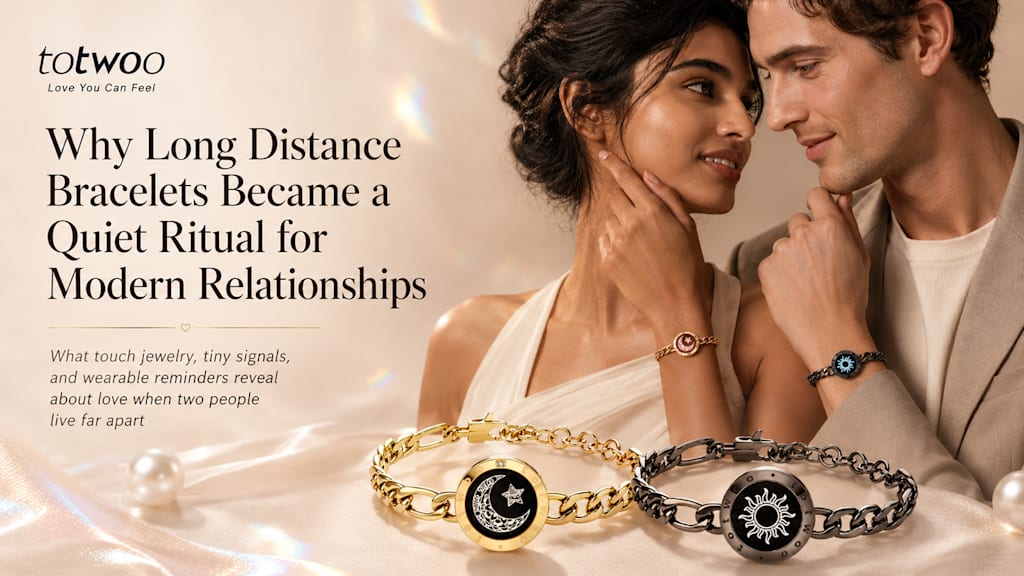
Long distance relationships are often described in dramatic terms. People talk about airports, time zones, late-night calls, missed birthdays, and the ache of not being able to reach across the table. But for many couples, the hardest part of distance is not always the big moments. It is the ordinary silence between them.
It is waking up and knowing the other person is still asleep in another city. It is walking home after work and wanting to share something small, but not wanting to interrupt their day. It is seeing a joke, a song, a restaurant, or a sunset and feeling the strange little pause that comes before sending a message. Love at a distance is often built inside these tiny pauses.
That may explain why long distance bracelets have become more than a passing internet trend. On the surface, they are simple connected accessories. One person touches a bracelet, and the other person receives a light, vibration, or gentle signal. But the emotional appeal is not really about the technology itself. It is about the human wish to be felt, not just contacted.
For years, digital communication has given couples more ways to stay in touch. They can text all day, video call at night, send voice notes, share photos, and react instantly to each other’s lives. In theory, people have never had more access to one another. Yet many still feel that something is missing.
A message can be read later. A call may require energy. A video chat can feel too scheduled. Even a sweet text can sometimes feel like another screen notification in a day already crowded with alerts. What long distance bracelets try to offer is different. They create a small physical moment. Not a conversation. Not an explanation. Just a signal that says, “I’m here.”
That kind of signal may seem minor, but relationships are often shaped by minor things. A hand on someone’s shoulder. A glance across a room. A squeeze before leaving. A habit of making tea for two people. When a couple lives in the same place, these small gestures happen naturally. When they are apart, they need to invent new versions of them.
This is where wearable connection becomes interesting. The bracelet is not valuable only because it lights up or vibrates. It becomes meaningful because the couple gives the signal a private meaning. One tap might mean good morning. Two taps might mean I love you. A longer touch might mean I need comfort today. Over time, the object becomes less like a device and more like a shared language.
This is also why long distance bracelets sit somewhere between jewelry, technology, and ritual. They are not as practical as a phone, but practicality is not the whole point. A ring is not practical either, yet people have worn rings for centuries because they carry symbolic weight. A bracelet that connects two people across distance is part of that same emotional tradition, updated for a world where relationships often stretch across cities and countries.
The appeal is especially clear among couples who are separated by school, work, family responsibilities, military life, travel, or immigration. Distance is not always romantic. Sometimes it is exhausting and repetitive. Some days are full of conversation. Other days are just busy, tired, and slightly lonely. A small signal on the wrist can become a reminder that the relationship still exists inside the ordinary day, not only during long calls or special occasions.
Of course, no bracelet can solve the real challenges of distance. It cannot replace trust. It cannot fix poor communication. It cannot make a time zone easier or turn a screen into a hug. In fact, expecting too much from any relationship gadget can make it feel disappointing. The healthier way to understand these bracelets is as emotional support tools. They add something small to an already living relationship.
This distinction matters because modern couples are surrounded by products promising connection. Apps promise better communication. Social platforms promise constant visibility. Smart devices promise convenience. But intimacy is not created by being reachable all the time. Sometimes intimacy is created by a gesture that does not demand an answer.
A bracelet tap is interesting because it can be received without pressure. The other person does not have to stop working, explain their mood, or type a reply immediately. They can simply feel the signal and know it was sent by someone who thought of them. In a culture where so much communication expects a response, that quietness is part of the charm.
There is also a design question behind these objects. If a connected bracelet looks too much like a gadget, some people may enjoy the function but stop wearing it. If it looks like jewelry, it has a better chance of becoming part of daily life. This is why brands in the connected jewelry space often focus on symbols, materials, and style as much as the app experience.
A company such as Totwoo reflects this shift. Its approach belongs to a broader movement where wearable technology is becoming softer, more emotional, and more personal. Instead of asking people to wear another screen, connected jewelry tries to hide the technology inside objects that already have emotional meaning. The bracelet is not only a transmitter. It is also a keepsake.
That may sound subtle, but subtlety is important. A long distance couple does not necessarily want to announce their private emotions to everyone around them. They may want something discreet enough to wear at work, in class, at dinner, on a plane, or during an ordinary walk. The signal should feel intimate, not theatrical. It should belong to the two people using it.
This is one reason long distance bracelets have become popular as gifts. They are not just useful; they are easy to understand emotionally. A candle may say, “Relax.” A photo frame may say, “Remember.” A connected bracelet says, “Even when I am not beside you, I still want a way to reach you.”
But the most meaningful version of the gift is not in the first day of unboxing. It is in what happens later. The first signal may feel cute. The tenth may feel familiar. The hundredth may become part of the couple’s rhythm. Like many relationship rituals, the meaning grows through repetition.
People often underestimate repetition in love. Grand gestures are memorable, but repeated gestures create safety. Saying good night every evening. Sending a photo from the same coffee shop. Watching a show together from different places. Sharing a playlist. Tapping a bracelet before sleep. These small actions become emotional anchors because they return again and again.
Long distance bracelets also reveal something about how people are rethinking presence. In the past, presence usually meant being physically in the same room. Today, presence can be layered. Someone can be absent physically but present emotionally through a voice note, a shared location, a playlist, a message, or a wearable signal. None of these replace physical closeness, but they create traces of closeness across distance.
This is not only a romantic idea. Similar connected objects are used between friends, parents and children, siblings, and family members living far apart. The emotional need is the same: people want a gentle way to say, “I remembered you today.” Not every relationship needs constant conversation. Some simply need a sign of care.
Still, the popularity of these bracelets says something specific about modern romance. Many couples are trying to balance independence with closeness. They want to support each other without becoming demanding. They want connection without constant surveillance. They want reminders without pressure. A small wearable signal fits that emotional space because it is present but not overwhelming.
The technology behind it may continue to change. Future versions may become slimmer, more stylish, more customizable, or more integrated with other forms of communication. But the basic reason people are drawn to them will probably remain the same. Humans have always attached emotions to objects. Letters, rings, lockets, bracelets, photographs, and keepsakes have always helped people carry someone with them.
Long distance bracelets are simply a modern version of that old habit. They take the ancient idea of a token and add the ability to respond in real time. They turn memory into a small, living signal.
Maybe that is why the idea resonates. Distance can make love feel abstract. You know someone cares, but you cannot always feel it in the body. A vibration on the wrist is not the same as touch, but it borrows the language of touch. It reminds the body before the mind has to explain anything.
In the end, the value of a long distance bracelet is not measured by how advanced it seems. It is measured by whether two people give it meaning. Without that shared meaning, it is only a small device. With it, it can become a ritual, a private code, and a daily reminder that someone far away is still emotionally near.
Distance does not disappear because of technology. It still asks for patience, honesty, planning, and care. But sometimes a small bridge is enough to make a difficult day feel softer. A light on the wrist. A quiet vibration. A signal sent across miles.
Not a replacement for love, but one more way of practicing it.
About the Creator
Enjoyed the story? Support the Creator.
Subscribe for free to receive all their stories in your feed.
Comments
There are no comments for this story
Be the first to respond and start the conversation.