
Why Local Operators Will Always Outrun National Giants in Transportation
How WNY Bus Co defeated a national transportation giant - and what it revealed about trust, local knowledge, and the real competitive advantage no corporation can manufacture.
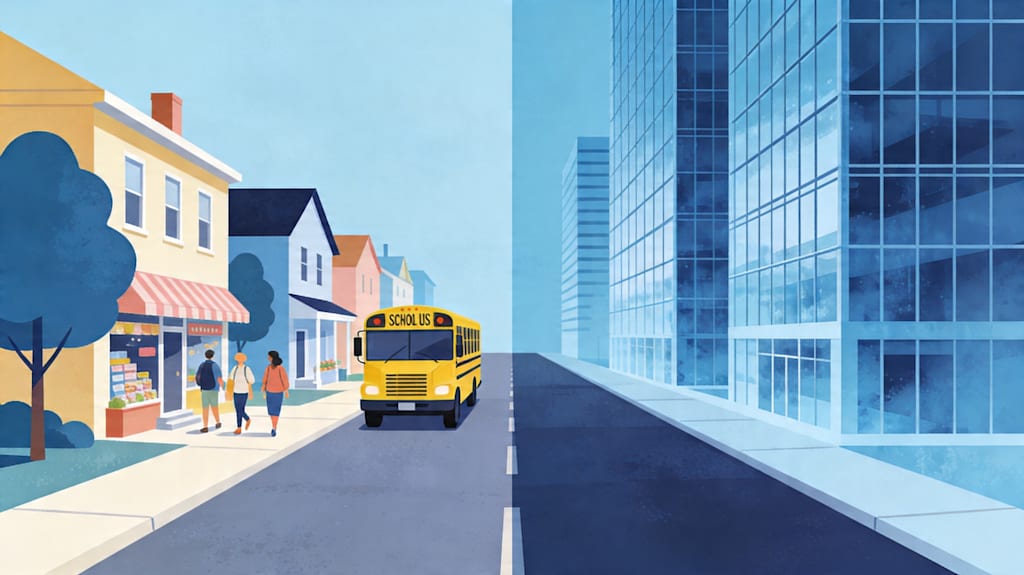
Every entrepreneur eventually faces the same moment: a bigger, better-funded competitor decides your market is worth taking. For me, that moment came when a large national transportation company set its sights on WNY Bus Co.'s school district contract in Western New York. I had built that business from the ground up, and someone with a corporate war chest decided it looked worth a fight.
What happened next is something I've thought about ever since - because it didn't go the way anyone outside our community expected.
We won. And the reason we won has shaped every business decision I've made since, from transportation to real estate and local infrastructure.
Here is the reality that national companies don't want to admit: in essential services, "local" isn't a disadvantage. It's a technical capability that cannot be bought.
The Accountability Gap That Scale Creates
Large corporations operate on standardization. It's the only way they can manage fleets across fifty different states. But standardization creates a critical accountability gap that shows up most clearly in a crisis.
When a school bus route is delayed during a Buffalo snowstorm, a national company relies on an escalation protocol that flows through regional managers and out-of-state call centers. By the time someone with real decision-making authority is involved, the problem has already compounded.
At WNY Bus Co., our dispatchers know the exact intersection that floods first. Our drivers know which steep hills become impassable before the salt trucks arrive. And if a school administrator needs an answer, they have my direct phone number. That level of hyper-local accountability is invisible on a corporate balance sheet, but it is the single most important metric for the families actually relying on the service.
Local Knowledge Is a Hard Operational Asset
In the transportation industry, people tend to treat "local knowledge" like a soft skill - something nice to have, but not a real business driver. That assumption is wrong.
Local knowledge is a hard operational asset with direct impact on cost, safety, and performance.
When you know the community, your routing is more efficient. Your drivers are less stressed. Your vehicle wear-and-tear decreases because you aren't sending buses down roads that look fine on a GPS but are nightmare bottlenecks in reality. The result is a cheaper, safer, and highly predictable service.
As I've described in detail before, the most durable businesses are built by people who stay genuinely connected to the day-to-day operational reality of their community - not by those managing from a distance.
Trust Doesn't Scale on a Spreadsheet
When the school board evaluated the bids, they weren't only looking at the math. They were looking at a long-term relationship. They were asking: who do we trust to transport our children safely, every single day, for the next several years?
That question has an answer built over time - through consistent performance, through showing up during difficult conditions, through being a visible and accountable presence in the community. It cannot be assembled in a bid document by a company that entered the market six months ago.
I've carried this thinking into every business I've built. It applies to how local entrepreneurs approach long-term value creation just as much as it applies to running a bus fleet.
National companies can buy routes. They cannot buy trust that has been earned over a decade, in a specific place, with specific people.
Local isn't a limitation. It's a strategy.
Igor Finkelshtein is a Buffalo-based entrepreneur and investor, founder of WNY Bus Co. and Buffalo Transportation Inc. Read more at igorfinkelshtein.org.
About the Creator
Igor Finkelshtein
Igor Finkelshtein is an entrepreneur and transportation expert, leading WNY Bus Co. and Buffalo Transportation. As a co-owner of RouteGenie, he combines innovation and leadership to drive industry growth and shares insights from his journey
Enjoyed the story? Support the Creator.
Subscribe for free to receive all their stories in your feed.
Comments
There are no comments for this story
Be the first to respond and start the conversation.