
Why L-Fucose Is Getting More Attention in Modern Ingredient Science
A simple look at how one rare sugar connects functional ingredients, glycan research, and advanced formulation trends

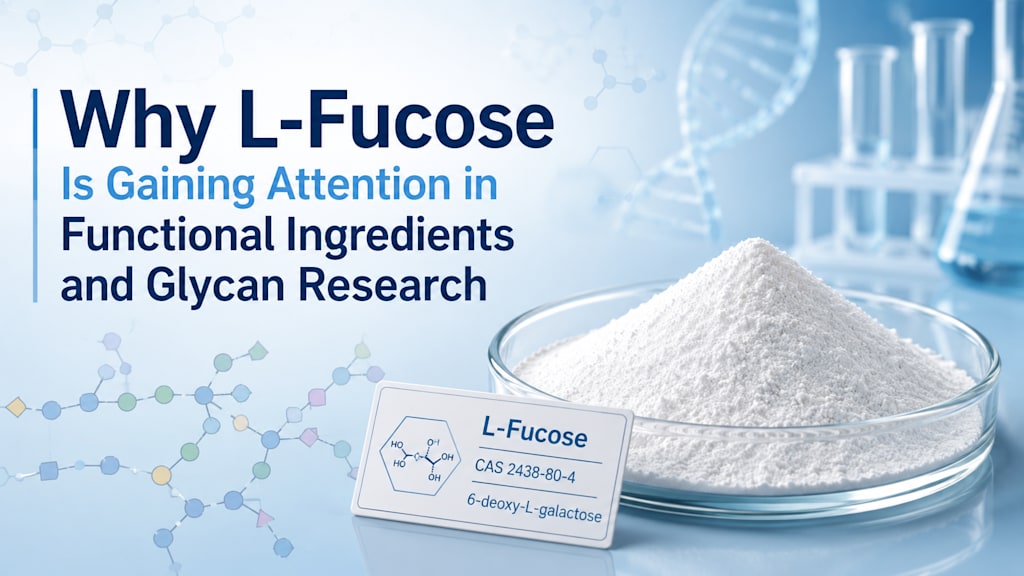
Not every important ingredient is used in large amounts.
Some materials become valuable because they sit quietly behind several growing industries. They may not be familiar to everyday consumers, but they matter to researchers, formulators, and companies working on the next generation of specialty ingredients.
L-Fucose is one of those materials.
Also known as 6-deoxy-L-galactose, L-Fucose is a naturally occurring rare sugar found in certain biological structures. It is not as common in daily conversation as glucose, fructose, or lactose. But in areas such as glycan research, personal care formulation, functional ingredient development, and biochemical studies, it is becoming more visible.
The growing interest in L-Fucose also reflects a bigger trend. Modern ingredient science is becoming more specific. Companies are no longer only looking for broad categories like “sugar,” “extract,” or “active ingredient.” They are looking at exact molecules, biological pathways, purity levels, and research-backed material functions.
What Makes L-Fucose Different?
L-Fucose belongs to a group of sugars often described as rare sugars.
This does not mean it is impossible to find. It means it has a more specialized role compared with common sugars used mainly for sweetness or energy.
In biological systems, fucose-containing structures are connected with glycans, cell surfaces, and biochemical recognition processes. This is one reason L-Fucose has become interesting in glycoscience and related research fields.
Glycans are important because they are involved in how cells communicate, recognize each other, and respond to their environment. As researchers learn more about these processes, materials connected to glycan biology naturally receive more attention.
For people outside the field, this may sound highly technical. But the basic idea is simple: small sugar-related molecules can have roles that go far beyond taste or calories.
Why Functional Ingredient Research Is Paying Attention
Ingredient science is changing quickly.
In personal care, formulators are exploring materials that can support hydration, skin comfort, barrier-focused products, and sensitive-skin positioning. In nutrition and food science, researchers are studying specialty carbohydrates, rare sugars, and compounds connected to microbiome and human milk oligosaccharide research.
L-Fucose appears in these conversations because of its connection to fucosylated structures and glycan-related studies.
This does not mean every L-Fucose product can be used in every finished product. Application depends on grade, regulation, formulation design, and local compliance rules. But it does explain why the molecule is being discussed more often.
For anyone studying functional ingredients, L-Fucose is a good example of how a small molecule can become relevant across several different research and formulation areas.
Why Glycan Research Matters
Glycan research is becoming more important in biotechnology, pharmaceutical research, and analytical science.
Many biological molecules are not only defined by their main structure. Their sugar-related modifications can also influence how they behave. This is especially important in areas such as biologics, cell research, enzyme studies, and advanced analytical methods.
Because of this, sugar-related compounds are often used as research materials, reference substances, or building blocks in laboratory work.
L-Fucose is relevant here because it is connected to fucose-containing glycans and related biological pathways. Researchers may study it in the context of enzymes, glycan structures, cell recognition, or biochemical analysis.
This is one reason rare sugars are gaining more respect. They are not just minor ingredients. They can be useful tools for understanding larger biological systems.
A Small Molecule With Broader Industry Meaning
The story of L-Fucose is also part of a broader change in specialty ingredients.
Today, many industries want materials that are more precise, more traceable, and better understood. Cosmetic companies want ingredients that fit modern formulation trends. Nutrition researchers want to explore next-generation carbohydrates. Biotech and pharmaceutical teams need high-purity materials for study and development.
This creates demand for specialty chemical knowledge.
Companies such as Foconsci Chemical are part of this wider supply chain, connecting fine chemicals, research materials, cosmetic ingredients, food-related raw materials, and specialty compounds used across different industries.
But the real point is not only supply. The bigger point is that modern product development depends on better understanding of small molecules.
A material like L-Fucose may seem niche, but niche materials often become important when science and industry move in the same direction.
Final Thoughts
L-Fucose is not a household name.
Most consumers will never see it on a product label. It is not as famous as common sugars, vitamins, peptides, or plant extracts.
But in functional ingredient research and glycan science, it has a growing role.
Its relevance comes from its connection to rare sugar chemistry, glycan biology, formulation science, and advanced research applications. As industries continue to explore more specific and science-driven ingredients, molecules like L-Fucose may become more important.
The bigger lesson is simple: innovation does not always come from the most visible materials.
Sometimes, it comes from small molecules working quietly behind the scenes.
About the Creator
Enjoyed the story? Support the Creator.
Subscribe for free to receive all their stories in your feed.
Comments
There are no comments for this story
Be the first to respond and start the conversation.