
Why Jeff Bezos Survived His Affair and Jensen Huang Didn't
The answer isn't morality. It's a 3.58% stake, a one-share-one-vote charter, and a political machine that knew exactly where to aim.
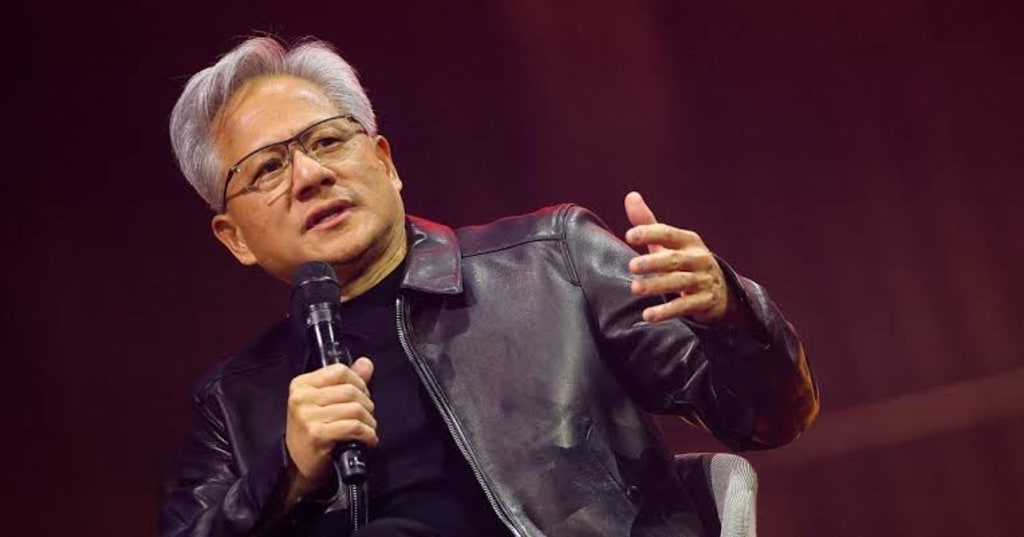
Put Jeff Bezos, Bill Gates, Sergey Brin, Chey Tae-won and Jensen Huang at the same table and ask whose extramarital affair was "more decent." The question is a trap. Infidelity does not rank on a moral ledger. What ranks is something else: after the scandal broke, who was left holding the cost, and who was able to push it onto someone else.
In July 2026, a Seoul court ordered Chey Tae-won to pay his ex-wife 944 billion won in cash. The court specified cash rather than stock because "the SK shares he holds are tied to the group's management control." He paid a record sum. SK's control did not move. That outcome came from the cross-shareholding structure, not from better character.
When Sergey Brin's affair with a Google employee surfaced in August 2013, Google stock rose 1% in early trading the same day. Brin and Larry Page held Google's Class B shares, which carry supervoting rights. The scandal did not reach him because the voting structure stood between him and the board.
Bill Gates left a board seat in March 2020, not an operating role. Microsoft's board investigated a relationship with a female engineer from nearly two decades earlier. Gates's spokesperson said the matter had ended "amicably" and denied that the departure was caused by the investigation. The cost was limited because he had not occupied the most dangerous chair for over a decade.
Bezos is the closest to a "survived it" case. When his affair became public in 2019, he was Amazon's founder-CEO and largest shareholder. The relationship was with an outside television anchor, not a direct report, and it was not folded into any "national security" narrative. He stayed as CEO until July 2021, more than two years, and left on his own timetable.
Each survived differently. What they shared: the scandal did not hit the intersection of "fragile equity" and "political toxicity" at the same time. Jensen Huang hit both.
Nvidia's governance had no moat
Nvidia uses a single class of common stock, one share one vote. There is no dual-class structure to amplify the founder's voting power. According to the 2026 proxy statement, Huang held approximately 3.58% of shares outstanding, including family trusts and the foundation. That puts him below BlackRock's 7.43% and Vanguard's 7.31%. Nvidia's articles of incorporation allow the board to remove the CEO "with or without cause" by a majority vote. Of eleven directors, ten are independent. Huang was the only non-independent director, sat on no committee, and the board had no chairman.
Analysts had noted before the scandal that Nvidia's board could, in theory, remove Huang at any time, because he had neither supervoting shares nor the kind of founder authority that makes a board afraid to act. He had run Nvidia for thirty-three years and turned a graphics-chip company into the main supplier of chips for AI training. In the company's governance code, he remained an employee who could be removed by a majority vote.
The "spy" narrative turned a private matter into a political vise
If Huang's affair had remained an internal relationship with a vice president, the matter would still have been a governance scandal. The board might have investigated, censured, and demanded remediation. The amplifier was Alice Huang, and the "Chinese spy" narrative built around her.
Singapore's Ministry of Home Affairs said in a statement on November 12 that Alice Huang had been investigated for "potential false declarations" related to server procurement at Megaspeed. The evidence was insufficient to prosecute. "She was not investigated for espionage," the statement said. She was warned and barred from re-entering Singapore because she provided information she knew to be inaccurate to downplay her role at the company.
Singapore did not label her a spy. U.S. intelligence and some members of Congress suspected her of intelligence work for China. Once that suspicion was layered onto Huang's affair, it acquired a political force that Singapore's investigation did not carry on its own.
Congress moved quickly. The Republican chairmen of three House committees (Foreign Affairs, the Select Committee on the CCP, and Intelligence) formally wrote to Huang. They demanded he appear before a closed joint briefing on November 18 regarding his relationship with Alice Huang, Nvidia's protocols against foreign intelligence penetration, and high-end chip export compliance. They warned that if he did not appear, Congress would issue a subpoena. After Huang resigned, Senate Banking Committee Chair Elizabeth Warren and Foreign Relations Committee Chair Chris Coons requested the preservation of all records concerning Nvidia's chip exports to China and Huang's contacts with Alice Huang. They were preparing for deeper investigation.
The apology email was a knife handed to the board
On November 8, Huang sent an email to all employees. He admitted infidelity, apologized to his family, employees, the board and shareholders, and wrote that he had "no excuse" for what he had done. On the same day, the board announced an independent investigation, said it had "full confidence" in him and his leadership team, and allowed him to remain CEO during the probe.
From the standpoint of marital ethics, the email was honest. From the standpoint of legal and governance combat, it gave up the fight before the formal investigation had produced a finding. The standard playbook for American business and political figures in this kind of crisis is to deny everything and litigate the facts until the other side's costs become unbearable. Huang did not run that play. His apology became, in the language of U.S. compliance practice, an admission of internal-control failure. A gift to the board and to any plaintiffs' lawyer drafting a class action.
Then came the second relationship. On November 11, The New York Times reported, citing five former Nvidia employees, that Huang had also had an affair with Kimberly Powell, a 48-year-old vice president of healthcare business who reported directly to him. An outside relationship is a moral problem. A relationship with a direct subordinate is a governance problem. Nvidia's code of conduct requires employees to avoid conflicts of interest; the board treated the two categories differently. That same day, The Wall Street Journal reported the board was preparing to remove Huang and had engaged an outside search firm for a successor. Bloomberg added that the board was considering an interim CEO. By the evening of November 12, the company announced Huang had resigned as president, CEO and director, effective immediately.
The first affair did not bring him down. The second one did, because it was with a direct report. And the first one became dangerous because the partner had been placed inside a "Chinese spy" narrative. The moral problem and the governance problem converged on the same desk as the political one. Huang stood at the convergence point with 3.58% of the vote.
The market repriced the man in four trading days
On November 7, analyst Dan Ives had put the probability of Huang's departure at 15%. After the resignation was announced, Ives immediately changed his framing, calling it time to "rip off the Band-Aid and move Nvidia into its next chapter," while maintaining a $300 target and an "outperform" rating. The stock opened down nearly 14% and closed down 4.3%, not enough to make the top ten single-day declines of the past two years.
The board's own pivot was just as fast. On November 8 it expressed confidence. By November 11 it was preparing a removal and searching for a successor. On November 12 the removal was packaged as a resignation. The language was gentler than a formal firing. The result was identical.
Back to decency and indecency
Decency, in this comparison, is not located in the affair itself. It is located in whether the person kept the cost on himself after the scandal broke, rather than dragging the company, subordinates and governance structure into the fallout of his private risk. Chey paid 944 billion won but did not use SK's control as collateral for his private life. Brin's affair did not become a channel for corporate resources. Bezos's partner was outside the reporting line, and Amazon's operations were not pulled into the scandal. Gates left a board seat he had not used to run the company for over a decade.
The indecency in Huang's case, if the word is to be used at all, does not rest entirely with him. The machinery itself deserves scrutiny. It packages private morality, ethnic identity and geopolitical anxiety into a single instrument: the affair provided the moral pretext, the Chinese face provided symbolic convenience inside the "spy" narrative, and bipartisan hawkishness provided the operating energy. His apology was a personal choice. His shareholding structure was a historical fact. But the upgrade of "Alice Huang, suspected spy" from an intelligence-community suspicion to a congressional subpoena passed through a political apparatus that does not require proof to keep running.
Jensen Huang spent thirty-three years building Nvidia into the compute empire of the AI era. The day before he resigned, Wall Street analysts still said the odds were 15%. The day after, they called it a fresh start. A CEO with no supervoting shares, inside a political environment that treats "national security" as a universal lever, was squeezed out by an affair and a one-share-one-vote charter at the same time. The number that opened this essay as a technical parameter, 3.58%, closes it as the quantified proof that he never had a seat at the table. He did not lose a moral trial. He lost a power game he was never eligible to enter.
About the Creator
Jin
Writer of reamstories
https://reamstories.com/jin
Enjoyed the story? Support the Creator.
Subscribe for free to receive all their stories in your feed. You could also become a paid subscriber, letting them know you appreciate their work.
Comments
There are no comments for this story
Be the first to respond and start the conversation.